Strengthening Your Relationship: Small Rituals for Greater Closeness
Closeness isn't created by grand gestures—but by small, recurring moments. Rituals that bring couples back together.

It happens so quietly that most couples don’t notice it until it’s been going on for a while: You share a bed, a daily routine, maybe even children and a refrigerator—and yet you’re still living somewhat at cross-purposes. No drama, no big fights. Just this creeping feeling that, while you’re side by side, you’re not really together. Conversations revolve around schedules, shopping lists, and who’s cooking tonight. The other person nods, then goes back to typing on their phone. And at some point, you ask yourself: When was the last time we actually talked?
If this sounds familiar, you’re in very good company. And if you feel like you want to strengthen your relationship—then this article is written for you. Not as a “fix-it” program, not as a twelve-step plan. But as an honest invitation to reconnect. Through small, everyday rituals that don’t require perfect planning—just a little attention and a willingness to turn toward each other.
Why Intimacy Is So Easily Lost in Everyday Life
Life is busy. That sounds trite, but it’s the most honest explanation for why even loving couples sometimes grow apart. Two full-time jobs, maybe a child, obligations, exhaustion. Evenings are then spent on the couch, streaming shows, scrolling on the phone. Not because you don’t love the other person—but because your energy is simply depleted.
Added to this is something described in psychology as attachment theory: People need a secure base to truly open up. This secure base isn’t a given—it must be renewed time and again through small gestures of affection. Couples therapist John Gottman calls these moments “bids”—small offers of connection. A glance, a question, a laugh at the same joke. Those who regularly respond to these signals build trust. Those who overlook them—often unintentionally, because they’re distracted—slowly create distance.
Sometimes deeper patterns also play a role: the so-called “inner child”—those early experiences of closeness, loss, or rejection that we all carry within us and that are particularly easily triggered in close relationships. When our partner is silent, a part of us might interpret that as rejection—even though they’re just tired. Recognizing these patterns is not a luxury, but a genuine key to creating more closeness in the relationship. And no: therapy isn’t a prerequisite—even though professional guidance can be very helpful with deep-seated patterns and can make a real difference.

The Daily Check-In: How Was Your Day, Really?
One of the simplest and most effective habits couples can adopt is the daily check-in. Not the polite “How was your day?” that’s answered with “Fine, and you?”—but a genuine, brief conversation.
The question could be: “How was your day, really?” Or: “What moved you the most today?” Five to ten minutes, without a cell phone, without distractions. No problem-solving, no giving advice—just listening. This kind of attention can convey the feeling: I’m here for you. You matter to me.
If you make this ritual a regular part of your routine—for example, at dinner or right after work—it gives your relationship a daily breathing exercise. Not spectacular, but consistent. People with a more insecure attachment style—who both seek and fear closeness—can especially benefit from this reliable, low-barrier ritual, because it creates a sense of security through repetition.
And for anyone who doesn’t want to start with words: A long, mindful hug right after coming home can also serve as a check-in. At least twenty seconds—long enough to lower stress levels and settle in. Not as a chore, but as an invitation.
Expressing Appreciation—and Why It’s So Hard
In long-term relationships, something strange happens: We often take our partner for granted—and forget to say out loud what we’re actually thinking and feeling. Of course he knows I like him. Of course she knows I’m grateful. But does the other person really know that?
Studies in relationship research suggest that regularly expressing appreciation can make a measurable difference in relationship satisfaction. Not grand declarations of love (though those have their place too), but specific, small phrases: “I think it’s great how patient you were with the kids today.” Or: “It means a lot to me that you took that on, even though you were tired too.”
Specific expressions of appreciation have a different effect than a general “You’re great”—because they show that you’ve really been paying attention. And that’s exactly what people look for in relationships: the feeling of truly being seen.
If this feels unfamiliar to you, that’s perfectly normal. Many people grew up in environments where affection was shown rather than spoken—a classic pattern from childhood that quietly carries over into relationships. It can help to start small: one sentence of genuine appreciation once a day. No pressure, no performance—just an honest moment.
Insights from Relationship Research "Every act of kindness is an investment in our shared foundation—and every distraction in such moments is a missed opportunity to connect." — loosely based on John Gottman, couples therapist and relationship researcher
Rituals for Couples: More Than Just a Scheduled Date
The word “date” sounds like a lot of effort—making reservations, picking out an outfit, finding a babysitter. But a couple’s ritual is really something much simpler: a recurring, intentional time that belongs only to the two of you. It could be a weekly Sunday walk. Cooking together without distractions. A board game night. Or even just half an hour on the balcony with tea, without either of you checking your phones.
What matters isn’t the activity—it’s the regularity and the shared intention. “This is our time” is a powerful message to both of you. Couples who maintain regular shared rituals often report that this fosters a stronger sense of togetherness—a shared experience that can act as a buffer during stressful times.
When life is especially busy right now: Think even smaller. Micro-moments count just as much. Have your first cup of coffee together. Hold hands briefly in the evening before falling asleep. Laugh together at something silly. These tiny connections add up—and over the course of months, they can create a real, supportive foundation.

Micro-Moments: Creating Closeness in the Little Things
There’s a persistent notion about closeness: that it requires grand gestures. The perfect vacation. The romantic weekend. The long letter. And yes—moments like these are beautiful and precious. But they’re rare. And relationships don’t thrive on those rare moments alone, but on the everyday moments in between.
What truly connects couples are micro-moments of affection. A glance that says, “I see you.” A hand on the shoulder while the other person is at the stove. The quick, “I was thinking of you when I saw that.” The quick text at noon, not because something important is up, but simply because you were thinking of him or her.
These moments cost nothing but attention. And attention is the most precious commodity in a relationship—scarcer than time, more valuable than money. Anyone who starts to consciously notice these small openings and respond to them will realize: closeness is often already there. It’s just waiting to be noticed.
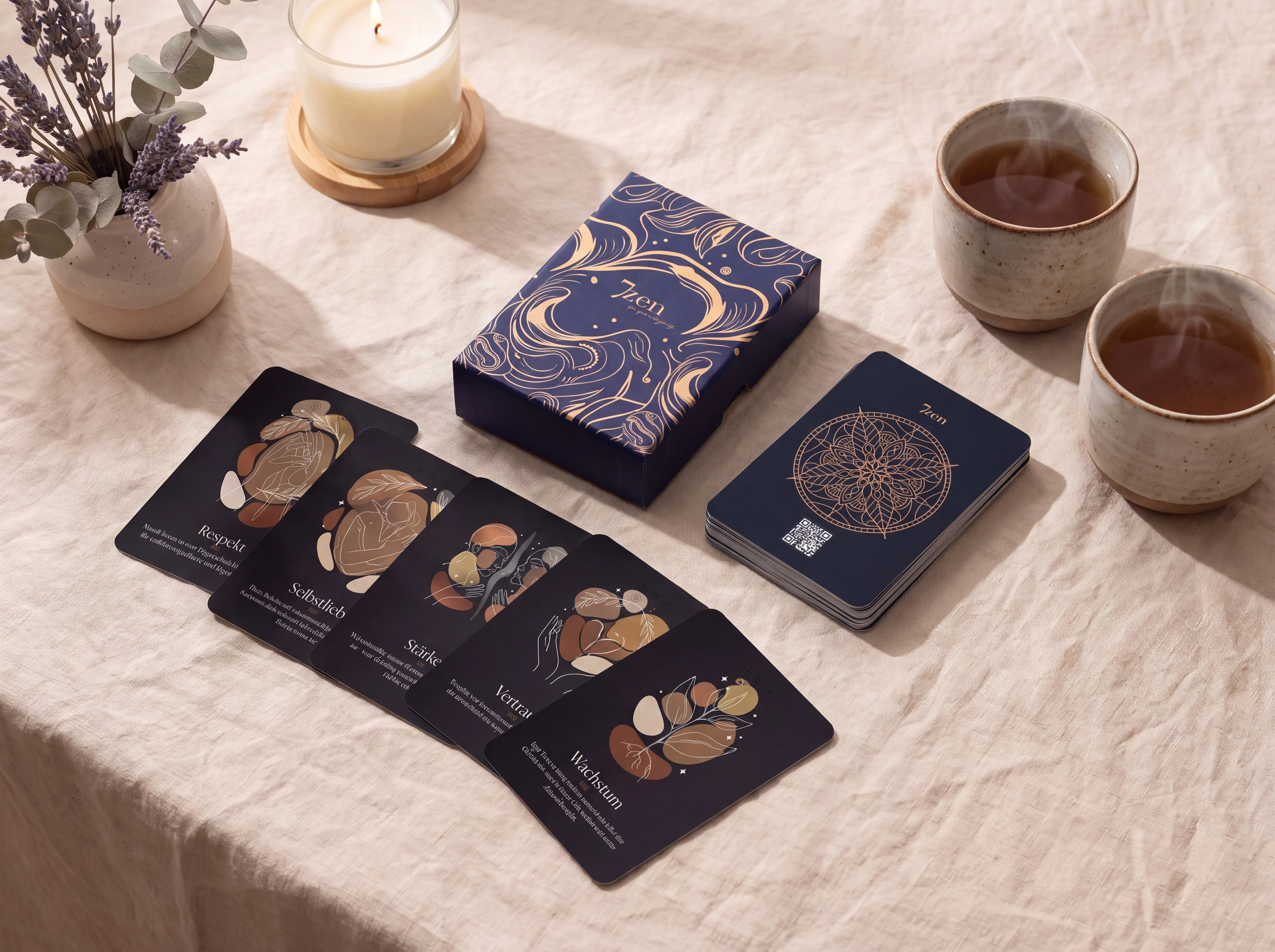
A "Card of the Week" as a Shared Ritual for Couples
If you’d like to add a slightly more playful—and perhaps even deeper—dimension to your couple’s ritual, you might try what’s known as a “Card of the Week.” The principle is simple: Once a week—for example, on Sunday evening or Monday at breakfast—each person draws one card from a deck. This can be a tarot or oracle card deck, a question deck, an affirmation card, or even a collection of prompts you’ve put together yourselves.
The crucial step comes next: Each person shares what the card evokes in them—what touches them about it, what it reminds them of, and how it makes them feel in that moment. This isn’t fortune-telling or a test—it’s a conversation starter that opens doors that often remain closed in everyday life.
Especially for couples who sometimes find it difficult to start deeper conversations, this ritual can serve as a gentle invitation. The card carries the question—and you don’t have to ask it yourself. Astrologically speaking, the new moon reminds us every month that there are cycles of new beginnings. A weekly card ritual can have a similar effect: as a small, mindful fresh start to the week, together and in connection.
What’s important here: There’s no right or wrong, no pressure to go deep. If you don’t feel like saying much one evening, you don’t have to. The ritual creates space—what you do with it is up to you.
What should you do if your partner doesn't want to participate?
An honest assessment that no article on rituals for couples should leave out: Both partners aren’t always equally enthusiastic. Sometimes one person thinks the card ritual is wonderful—while the other is rolling their eyes inwardly. This isn’t a rejection of the relationship, but rather an expression of different ways of connecting.
Instead of forcing the desired ritual or trying to convince the other person, it can be helpful to ask together: “What would you like? What would feel good to you?” Maybe the other person would prefer an evening walk together rather than a conversation ritual. Maybe a daily hug is enough for them. Maybe they need a few weeks before they can open up to something new.
Closeness cannot be imposed—neither on yourself nor on the other person. What can work: offering a ritual without expectations. And then waiting to see if there’s a response. Incidentally, this also reflects attachment theory: A secure base isn’t created through pressure, but through reliable invitations that remain open-ended.
If the feeling of drifting apart runs deeper or conflicts pile up, professional support through couples counseling or therapy can create a valuable space—not a sign of failure, but a sign that you’re taking the situation seriously.
Improving a Relationship Without the Pressure to Perfect It
There’s a subtle but important difference between the desire to improve a relationship and the expectation to make it perfect. The former comes from love—from a genuine desire to see the other person and to be seen. The latter often stems from fear: fear of not being good enough, of failing, of being abandoned.
Rituals can be wonderful anchors—but they can also become a chore when you start judging them. “We didn’t check in this week; we’re doing everything wrong.” That’s the pressure to optimize, which doesn’t foster closeness—it prevents it.
The invitation in this article isn’t a checklist. Not a system. It’s more like what’s called “beginner’s mind” in Zen—the ability to see something with fresh eyes, without knowing in advance how it’s supposed to turn out. Relationships need this spirit: the willingness to encounter one another anew time and again, even if you’ve known the other person for years or decades.
Small rituals can help with this—not because they solve problems, but because they create a rhythm of closeness. A pulse of connection that keeps beating even when life is loud and fast-paced.
If there’s just one thing you take away from this article, let it be this: You don’t have to change everything today. You don’t have to establish the perfect ritual, have the ideal conversation, or come up with the most romantic gesture. You could simply tell your partner honestly tonight how your day really went. Or ask how he or she is really doing. And then listen—without a cell phone, without distractions, without having to come up with a solution right away.
Closeness arises in moments like these. Not dramatically, not with fanfare. It arises quietly, in the space between two people who truly turn toward one another. And that’s more than most grand gestures could ever achieve.
Your call to action for today: Choose just one small ritual from this article—the daily check-in, a “card of the week,” a long hug when you get home, or a sincere word of appreciation—and try it out this week. Not as a test, not as an experiment with a specific outcome. Simply as an invitation to both of you.
How can I strengthen my relationship when I don't have much time?
Especially when time is tight, small, everyday rituals can be more helpful than occasional extended breaks. A five-minute daily check-in, a mindful hug when you get home, or a brief word of appreciation in the evening can help keep the connection alive—without any extra effort or planning.
What should I do if my partner doesn't like rituals or is skeptical about them?
Not everyone connects in the same way. It can be helpful to explore together what kind of connection feels right for both of you—perhaps a walk together instead of a structured conversation, or simply spending time together without a set agenda. The most important thing is the intention behind the connection, not the form of the ritual.
How often should couples engage in shared rituals?
There’s no ideal frequency that applies to all couples. Small daily moments of connection—a quick check-in, a hug, an honest conversation—can be just as meaningful as a larger weekly ritual. What matters isn’t the frequency, but the consistency and the shared intention behind it.
Can a shared card ritual really help improve a relationship?
A “Card of the Week” can serve as a playful conversation starter and open up topics that often don’t get a chance to come up in everyday life. Whether it’s tarot, oracle cards, or a question deck—the ritual creates a safe moment of shared focus. It’s no substitute for professional counseling, but it can serve as a low-barrier invitation to explore deeper connections, which many couples find soothing.
What is the difference between building rapport and the pressure to perform?
Building closeness means turning toward the other person with genuine interest—without expecting a specific outcome. Pressure to “optimize” arises when rituals become a chore or are used as proof that the relationship is working. A helpful question to ask is: Am I doing this out of love or out of fear? Rituals that arise from sincere affection have a very different effect than those that are simply checked off a to-do list.
What can I do if I feel like we've grown apart?
The feeling of growing apart is common and not a sign that something is fundamentally wrong. Small rituals can help you gradually rebuild your connection—but if you’re experiencing deeper feelings of distance or ongoing conflicts, professional support through couples counseling or therapy can be meaningful and helpful. This isn’t a sign of failure, but a conscious step you’re taking for each other.