Boosting self-confidence in children: What parents can really do
How do we strengthen our children's self-confidence in the long term? Developmental psychology-based tips for everyday family life.

There’s that one moment that every mother and father is familiar with: The child stands at the edge of the playground, watching the other kids run around—and just doesn’t have the courage to join in. Or they come home from school, toss their backpack in the corner, and say quietly, “I can’t do it anyway.” In moments like these, we as parents feel a deep longing: we simply want to be able to give our child a little bit of our own courage.
But how do you truly build children’s self-confidence—in a lasting way, without pressure and without false praise? This question concerns not only parents, but also developmental psychologists, educators, and everyone who supports children on their journey. In this article, we’ll show you what really lies behind healthy self-confidence in school-age children, why the years between 6 and 12 are so crucial—and what specific things you, as a mother or father, can do in everyday life to help your child thrive.
What Self-Confidence Really Means for Children
Before we discuss strategies, it’s worth taking a brief look at what self-confidence in children actually is—and what it isn’t. Many parents confuse self-confidence with overconfidence or with the ability to act loudly and dominantly. Yet true self-confidence is something much deeper and quieter.
From a developmental psychology perspective, a child’s self-confidence consists of two closely related concepts: self-concept—that is, the image a child has of themselves—and self-efficacy—the belief that their own actions can make a difference. A child with healthy self-confidence doesn’t have to be the loudest in the room. They just need to know deep down: I am good enough. I can do this. And if not, I’ll try again.
Middle childhood—the period between the ages of six and twelve—is particularly formative. School-age children begin to seriously compare themselves to others—to classmates, siblings, and role models. They develop an increasingly realistic self-image. This phase is both a great opportunity and a sensitive time: what parents, teachers, and the social environment reflect back to them now leaves a deep impression.

Why School Years Are So Crucial for Building Self-Confidence
When children start school, a whole new world opens up for them—and with it, a new dimension of comparison. Suddenly, there are grades, evaluations, and public moments of failure and success. Schoolchildren don’t just learn to read, write, and do math; they also learn: What am I capable of? Where do I stand? Am I valuable?
Developmental psychologists describe this phase as particularly sensitive for the formation of what is known as the academic self-concept—that is, the assessment of how well one performs in school. But the social and physical self-concepts also develop rapidly. Children ask themselves: Am I liked? Am I strong enough? Am I funny? Am I smart?
In astrology, the transition into middle childhood is often seen as the time when a person’s inner light begins to seek its own path—much like the sun takes on a new angle each day as it travels its course. This image fits perfectly: Children at this age are seeking their own light, their own direction. And parents can serve as beacons—not by dictating the path, but by providing guidance and security.
The good news: Self-confidence isn’t a fixed trait that you either have or don’t have. It’s a skill that develops in everyday life—through experiences, relationships, and the way we, as parents, interact with our children.
The Power of Genuine Recognition: Praise That Truly Builds Confidence
One of the most powerful tools available to parents is praise—but only when used correctly. Because not all praise builds children’s self-confidence. On the contrary: Too much undifferentiated praise can actually be harmful.
Developmental psychologist Carol Dweck has shown through decades of research that it makes a crucial difference what we praise children for. If we praise them for their innate traits—“You’re so smart!” or “You’re so talented!”—they develop what’s known as a fixed mindset. They believe their abilities are fixed and avoid challenges so as not to jeopardize that image.
If, on the other hand, we praise them for effort, strategy, and perseverance—"I’m so proud of how hard you worked today!" or "That wasn’t easy, but you didn’t give up—that’s impressive!"—they develop a growth-oriented self-concept. They understand that abilities grow through effort. And that is precisely the root of genuine, lasting self-confidence.
Specific phrases for everyday life
- “I saw how long you worked on this task. That was real perseverance.”
- “That part was difficult—how did you figure it out?”
- “You made a mistake and kept going anyway. That’s strength.”
- “What did you enjoy most about this project?”
These phrases focus attention on the process, not the result. They signal to the child: Your worth doesn’t depend on whether you succeed. Your worth lies in trying.
Wisdom from developmental psychology "A child who knows that they are loved - regardless of their achievements - has an anchor that holds them in place even in stormy times."
Building Self-Confidence Through Real Challenges and Independent Decisions
One of the most important—and for many parents, also the most difficult—realizations is this: Children need real challenges to develop self-confidence. Not the challenges we as adults pick out for them. But the ones they choose themselves—and where they’re allowed to fail.
When we parents remove all obstacles from their path, we simultaneously deprive our children of their most important learning moments. The schoolchild whose homework is always half-done doesn’t learn: “I can do this.” Instead, they learn: “I need someone to do this for me.” That is the exact opposite of self-confidence.
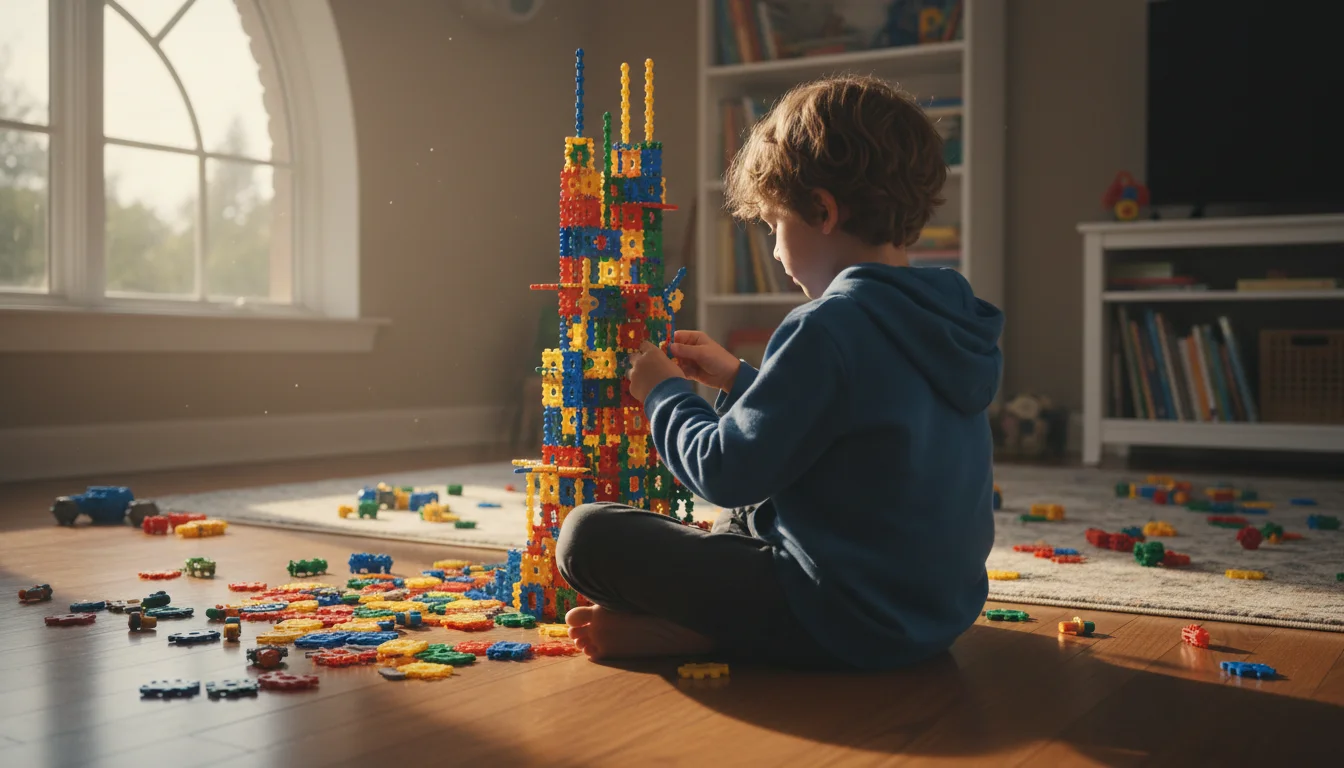
In terms of developmental psychology, we’re talking about experiences of self-efficacy: moments when a child realizes that their own actions produce a result. Such experiences are the strongest building blocks for lasting self-confidence. They arise when cooking the first scrambled eggs, when solving a tricky puzzle, when resolving a conflict with a friend—and yes, even when falling off a bike and getting back up.
More personal responsibility in everyday life—here’s how
- Delegate decisions: Let your child decide for themselves what to wear, which book to read, and how to spend their free time.
- Assign tasks: Children between the ages of 6 and 12 can take on real household chores—not as a punishment, but as a genuine contribution to the family.
- Allow for failure: If the homemade muffins burn, that’s not a failure. It’s a story your child will tell for the rest of their life.
- Ask questions instead of solving problems: Instead of giving the answer, ask, “What do you think might help?”
Security as a Foundation: The Role of the Parent-Child Bond
All strategies, all tips, and all wise words are of little use if the foundation is missing: a secure, reliable bond between parent and child. For decades, attachment research has shown that children who feel safe and accepted in their family are more courageous in exploring the world from that foundation. The bond is the soil from which self-confidence grows.
For parents of school-age children, this means above all: being present. Not giving the perfect answer, not doing everything right—but simply being there. Listening. Asking questions. Putting away your phone when your child comes home and wants to talk about their day.
How we respond to negative emotions is especially important. When a child is angry, sad, or ashamed—how do we react? Parents who validate these feelings (“I understand that this makes you angry”) instead of dismissing them (“Don’t be so dramatic”) give their child something priceless: the message that all feelings are welcome. That the child is still lovable even when things aren’t going well.
This emotional security is the foundation upon which true self-confidence can be built.
Body and Movement: Self-confidence also takes root in the body
Self-confidence isn’t just a matter of the mind. It also resides in the body—in posture, in breathing, in the experience of what this body is capable of. For schoolchildren, physical activity is therefore far more than just sports: it is an important source of self-efficacy and body awareness.
Studies show that children who are regularly physically active not only sleep better and perform better in school—they also report higher self-esteem. Activities where the child can see their own progress are particularly valuable: riding a bike without training wheels for the first time, swimming a full length of the pool, or mastering a difficult hold while climbing.
What’s important here: It’s not about performance or competition, but about the joy of one’s own physicality. Martial arts, dancing, climbing, swimming, biking, yoga for kids—all of these can help. The key is that the child finds joy in it themselves and doesn’t feel pressured to meet expectations.
Small movement rituals for at home
- A morning walk together or a bike ride on the weekend
- A dance break after homework—just turn up their favorite music
- Taking on small challenges together in the garden or at the playground
- Yoga or breathing exercises as an evening ritual for relaxation and body awareness
Language shapes identity: What we say when we talk about our children
Children hear everything. Including—and especially—what parents say about them when they think the child isn’t listening. A child who overhears their mother saying on the phone during dinner, “He’s just shy; he never dares to do anything,” internalizes that very description. It becomes part of their identity.
The reverse is also true: Children who hear their parents attribute a strength to them in front of others—“Lena really sticks with it when something is important to her”—begin to see that strength as part of themselves.
Developmental psychologists call this narrative identity formation: children construct their self-image from the stories told about them. Particularly influential are phrases that portray traits as unchangeable. “You’re always so nervous” is a statement the child interprets as a fixed trait. “You were excited today—I know that feeling when something is important to me,” on the other hand, normalizes the emotion without labeling it as a permanent trait.
Words that empower — phrases to try
- Instead of: “You’re so anxious” → “You think things through carefully before you try something. That’s caution, not weakness.”
- Instead of: “Why can’t you ever do that?” → “That’s still difficult for you—what do you need to try it?”
- Instead of: “Don’t worry” → “I understand that you’re worried. What’s troubling you the most?”
Building Self-Confidence Through Social Experiences and Friendships
Children need peers. Between the ages of 6 and 12, friendships become one of the most important sources of identity and self-worth. School-age children learn: Am I liked? Can I resolve a disagreement? Can I set boundaries? Can I ask for help?
Parents cannot control this area—and shouldn’t try to. But they can create a framework in which social experiences can flourish: inviting friends over, facilitating shared activities, listening and supporting during conflicts without immediately intervening.
Group experiences are particularly valuable in this regard: a sports club, a theater group, a choir, a scout troop. In such communities, children experience that they are needed, that their role is important—and that they belong. Belonging is one of the deepest human needs, and for school-age children, it is directly linked to self-confidence.
If a child has difficulty making or maintaining friendships, it’s worth taking a closer look: Is it social shyness that will fade over time? Are there specific fears? Or are there signs of deeper challenges where professional support would be helpful? Parents should trust their gut instincts here and seek support early on if needed.
Setting an Example: How Parents Can Model Self-Confidence
Children don’t primarily learn from what we tell them. They learn from what we do. The most effective way to build a child’s self-confidence may therefore be the unexpected one: working on how we ourselves handle mistakes, uncertainty, and challenges.
A child who sees their mother say after a long, difficult day, “A lot went wrong today. But I learned something from it,” receives an important lesson in resilience. A child who watches their father practice a new skill, make mistakes in the process, and laugh about it learns: Failure is normal. It’s part of learning.
It is particularly effective when parents speak openly about their own insecurities—in an age-appropriate way and without burdening the child. “You know, I used to get nervous sometimes, too, when I had to try something new. I would then imagine what it would be like once I’d succeeded.”
Moments of authenticity like these create a deep connection and convey the most powerful message of all to children: I’m not alone with my doubts. And having doubts doesn’t mean I can’t do it.
Building self-confidence in children isn’t a project with a beginning and an end. It’s an attitude we adopt every day—in small moments, in casual remarks, in the way we listen. It’s the patience we muster when a child explains for the third time how their favorite computer game works. It’s the confidence we show when we say, “I think you can do it”—and truly mean it.
Perhaps it’s no coincidence that in astrology, Leo—the sign so often associated with self-expression and inner fire—is not born a king, but a cub that must first learn to roar. Self-confidence isn’t a gift. It’s a process of growth. And you, as a parent, are the most important gardener in that process.
You don’t have to be perfect. You just have to be present.
At what age can I actively boost my child's self-confidence?
Parents can foster their children's self-confidence from birth - through secure attachment, responsiveness and loving support. However, the phase between the ages of 6 and 12 is particularly formative because children begin to seriously compare themselves with others and develop a realistic self-image. Strategies such as process-oriented praise, giving responsibility and allowing challenges are particularly effective in this age group.
My child often says "I can't do it" - what should I say?
Avoid statements like "Of course you can!" - although they sound encouraging, they often don't feel credible to the child. It is more effective to rephrase the sentence slightly: "You can't do that yet - but you're learning." This signals that skills grow through practice and at the same time validates the real difficulty that the child is currently experiencing. Then ask curiously: "What is the hardest part of this for you?".
How much praise is too much? Can I praise my child excessively?
Yes, this is possible - but the problem usually lies not in the frequency of the praise, but in the type. Blanket praise such as "You're so great!" or "You're the best!" can lead to children avoiding challenges in order to protect this image. Praise that is related to specific behavior and effort, on the other hand, can hardly be too much. It is important that the praise is honest and specific - children can sense when something is wrong.
My child is very shy. Is this a sign of a lack of self-confidence?
Shyness and a lack of self-confidence are not the same thing, even if they sometimes overlap. Some children are naturally more introverted and need more time to warm to new situations - this is a temperamental trait, not a deficit. The decisive factor is whether the child blossoms in familiar surroundings and whether the shyness severely restricts them in everyday life. If the latter is the case or if the child suffers from it themselves, a consultation with a child psychologist can be very helpful.
What role does school play in the development of self-confidence?
School plays a huge role, as children experience performance assessments and compare themselves with their peers on a daily basis. A supportive teacher who recognizes and encourages strengths can massively boost a child's self-confidence. Parents can actively seek cooperation with the school: Use teacher-parent conversations to find out where the child is experiencing joy and success - not just where they have deficits. And create an atmosphere at home in which school failures can be discussed without the child feeling ashamed.
What should I do if I have the feeling that my child's self-confidence is not growing despite my efforts?
Development takes time, and progress in self-confidence is often not immediately visible. Sometimes the first changes only become apparent months later, when the child masters a new situation that would previously have been too much for them. However, if you have the feeling that your child is suffering from a lack of self-confidence over a longer period of time, consistently avoids social situations, suffers from anxiety or is increasingly withdrawn, professional support is not a defeat - but a sign of care. Child psychologists, educational counseling centers and educational specialists can offer valuable support.