The Wheel of Life: Assessing Where You Stand to Find More Balance
The Wheel of Life shows you at a glance where you stand—honestly, without any pressure. A guide to filling it out and interpreting it.
Do you know that feeling where you’re getting by—but you sense a faint tug somewhere? Not because something is going dramatically wrong, but because one area of your life has been on the back burner for months. Maybe it’s the friendship you keep putting off. Or the bank account you’d rather not think about. Or your body, which is crying out for attention while you drift through another workday.
The Wheel of Life is designed for moments exactly like these—it’s one of the clearest and most honest tools for personal development. You don’t need an app, a coach, or any prior knowledge. Just a few minutes, a piece of paper—and the willingness to take an honest look. This article guides you step by step through the Wheel of Life: what it is, how to fill it out, and what your results really mean—all without the pressure of having to be a perfect ten in every area.
What Is the Wheel of Life? An Honest Look at the Tool
The Wheel of Life—known in English-speaking coaching circles as the Wheel of Life—is a visual self-reflection tool that depicts various areas of life in a circular format. Each area is a segment of the wheel. You rate how satisfied you currently are with it. The result shows at a glance where you currently stand—and where the wheel might be hitting a few bumps.
It was developed in the second half of the 20th century in the context of personal success and self-management coaching, largely influenced by the American entrepreneur and motivational author Paul J. Meyer. Since then, the tool has found its way into countless coaching contexts—from management consulting firms to wellness retreats.
Important to know: The Wheel of Life is not a measuring tool that reflects objective truth. It’s an invitation to conversation—a mirror you hold up to yourself. What you see in it depends on where you stand today. And that’s okay to change.
The 8 Areas of Life in the Wheel of Life—and Honest Questions About Them
The classic Wheel of Life comprises eight areas that together paint a multifaceted picture of your everyday life and your inner world. No area is more important than another—they’re all part of a fulfilling life, even if they take up different amounts of space at different times.
Take your time reading through each area. Let the questions sink in without answering right away. Sometimes your first gut feeling says more than a lot of deep thinking.
1. Personal Development
This area encompasses your growth as a person—learning, curiosity, the feeling of evolving, and getting closer to your inner self.
Do you feel like you’ve learned something new about yourself this year?
Are there any impulses, ideas, or topics that you keep avoiding—even though they fascinate you?
2. Home & Environment
This refers not just to your home, but to the feeling of belonging: How comfortable do you feel in the space that is your everyday life?
Do you walk into your home with a slight sigh of relief—or with a quiet sigh?
Is there something in your surroundings that you’ve wanted to change for a long time but keep putting off?
3. Health & Body
Physical and mental health—how well do you listen to what your body is telling you?
When was the last time you really slept in, without an alarm clock or a guilty conscience?
Do you notice your body’s warning signs—and do you take them seriously?
4. Work & Career
This isn’t just about performance, but about meaning: Does what you spend your time on feel meaningful?
Are there moments at work when you lose track of time?
Or does the feeling of just going through the motions dominate?
5. Friendships & Social Life
Connections with people outside your family and romantic relationship—people with whom you can just be yourself.
When was the last time you spent time with someone who really makes you feel good—with no hidden agenda, no obligations?
Do you feel like your friendships are a mutual give-and-take?
6. Love & Relationships
Whether you’re in a relationship or not—this area explores the quality of closeness, connection, and how you treat yourself as a loving being.
Do you feel truly seen in your closest relationships?
How do you nurture your relationship with yourself—with patience or with harsh judgment?
7. Finances & Material Security
Money isn’t a taboo subject. It’s an area of life like any other—and deserves honest attention.
Do you know how much you spend—and how much you’d like to have?
Does your financial situation feel more secure, insecure, or simply unclear?
8. Leisure & Recreation
What do you do just because it brings you joy—without any specific outcome, without productivity, and without needing to justify it?
Are there activities in your daily life that feel like true relaxation—not just a distraction?
When was the last time you played, laughed, or did something that felt both pointless and wonderful at the same time?

Filling Out the Wheel of Life: A Step-by-Step Guide to Assessing Where You Stand
You’ll need: a sheet of paper (or the 7zen Workbook), a pen, about 20 minutes of uninterrupted time—and a calm, supportive attitude toward yourself. No test, no judgment. Just an honest moment with yourself.
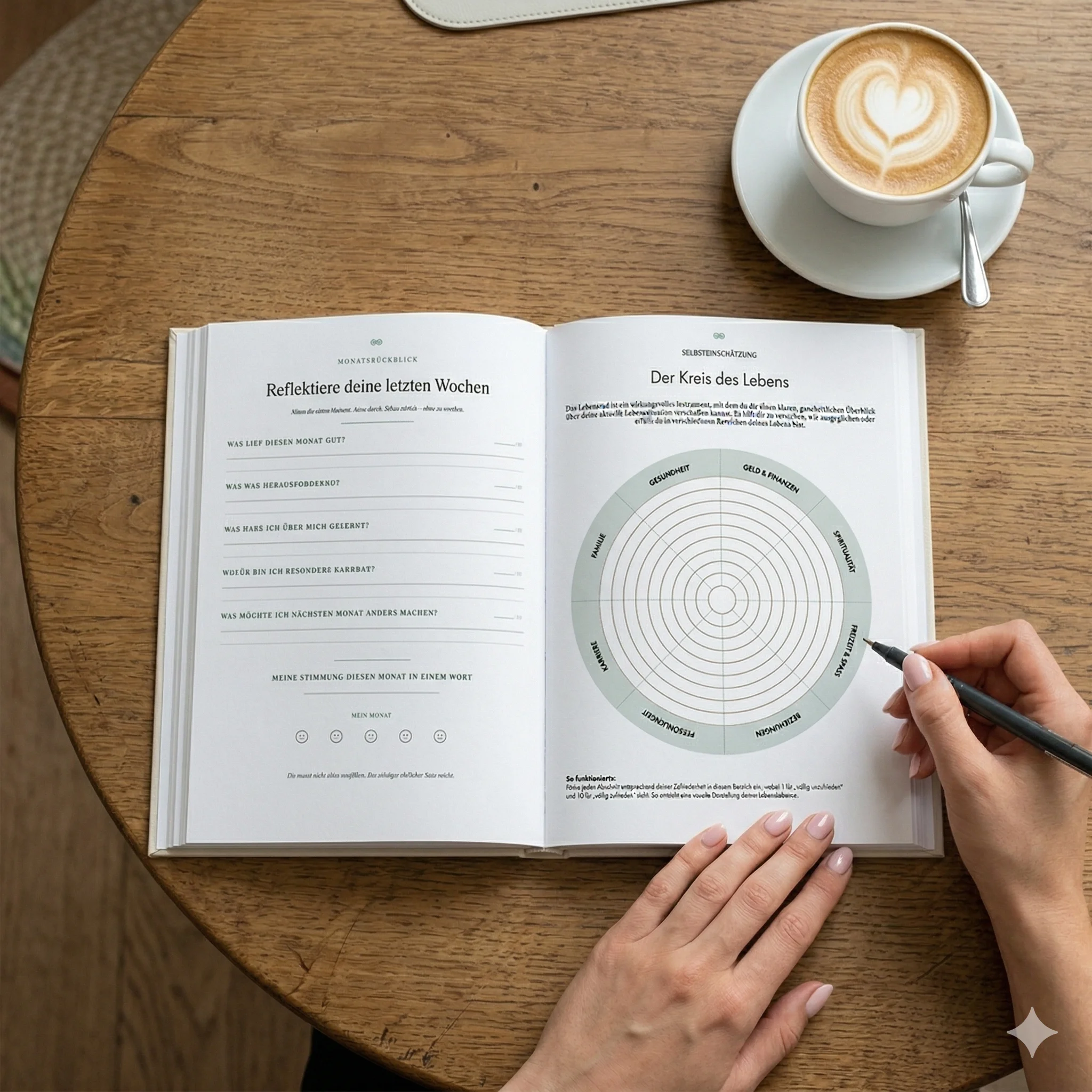
Step 1: Draw your circle. Draw a large circle on the paper. Divide it into eight equal segments—like slices of a pie. Label each segment with one of the eight areas of life: Personal Development, Home, Health, Work, Friendships, Love, Finances, Leisure.
Step 2: Rate from the inside out. The center of the circle corresponds to a rating of 1 (very dissatisfied), and the outer edge corresponds to a rating of 10 (very satisfied). In each segment, mark the point that corresponds to your current level of satisfaction—intuitively, without overthinking it. Then connect all the points. This creates your personal wheel of life.
Step 3: Look at the shape. Is the wheel reasonably round—or does it have noticeable bulges and indentations? Are there areas that were rated surprisingly high or low? Which area made you pause while filling it in?
Tip: In the 7zen Workbook, you’ll find a ready-to-use template to fill out—with space for notes and further reflection questions for each area.

7zen Inspiration "A wheel doesn't have to be perfectly round to turn. It just has to be set in motion." – Balance in life doesn't mean having everything in balance at the same time, but rather consciously sensing where energy is needed.
Reading Your Life Balance—Without the Pressure to Score a Ten in Every Area
Now your Wheel of Life is in front of you. Maybe you see a nearly even wheel with scores between six and eight. Maybe you’ve rated three areas as a four and one as a nine. Both are fine. Both are honest.
The most common misconception about the Wheel of Life is the assumption that the goal is a perfect circle—in other words, a ten in every area. But that’s neither realistic nor desirable. Life balance is subjective. It doesn’t mean that all areas take up equal space, but rather that you know how they feel right now—and why.
An area rated a three doesn’t need to be “addressed” right away. Maybe it has consciously taken a back seat because another area deserves your full attention. Maybe the low score is an invitation, not a failure.
Instead, ask yourself: Which area is currently draining the most energy from me because it’s being neglected? And: Which area, if given a little more attention, would have a positive impact on all the others? These questions are often more helpful than trying to tackle everything at once.
There’s no wrong answer. And no result means you’ve failed. The Wheel of Life simply shows you where you stand today. Tomorrow, things might look different.
Exploring an Area in Depth: What to Do with the Results?
Once you have your Wheel of Life overview in front of you, a logical next step might be to pick out a single area—the one that appeals to you the most, moves you, or bothers you—and take a closer look at it.
Not all eight at once. Not with a master plan for the coming year. Instead, start with a small, specific question: What would be a tiny, achievable step in this area—this very week?
For example:
Health with a four: Go to bed ten minutes earlier tomorrow.
Friendships (a 3): Send a quick message today to someone you think about often.
Finances (a 2): Take a moment to calmly check your bank balance without taking immediate action—just to break the cycle of avoidance.
Small steps add up. And often, the first step isn’t the action itself—it’s the willingness to take a closer look.

The Wheel of Life as a Ritual: Your Recurring Self-Assessment
The Wheel of Life reveals its deepest value not as a one-time experience, but as a recurring ritual. Those who fill it out regularly—for example, at the start of each quarter or at the turn of the year—gain something valuable over time: a personal timeline. A record of how their own life has changed over months and years.
In astrology, there is the idea that certain transitions in the annual cycle are natural moments for reflection and realignment—the solstices, the equinoxes, the beginning of a new season. These cosmic rhythms can serve as a gentle invitation to pause and re-examine your own wheel. Not because the stars dictate it, but because regular pauses for self-reflection can add depth to your life.
A possible ritual might look like this: Plan a quiet evening, perhaps with a warm drink and a candle. Take out your old wheel of life. Fill out a new one. Place the two side by side and observe them without judgment: What has changed? What has stayed the same? What surprises me?
This comparison is often more moving than the individual result—because it shows that you’re evolving. Even if it doesn’t always feel that way on the inside.
The Wheel of Life and Self-Improvement: An Important Difference
It would be a shame to turn filling out the Wheel of Life into yet another self-improvement project. In an age when we’re constantly being told we need to be more productive, healthier, more balanced, and more successful, we need tools that take the pressure off—not ones that create even more pressure to meet expectations.
The Wheel of Life isn’t a performance test. There’s no minimum score you have to reach. There’s no result that makes you a better or worse person. It’s simply a mirror—and you decide for yourself how long you look into it and what you do with what you see.
Sometimes the most valuable insight from the Wheel of Life isn’t: “I need to improve this area now.” But rather: “I see what I’m currently accomplishing—and that’s more than I thought.” Or: “I’ve neglected this area for so long because I find it painful. And that’s only human.”
Taking stock of where you are in life isn’t a starting signal for more effort. It can also be a moment of appreciation—for what already is.
Perhaps your wheel of life is right in front of you right now. Perhaps you haven’t drawn it yet and the images are still in your mind. Both are a starting point.
Whatever your wheel shows right now—it shows who you are. In this moment, in this phase of life, with everything you’re carrying right now and everything that’s still ahead. That’s not a shortcoming. It’s a starting point.
And the next time you feel that quiet tug—that sense that one area is being neglected—then you’ll know where to start. Not with a grand plan. But with a circle, eight segments, and a moment of honesty with yourself.
Your call to action for today: Take twenty minutes now—or tonight. Draw your wheel of life. Intuitively assess each area. And write just one sentence next to it: what this area is trying to tell you right now. No plan, no to-do list. Just one sentence. Sometimes there’s more clarity in that than in hours of thinking.
Draw Your Wheel of Life: The Workbook
The 7zen Workbook is the perfect place to take stock of where you are—with space to map out your wheel of life and revisit it time and again.
Your daily companion for personal growth
With the 7zen app, you'll receive daily coaching tips, guided breathing exercises, and personal reflections—all based on your individual profile.
How often should I fill out the Wheel of Life?
There’s no set rule—and that’s by design. Many people find it helpful to fill out the Wheel of Life two to four times a year, for example at the start of each quarter or during a seasonal transition. More important than the frequency is consistency: If you use the Wheel of Life repeatedly on the same occasion, over time a personal development trajectory emerges that is much more meaningful than a one-time result.
What if I really don't know how to evaluate a particular area?
This is completely normal—and often a valuable clue. If an area is difficult to rate, it may mean that it hasn’t received much attention for a long time, or that you’re consciously or unconsciously avoiding it. In this case, trust your initial gut feeling. A number that feels “roughly right” is better than none at all. The Wheel of Life isn’t a precision instrument—it’s a starting point for conversation.
Do I need to aim for a high score in all areas?
No. That’s one of the most common misconceptions about the Wheel of Life. Life balance doesn’t mean scoring a ten in every area. It means having a conscious relationship with the different areas of your life—knowing which ones are currently getting more energy and which ones you’re consciously keeping in the background. A four in one area isn’t a failure. It’s an honest assessment of where you stand.
Can the Wheel of Life replace professional counseling or therapy?
No—and that’s not its purpose. The Wheel of Life is a self-reflection tool for people who want to gain a structured overview of their lives. It is not a substitute for professional counseling, coaching, or psychotherapeutic support. If you notice that certain areas of your life are causing you significant stress or you feel consistently overwhelmed, it may be helpful to seek professional support.
What if my Wheel of Life scores are very low in several areas?
First of all: Thank you for your honesty. It takes courage to take a close look. If you look at your wheel of life and see that many areas are rated low, that’s not a sign of failure—it’s a sign that you’re going through a challenging phase right now. Choose a single area that feels most accessible, and think about what small step you could take there. And remember: This tool is meant to provide relief, not add to your burden. If it feels too difficult, set it aside for a moment.
Is there a Wheel of Life template I can use?
Yes—in the 7zen workbook, you’ll find a ready-made Wheel of Life template with all eight areas of life, space for your ratings, and follow-up reflection questions. But you can also easily draw the Wheel of Life yourself on a sheet of paper: a large circle, eight segments, labels, and a rating scale from 1 to 10—that’s all you need.