EFT for Stress and Anxiety: Emotional Freedom in Minutes
How EFT Can Provide Immediate Relief from Acute Stress and Anxiety – Backed by Science, with a Tapping Sequence, and a Truly Amazing Result.
Do you know that feeling when stress wraps itself around your chest like an invisible hand—and you just don’t know how to shake it off? Maybe you’re sitting at your desk right now, your mind racing, and you’re longing for just a single moment of true peace. Or anxiety creeps back in, quietly but surely—like a shadow that won’t go away.
This is exactly where EFT comes in. EFT stands for Emotional Freedom Techniques. It’s a method that seems unusual at first glance: You tap certain points on your body with your fingers while focusing inwardly on what’s weighing you down. Sounds simple? It is. And that’s exactly where its strength lies.
In this article, you’ll learn how EFT works for stress and anxiety, what science has to say about it, and—most importantly—you’ll get a complete tapping sequence that you can try right away. Welcome on the path to a little more emotional freedom.
What is EFT? An explanation of Emotional Freedom Technique
EFT was developed in the 1990s by American engineer Gary Craig and is based on an older method called TFT (Thought Field Therapy) developed by psychologist Roger Callahan. Craig simplified the system and made it accessible to everyone—without years of training, without expensive tools, and without prior knowledge.
The basic idea is as old as Traditional Chinese Medicine: Life energy flows through our bodies along specific pathways known as meridians. When this energy becomes blocked due to emotional distress, stress, or anxiety, physical and mental ailments arise. Tapping on the meridian endpoints—combined with focused mental attention—is said to get this energy flow moving again.
Does that sound like esoteric wishful thinking? Understandable skepticism. But research over the past two decades has given EFT a solid scientific foundation—more on that in the next section. What we can say right now: EFT is not a matter of faith. It is a practical, learnable technique that you can start using today.
EFT and the Body: Why Tapping Works
When we’re under stress or experiencing fear, our nervous system activates the so-called fight-or-flight response. The body releases cortisol and adrenaline, the heart beats faster, and the muscles tense up. In prehistoric times, this was a lifesaver. In modern daily life—at the thought of a difficult email or a packed schedule—this reaction, however, becomes a problem.
Tapping on acupressure points sends a calming signal to the brain. Studies show that it measurably reduces the activity of the amygdala—our body’s built-in alarm system. At the same time, the verbal guidance accompanying the tapping brings rational thinking into play and prevents us from getting lost in our emotions. The result: relaxation often sets in within a few minutes.
What Science Says About EFT
EFT is one of the most extensively researched complementary methods in recent years. A meta-analysis evaluating data from over 50 clinical studies reached a remarkable conclusion: EFT reduces anxiety symptoms significantly more than control conditions—both in cases of short-term acute stress and chronic anxiety.
Particularly impressive: In a study involving nurses suffering from significant occupational stress, a single EFT session resulted in a significant reduction in blood cortisol levels—by an average of nearly 25 percent. Cortisol is the body’s primary stress hormone. Such an effect in such a short time is remarkable.
Further research demonstrates positive effects in cases of post-traumatic stress disorder, phobias, sleep problems, and pain. The American Psychological Association (APA) has added EFT to its list of empirically validated treatment methods—a move that would have seemed unthinkable in professional circles just a few years ago.
What does this mean for you? EFT is not a miracle cure that solves all problems. But it is a scientifically grounded tool that can provide you with genuine relaxation in your daily life—quickly, for free, and applicable anywhere.
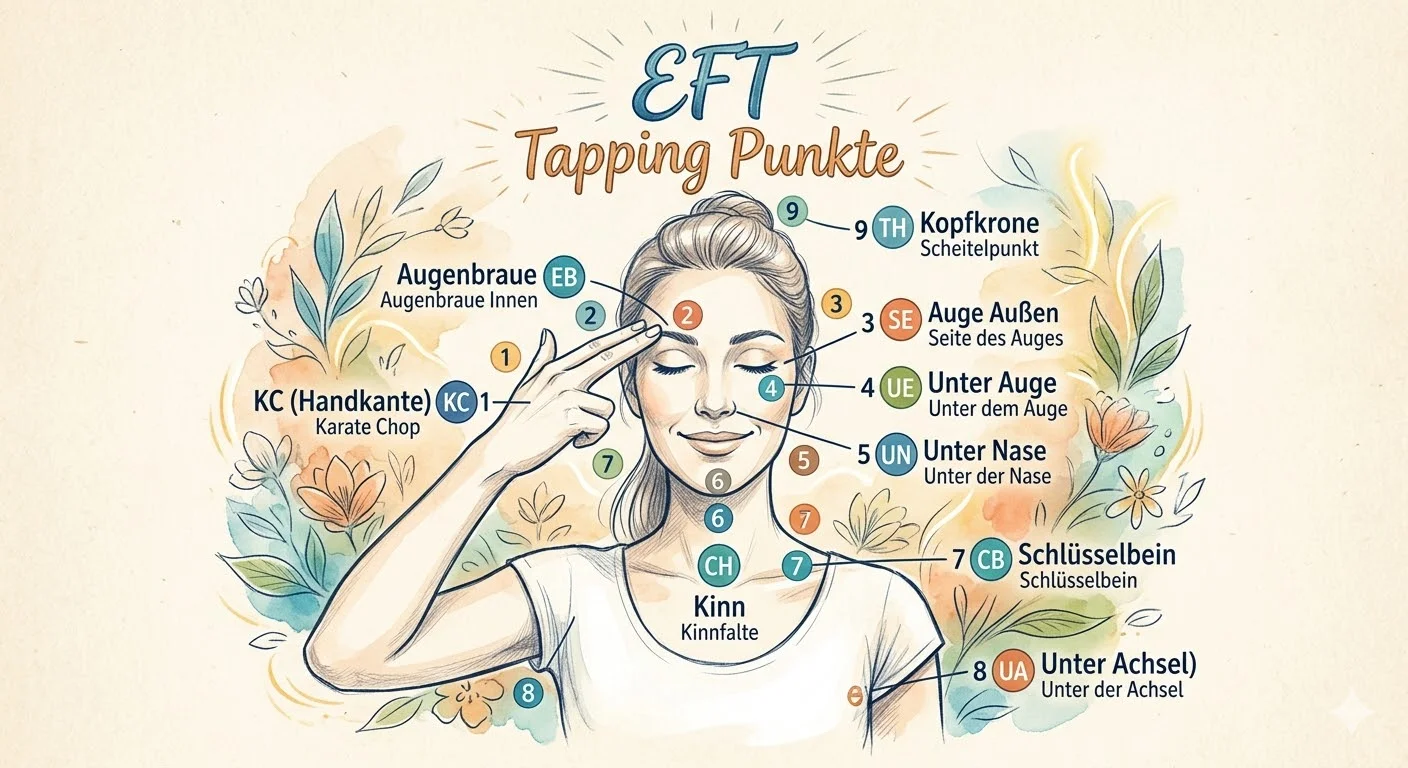
The Tapping Points: Your Map to Emotional Freedom
Before you begin the tapping sequence, you’ll first learn the most important points. You don’t need to memorize them—a basic introduction is all you need. Over time, you’ll find them intuitively.
KC (Edge of the Hand): The fleshy outer edge of the hand, between the little finger and the wrist. This point is often used to start.
EB (Start of the Eyebrow): Right at the inner start of the eyebrow, slightly above the bridge of the nose.
SE (Side of the Eye): On the bone at the outer corner of the eye—not on the temple, but directly on the bone.
UE (Under the Eye): On the cheekbone, about one centimeter below the pupil.
UN (Under the Nose): In the center between the underside of the nose and the upper lip.
UK (Under the Chin): In the center of the chin, in the small hollow between the lower lip and the tip of the chin.
KB (Collarbone): About three centimeters below the collarbone, slightly to the side of the center of the sternum—where the collarbone meets the sternum.
UA (Under the Arm): About a hand’s width below the armpit, at the level of the bra strap.
SH (Crown): Right at the top of the head, at the crown.
Tap each point gently but firmly about five to seven times. It doesn’t matter which hand you use—or which side of the body. The meridians run symmetrically on both sides.
Cosmic Wisdom “Even the scorpion carries its own antidote within.” – In astrology, the sign of Scorpio is considered the master of transformation: what weighs us down already holds the seed of healing within it. EFT makes this very principle tangible—we turn toward the pain in order to let it go.
Using EFT for Stress: The Complete Tapping Sequence
Now it’s time to put it into practice. You can use this sequence right away—at your desk, in the car (while parked!), in the bathroom, or in a quiet corner. It takes about five to ten minutes and nothing more than your hands.
Step 1: Identify the problem
Take a moment and describe as specifically as possible what’s weighing on you right now. Not “I’m stressed”—but rather: “This anxiety about talking to my boss tomorrow” or “This tightness in my chest when I think about my to-do list.”
Then rate how intense the feeling is right now on a scale from 0 (no stress at all) to 10 (the strongest stress imaginable). This number is your baseline—you’ll see how it changes.
Step 2: The Setup Statement
Tap continuously on the edge of your hand (KC) while saying this sentence aloud or in your mind three times:
“Even though I have [your problem], I accept myself completely and with all my heart.”
Example: “Even though I have this paralyzing fear of tomorrow’s conversation, I fully accept myself with all my heart.”
This statement is the heart of EFT. It connects two apparent opposites: the honest acknowledgment of the problem and self-acceptance. No sugarcoating, no denial—and yet no wallowing.
Step 3: The Tapping Round
Now tap the points in order while repeating a short reminder phrase—a brief version of your problem. For example: “This fear,” “This stress,” “This tightness in my chest.”
EB (Eyebrow Start): “This fear…”
SE (Side of the Eye): “This stress inside me…”
UE (Under the Eye): “This oppressive feeling…”
UN (Under the Nose): “I can feel it right now…”
UK (Under the Chin): “It’s really there…”
KB (Collarbone): “This pressure…”
UA (Under the arm): “This tension…”
SH (Crown): “I allow it to be there.”
That was one round. Take a deep breath, close your eyes briefly, and assess again: How intense is the stress now on a scale of 0 to 10?
Step 4: The Neutralization Round
If the number has gone down, you can now do a second round—this time with more positive phrasing. You let go and make room for something lighter.
EB: “I am allowed to let go…”
SE: “I am safe…”
UE: “My body knows how to relax…”
UN: “I trust myself…”
UK: “I am greater than this stress…”
KB: “I am allowed to be calm…”
UA: “I choose peace…”
SH: “I am okay, right now.”
End the sequence with three long, deep breaths. Let your belly rise and fall completely as you do so.
Klopf-Assistent
Geführter Klopfablauf mit Handkante und drei Punkten, ca. 3 Minuten, mit gesprochener Anleitung. Vorher und nachher wird die eigene Belastung auf einer Skala von 0 bis 10 eingeschätzt.
Der Ablauf
- Handkante — der Setup-Satz, dreimal
- Augenbraue — am Anfang der Braue, siebenmal
- Unter dem Auge — auf dem Knochen unter der Pupille, siebenmal
- Schlüsselbein — knapp unterhalb der Mulde, siebenmal
Themen zur Auswahl
- Anspannung & Stress — Wenn alles zu viel wird.
- Schlaf — der Kopf wird nicht still — Wenn die Gedanken kreisen.
- Sorge & Grübeln — Wenn etwas dich nicht loslässt.
- Selbstzweifel — Wenn die innere Stimme klein macht.
- Trauer & Schwere — Wenn das Leben sich schwer anfühlt.
- Angst — Wenn die Brust eng wird.
- Ärger & Wut — Wenn etwas in dir kocht.
- Überforderung — Wenn der Tag größer ist als du.
Mit einem 7zen-Kartenset steht in der App der vollständige Assistent mit allen neun Klopfpunkten zur Verfügung.
7zen ist kein Ersatz für Psychotherapie. Bei anhaltenden Beschwerden wende dich an eine Fachperson.
EFT for Anxiety: When the Spiral Begins
Anxiety is one of the most common reasons people turn to EFT. Whether it’s that vague, underlying anxiety that sometimes feels like a low, constant hum—or the acute panic before an exam, a difficult conversation, or a trip—EFT offers a direct approach in both cases.
The key difference from traditional relaxation techniques like meditation or progressive muscle relaxation: EFT doesn’t ask you to ignore or drown out your anxiety. Quite the opposite. You focus your full attention on what frightens you—and tap as you do so. It is this combination of exposure and physical calming that makes EFT so effective.
In behavioral therapy, this principle is called exposure with response prevention: You face the fear-inducing stimulus without running away—and thereby learn that it will not destroy you. EFT does exactly that, only more gently and on your own. Many people report that after a tapping sequence, not only does the intensity of the fear decrease, but its nature also changes: it feels less threatening, less physically overwhelming.
If you notice that your anxiety is deeply rooted or linked to traumatic experiences, it is recommended that you seek guidance from a trained EFT therapist. As a self-help tool for everyday anxiety and stress, however, EFT is an exceptionally accessible method—safe, gentle, and effective.
Incorporating EFT into Your Daily Life: Small Rituals, Big Impact
One of the best things about EFT is its flexibility. You don’t need a yoga mat, a quiet hour, or any special equipment. All you need are your hands and a few minutes.
Morning Ritual: Start the Day Relaxed
Many people start their day with a short round of tapping, even before they check their phone. Choose a topic that’s on your mind for the day—whether it’s a task, an encounter, or simply your general mood. Five minutes can change the tone of your entire day.
In stressful moments: The mini-round
When stress boils over in the middle of your day—before a presentation, after an argument, while waiting in line—you can do a mini-round using only the edge of your hand (KC) and the crown of your head (SH). Tap alternately while breathing consciously. Even that is often enough to release the initial tension.
Evening ritual: Letting go of the day
In the evening, before you go to sleep, you can dedicate a round to letting go of the day. Name what’s left undone, what’s still on your mind—and tap it out point by point. Many report deeper, more peaceful sleep after this practice.
The emotional freedom that EFT promises doesn’t come from a single magical session. It grows through regularity—like a muscle you’re training. Even just two to three short sessions a week can make a noticeable difference over time.
EFT and Stress Hormone Regulation: What Happens in the Body
For anyone who wants to understand what’s behind the technique: Let’s take a look behind the scenes of the body.
When you tap, you send mechanical stimuli to the nerve endings in the skin. These stimuli travel through the nervous system directly to the brain—more specifically to the amygdala, the part of the limbic system responsible for processing fear and threat. The amygdala responds to touch by reducing its activity—this is well-documented in neurobiology.
At the same time, the steady, rhythmic tapping activates the parasympathetic nervous system—the so-called rest-and-digest mode, the exact opposite of the stress response. The heart rate slows down, the muscles relax, and breathing becomes deeper.
Added to this is the cognitive component: by having to name and articulate the problem, you activate the prefrontal cortex—the rational thinking brain. This effectively takes control away from the overreacting amygdala. The result is a neurobiologically grounded state of calm and clarity.
So relaxation isn’t magic—it’s biochemistry. And EFT is a tool that elegantly triggers this biochemical process.
Common Mistakes When Tapping – and How to Avoid Them
EFT is generally a very forgiving method—you can do a lot of things slightly wrong and still achieve good results. Nevertheless, there are a few pitfalls worth being aware of.
Defining the problem too vaguely
“I’m stressed” is too general. The more specific your focus, the more precise the effect. Ask yourself: Which aspect of this stress is strongest right now? Where do I feel it in my body? What exactly is scaring me? The more specific, the better.
Tapping too fast
EFT isn’t a competition. Tap slowly enough to really feel the points—five to seven times per point is a good pace. Go at your own speed.
Breaking the emotional connection
While you’re tapping, stay mentally focused on the issue that’s bothering you. It’s tempting to let your mind wander—but then you lose the therapeutic effect. A quick glance at your issue between points helps maintain the connection.
Expecting an instant fix
EFT can bring noticeable relief within minutes—but deep, long-standing patterns often require several sessions. Be patient with yourself. Every round is a step.
Who is EFT particularly suitable for?
EFT is generally suitable for anyone who is willing to explore their emotions—with an open mind, curiosity, and without pressure to perform. The method has proven particularly helpful in the following areas:
Acute stress in everyday work life: Before presentations, in conflict situations, or after a grueling day.
Test anxiety and stage fright: EFT can significantly reduce physical tension right before an important moment.
Sleep problems caused by racing thoughts: An evening tapping sequence helps clear your mind.
Chronic background stress: As a daily practice, EFT can lower overall stress levels in the long term.
Minor phobias and aversions: Fear of spiders, fear of flying, social anxiety—EFT has been shown to be effective in studies.
Important: In cases of serious mental illness, trauma, or persistent anxiety disorders, EFT should be viewed as a supplement to professional therapy, not a replacement. It is a powerful self-help tool—but not a substitute for professional support when it is needed.
How quickly does EFT work for acute stress?
Many people report feeling noticeable relief after just one round of tapping—which can happen in as little as three to five minutes. The results depend on how specifically you describe the problem and how regularly you practice EFT. For deeply rooted issues, multiple sessions are recommended.
Do I have to believe in EFT for it to work?
No. EFT works even for skeptics because it directly affects neurobiological processes in the body. The reduction in cortisol and the calming of the amygdala are measurable physiological processes that occur regardless of your inner attitude. However, it helps to approach it with an open mind.
Can I use EFT with children?
Yes, EFT is very well suited for children ages five and up. For younger children, a parent can gently tap the points while the child talks about their problem. The language used should be age-appropriate and simple. Children often respond particularly quickly to this method.
What is the difference between EFT and acupressure?
Both methods work with the meridian points of Traditional Chinese Medicine. Acupressure focuses on physical ailments and applies sustained pressure to the points. EFT combines tapping on the meridian points with simultaneous mental focus on emotional issues, using specific phrases. As a result, EFT specifically targets emotional patterns.
How often should I use EFT to see long-term results?
For lasting results, many EFT practitioners recommend two to three sessions per week, each lasting about ten to twenty minutes. As a brief daily ritual of five minutes in the morning or evening, EFT can significantly reduce overall stress levels over the long term. Consistency is more important than intensity.
Are there situations in which I should avoid using EFT on my own?
When working with traumatic experiences, severe anxiety disorders, or depression, EFT should always be practiced under the guidance of a trained professional. The method can trigger strong emotions in these situations, which require professional support. However, as a self-help tool for managing everyday stress and mild anxiety, EFT is very safe to use.
If you’ve read this far, you may already sense it: Emotional freedom isn’t some distant goal. It’s something you can work toward a little bit more each day—with your own hands, at your own pace, and with no effort at all.
EFT caught me personally at a moment when I thought I just had to endure my stress—as if it were a part of me. What I experienced during the first tapping sequence wasn’t an epiphany. It was something more modest and yet deeper: the feeling that my body knows how to calm itself. That I’m not at the mercy of it. That I can do something.
And that is exactly what we want to share with you: You are not helpless in the face of your stress. You are not a victim of your fear. You have tools. You have these hands. And you now have a technique that brings you back to yourself in minutes.
Your action step for today: Choose an issue that’s on your mind right now—something that’s weighing on you or holding you back in your daily life. Rate it on a scale from 0 to 10. Then tap through a single complete round, as described above. And see what happens. Not with expectation—but with curiosity.
Emotional freedom begins with a single tap.