What Is Ikigai? What the Japanese Term Really Means
Many people know ikigai as the "four-circle diagram"—but that's a Western invention. Find out what the term really means here.
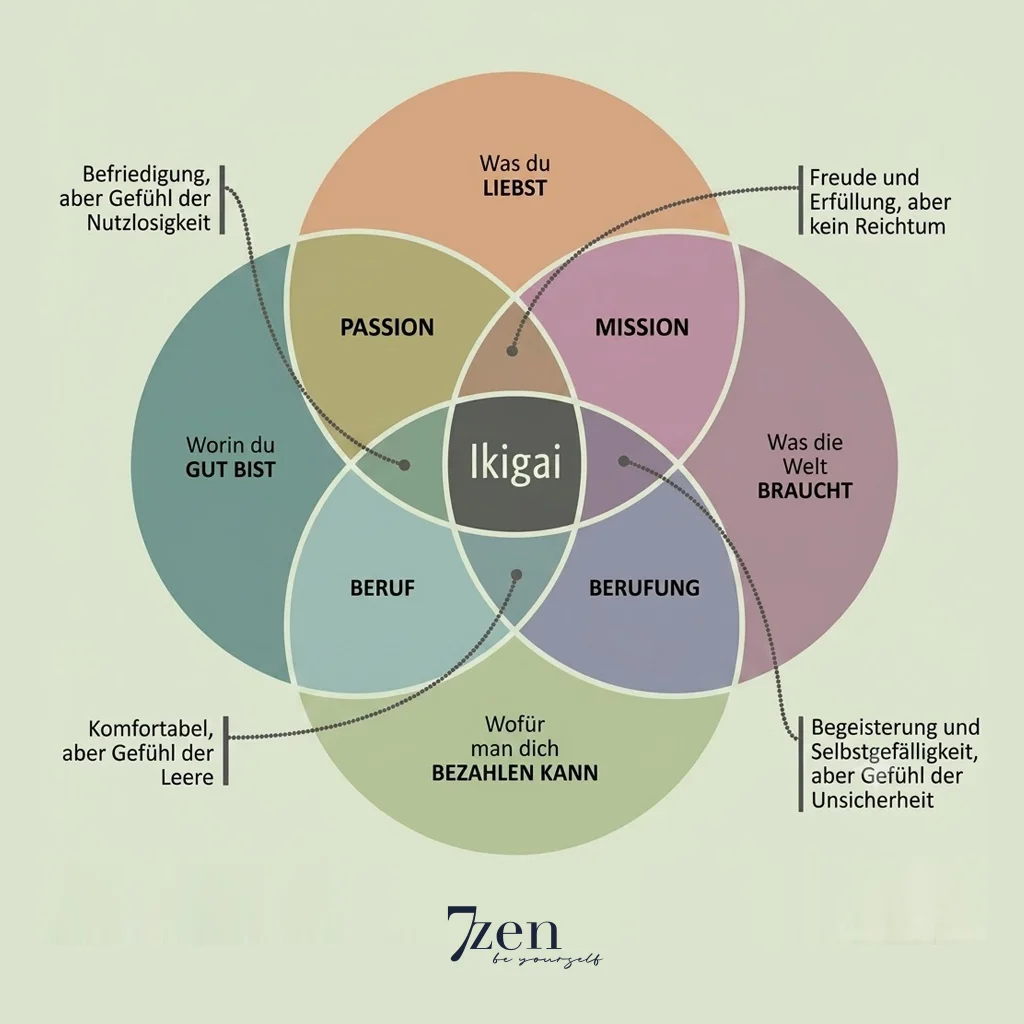
Perhaps you’ve seen it too: a diagram with four overlapping circles, labeled with terms like passion, mission, calling, and career. In the center, where all the circles meet, is one word: ikigai. The image has been circulating on social media for years, appears in self-help books, and is presented in workshops—as the Japanese key to a fulfilling life. But this is where a remarkable misunderstanding begins. Because this diagram is not Japanese wisdom. It is a Western invention—and the original concept of ikigai-2" class="glossary-link">ikigai-2" class="glossary-link">ikigai-2" class="glossary-link">ikigai means something fundamentally different, something deeply human and at the same time much more modest. This article aims to honestly clarify what ikigai really is, where it comes from, what it is not—and what it might cautiously offer to the Western view of meaning and life.
The Misconception: Ikigai and the Venn Diagram
In 2014, British entrepreneur Marc Winn published a blog post in which he linked two different concepts: a diagram by Spanish author Andrés Zuzunaga on “purpose” (meaning of life) and the Japanese term ikigai. Winn simply replaced the word “Purpose” at the center of the Venn diagram with “ikigai-2" class="glossary-link">ikigai-2" class="glossary-link">ikigai-2" class="glossary-link">Ikigai”—and a viral myth was born.
The result was memorable, aesthetically pleasing, and promised clear guidance: Find out what you love, what the world needs, what you can get paid for, and what you’re good at—and where these overlap lies your ikigai. The problem: This description does not correspond to what “ikigai” means in Japanese culture. It is a Western reinterpretation that has gained the appearance of authenticity through constant repetition.
This is not a criticism of Marc Winn or the many people who have spread this model—the idea behind it is certainly valuable. But it’s worth honestly clarifying what the original concept means before appropriating it. Because true ikigai is richer, more serene, and more human than any career diagram.
Ikigai: What the Japanese Term Really Means
The Japanese word "ikigai" is composed of "iki" (生き, life, to be alive) and "gai" (甲斐, value, dignity, meaning). Together, it could be translated as: the value of life, or, more loosely: a reason to get up in the morning.
The first systematic exploration of this concept comes from the Japanese psychiatrist and author Kamiya Mieko. In her 1966 work *ikigai-2" class="glossary-link">ikigai-2" class="glossary-link">ikigai-2" class="glossary-link">Ikigai ni tsuite* (roughly: “On Ikigai”), she examined what people—including those with serious illnesses—experienced as giving their lives meaning. Kamiya’s analysis was profound and multifaceted: she described ikigai not as a single, grand purpose in life, but as a quality of experience that can arise from many small, everyday moments—something that makes life seem worth living.
In everyday Japanese life, ikigai can be very concrete and modest: morning coffee, the garden, the grandchildren, a conversation with an old friend, working on a craft project. It doesn’t have to be a grand life’s work. Some people experience ikigai precisely in these unassuming things—and, from a cultural perspective, that is indeed the essence of the concept.
Okinawa, Ogimi, and Longevity: What Research Suggests
ikigai-2" class="glossary-link">ikigai-2" class="glossary-link">ikigai-2" class="glossary-link">Ikigai has also received special attention in the West due to observations regarding the exceptional life expectancy on the Japanese island of Okinawa. As part of his Blue Zones project, journalist and author Dan Buettner coined the term “Blue Zones”—regions of the world where people live exceptionally long and healthy lives. Okinawa, particularly the village of Ogimi, is one of these regions.
Buettner and his team observed that residents of this area were often able to answer the question about their ikigai—and that this sense of purpose and belonging might contribute to their quality of life. Research suggests that the feeling of being needed and making a contribution may be linked to mental well-being. However, it is difficult to scientifically prove a direct causal relationship—these are observations, not controlled experiments.
What these observations do suggest, however, is that the small, concrete reasons for getting up in the morning might play an underestimated role in well-being—not as a magic formula, but as the quiet foundation of everyday life. Incidentally, this corresponds much more closely to the original Japanese understanding than to the Western Venn diagram.
The popularization of the term in the West—particularly through the 2016 book *Ikigai: The Japanese Secret to a Long and Happy Life* by Héctor García and Francesc Miralles—has helped make the concept accessible to a broad audience. At the same time, as is so often the case with cultural translations, some elements were simplified and others were added that were not present in the original.
Mieko Kamiya, *On Ikigai* (1966) Kamiya Mieko described ikigai not as a single, overarching purpose in life, but as a quality of experience: the sense that life is worth living—nourished by many small, everyday sources of joy and meaning. This humility is perhaps the most profound aspect of the original concept.
Putting the 4-Circle Model into Perspective: A Useful Tool, but Not a Japanese Original
It would be unfair to simply dismiss the Venn diagram model as a mistake. As a Western tool for self-reflection, it certainly has value: It encourages people to think about their own lives—about their skills, values, contributions, and livelihood. These questions are by no means unimportant. Many people report that this model has helped them gain clarity about their career path or question old ways of thinking.
But there is one crucial difference: The 4-circle model primarily asks about one’s overarching life purpose—a kind of destiny that one must find and then live out. The original Japanese ikigai, on the other hand, asks: What makes this morning, this day, this moment worth living? One question directs our gaze forward and upward; the other directs it inward and toward the present moment.
For some people, the pursuit of “that one great purpose” can even be unsettling—especially when their own life doesn’t currently seem to be on a grand mission. The Japanese perspective could be a source of relief here: it allows us to find meaning even in small things, without having to demonstrate a groundbreaking life’s mission.
Anyone who wants to use the 4-Circle Model as food for thought is welcome to do so—but perhaps with the understanding that it is a Western distillation, not an original recipe from Japan.
Ikigai, Meaning of Life, and Purpose: Subtle but Important Differences
In Western discourse on personal development, we encounter many related terms: meaning of life, purpose, calling, fulfillment. It’s worth pausing briefly to ask how ikigai relates to these concepts—because the differences are subtle but significant.
Meaning of life in the psychological sense—much as Viktor Frankl described it in his logotherapy—refers to the overarching feeling that one’s own existence has meaning. This is an existential category that is relevant across cultures. ikigai-2" class="glossary-link">ikigai-2" class="glossary-link">ikigai-2" class="glossary-link">Ikigai touches on this level but remains more down-to-earth: it is less philosophical than concrete, less abstract than tangible.
“Purpose” is a term primarily used in the English-speaking world, often associated with professional fulfillment and social contribution. The 4-Circle Model, which is mistakenly circulated as ikigai, is actually a “purpose” model—which explains why it has fit so well into Western debates on careers and self-actualization.
“Berufung,” on the other hand, often carries a religious or at least solemn connotation in German-speaking contexts—something to which one is called, from outside or from above. Ikigai lacks this weight. It is not a calling, but a quiet inner “yes” to the present moment.
What may distinguish ikigai from the Western discourse on the meaning of life is this: it does not have to be worked out or discovered like a hidden truth. It might already be there—in your morning tea, in the hand of an elderly person, in the sound of familiar music.

What Science Suggests About Experiencing Meaning in Everyday Life
Even though “ikigai” class="glossary-link">ikigai-2" class="glossary-link">ikigai-2" class="glossary-link">ikigai-2" class="glossary-link">ikigai as such is still a relatively new topic in Western research, there are related scientific findings that may give us pause for thought.
Research in the field of positive psychology—such as the work of Martin Seligman and his colleagues—suggests that the subjective experience of meaning and connectedness may be linked to well-being and resilience. Research suggests that people who regularly engage in activities they perceive as meaningful are more likely to report feeling alive and connected—regardless of whether these activities are large or small.
A study from Japan, published by Tanno and colleagues (2009) in the Journal of Epidemiology, examined associations between the self-reported experience of ikigai and various health measures. The results suggested that people who reported having an ikigai tended to have lower mortality rates. Here, too, it’s important to note that such observational studies show correlations, not causes—and they are no substitute for medical or psychological counseling. But they invite us to take the question seriously: What gives my everyday life meaning?
What research on a sense of meaning might suggest overall is this: It doesn’t have to be big projects. Even regularly experiencing small moments of significance—whether in a relationship, an activity, or a habit—can potentially help nurture one’s well-being.
Ikigai in Everyday Life: What the Concept Could Gently Offer the West
It would be tempting to market ikigai as a solution—as a secret formula for a fulfilling life. But that would be dishonest to the concept. What ikigai-2" class="glossary-link">ikigai-2" class="glossary-link">ikigai-2" class="glossary-link">ikigai could offer the Western perspective is more modest—and perhaps all the more valuable for that very reason.
First: the permission to seek meaning in the small things. In a culture that often asks about life’s grand purpose, one’s personal brand, or the next career move, ikigai could be a quiet counter-movement. It reminds us that life consists of many small moments—and that these moments matter.
Second: a different attitude toward time. Ikigai is not a project to be completed. It is more of a question one could ask oneself anew each day: What makes this morning worth living? What do I want to experience, create, or pass on today?
Third: community as a source of meaning. In Japanese cultural understanding, ikigai is often embedded in relationships and social roles—being there for one another, being part of a community. This is an aspect that sometimes takes a back seat in Western discourse on self-actualization.
Anyone who wants to explore more deeply how these ideas might feel in concrete terms in everyday life will find further insights in the article “Ikigai in Everyday Life”—which focuses less on theory and more on lived experience.
What Ikigai Is Not—and Why That Might Be Liberating
Sometimes it’s just as important to know what a concept doesn’t mean. After all, misunderstandings can create pressure where there should actually be ease.
ikigai-meaning" class="glossary-link">ikigai-2" class="glossary-link">ikigai-2" class="glossary-link">ikigai-2" class="glossary-link">Ikigai is not a promise of happiness. There is no Japanese tradition that states that finding ikigai guarantees a permanently happy life. Kamiya Mieko herself worked with seriously ill people—people who, facing difficult circumstances, were searching for meaning in their lives. Ikigai does not arise in spite of difficulties, but it can potentially shine through them.
Ikigai is not a career goal. As we have seen, the link to work and career is a Western addition. In the original Japanese understanding, ikigai can be completely separate from one’s profession and income. A retiree who tends to his garden in the morning can experience a deep sense of ikigai—without any business plan at all.
Ikigai is not a technique. There is no step-by-step guide that reliably leads to ikigai. It is more a direction of focus—inward, toward the present moment, toward what is already there—than a destination to be reached.
This sense of relief could be particularly helpful for people who feel pressured to live the “right” life or who feel they haven’t yet found their calling. The Japanese concept of ikigai whispers: First, take a look at what’s already there today.
An honest conclusion: Ikigai as an invitation, not a recipe
ikigai-meaning" class="glossary-link">ikigai-2" class="glossary-link">ikigai-2" class="glossary-link">ikigai-2" class="glossary-link">Ikigai is a concept that carries much more meaning than the viral diagram suggests. Its roots lie in a humble, profound question: What makes life worth living—today, in this moment, with what is available?
The answer to that could be grand. But it could also be very small. And that is perhaps the most beautiful thing about this concept: it allows for both.
The 4-Circle Model is a useful Western tool that has its own value—but marketing it as “the Japanese ikigai” does the original a disservice. What we gain when we consider the concept in its original form is something quieter and more enduring: the opportunity not to search for meaning as if it were a lost key, but to perceive it—perhaps right where we are standing right now.
Perhaps today, without any pressure, you might ask yourself a single question: What is my reason for getting out of bed this morning? The goal isn’t the perfect answer—it’s the mindfulness with which you ask the question.
Exploring Your Sources of Meaning: The Workbook
The 7zen Workbook gives you the space to explore your small and big ikigai moments through honest reflective questions.
Your daily companion for personal growth
With the 7zen app, you'll receive daily coaching tips, guided breathing exercises, and personal reflections—all based on your individual profile.
What does "ikigai" mean in German?
The Japanese word "ikigai" is composed of "iki" (life, being alive) and "gai" (value, meaning, dignity). Literally, it could be translated as “the value of life” or, more loosely, as “a reason to get up in the morning.” In everyday Japanese life, it refers to the experience of knowing that one’s own life is meaningful—drawn from small, concrete sources of joy and a sense of belonging.
Is the 4-circle Venn diagram really not a Japanese concept?
No, at least not in its popular form. The Venn diagram with the four circles (passion, mission, calling, career) was developed by the Spanish author Andrés Zuzunaga and was linked to the term “ikigai” by the British blogger Marc Winn in 2014. This combination has spread rapidly, but it does not correspond to the original Japanese understanding of ikigai, which relates far less to career and profession.
Where does the term "ikigai" come from?
One of the first systematic explorations of the concept comes from the Japanese psychiatrist Kamiya Mieko, who published the book “Ikigai ni tsuite” (On Ikigai) in 1966. In it, she explored what people—even under difficult circumstances—experience as giving their lives meaning. However, ikigai as a term used in everyday life is deeply rooted in Japanese culture and cannot be traced back to a single source.
What does ikigai have to do with Okinawa and the Blue Zones?
As part of his Blue Zones project, journalist Dan Buettner observed that residents of Okinawa—a region with above-average life expectancy—often reported having an ikigai. Research suggests that a sense of purpose and social connectedness may be linked to well-being. However, a direct cause-and-effect relationship cannot be inferred from these observations.
Can ikigai help with choosing a career?
The 4-Circle Model, popularized by Marc Winn, can certainly be a useful Western tool for reflection when considering career decisions. However, it is important to note that this does not reflect the original Japanese concept of ikigai. The original concept is much less focused on work and career and refers instead to the everyday experience of meaning—regardless of how one earns a living.
Do I have to actively search for my ikigai?
In Japanese cultural understanding, ikigai is less something you seek and find, and more something you recognize and nurture. It might lie in things that are already part of everyday life—in relationships, habits, and small pleasures. Instead of embarking on a grand quest, it might help to focus your attention on what’s already there and feels meaningful. This is, by nature, a very personal process for which there is no universal roadmap.