Ikigai
Ikigai is a Japanese concept that explores one’s personal purpose in life and the reason for getting up in the morning. It describes the intersection of what you love, what you’re good at, what the world needs, and what you can do to make a living. Finding one’s own ikigai is often described as a path to deeper fulfillment and inner balance.
What is Ikigai?
Ikigai (生き甲斐) is a Japanese term that can be roughly translated as “reason for living” or “what makes it worth getting up in the morning.” It is composed of iki (life) and gai (value, purpose). In Japanese culture, ikigai is not understood as a grand, singular life goal, but rather as something that can manifest in small, everyday moments—in a conversation with a loved one, in work that brings joy, or in a hobby that invites a sense of calm.
The Four-Circle Model
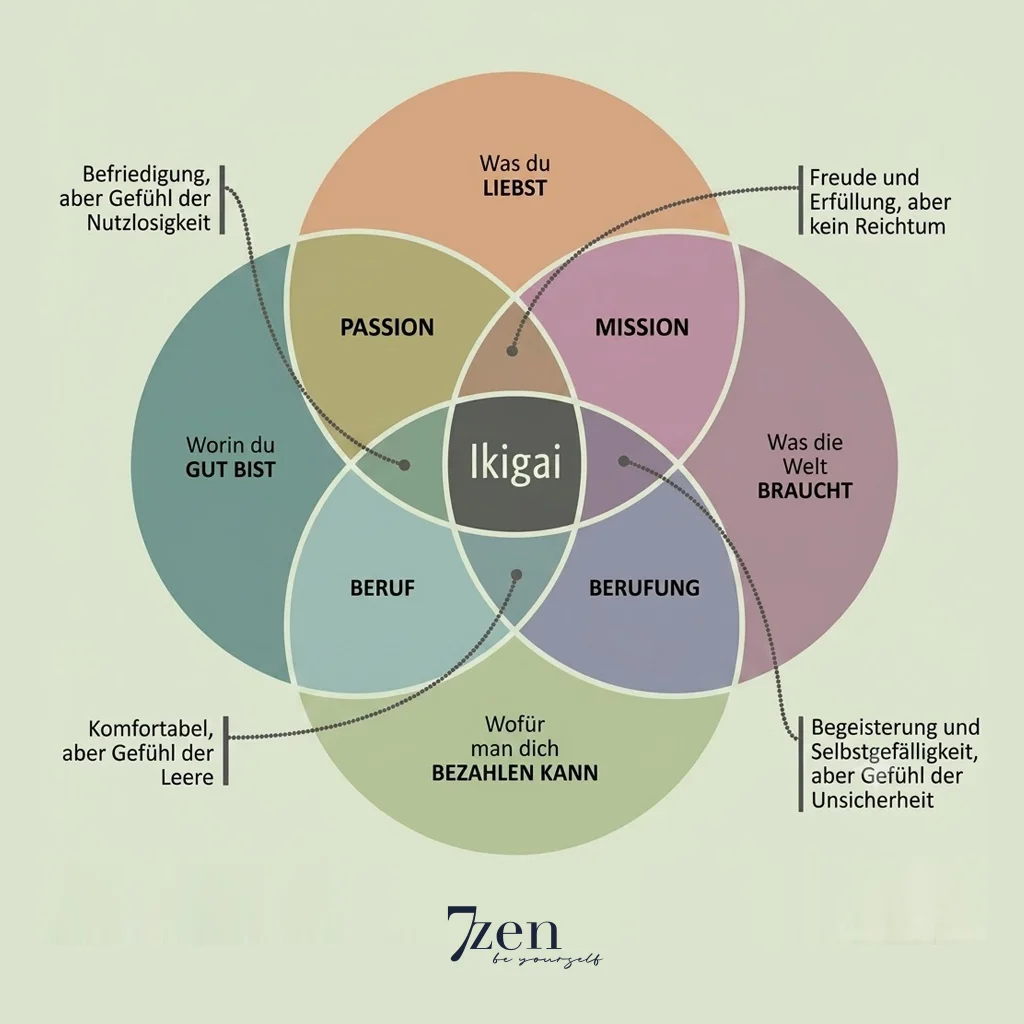
In the Western world, ikigai became widely known primarily through a diagram showing four overlapping circles. Anyone who wants to find their ikigai can ask themselves four questions:
- What do I love? – Activities that bring intrinsic joy
- What am I good at? – Skills and strengths that come easily to you
- What does the world need? – Contributions that extend beyond the self
- How can I make a living? – Economic reality and sustainability
The intersection of all these areas is considered one’s personal ikigai. Research suggests that a sense of purpose in life may be linked to greater well-being and greater inner resilience—similar findings are also supported by Lyubomirsky’s research on habits of happiness.
Discovering Ikigai in Everyday Life
The model doesn’t encourage you to turn everything upside down right away, but rather to observe with curiosity at first: When does time feel effortless? What would you do even without recognition? Those who explore their ikigai may also discover which inner patterns have prevented them from answering these questions honestly—in this context, engaging with the “inner adult” can be a helpful complement. Ikigai is not a destination but a living process.
Does my ikigai have to be related to my career?
Not necessarily. In its original Japanese meaning, ikigai can also be found in relationships, hobbies, or daily rituals. While the Western “Four Circles” model emphasizes the professional aspect, ikigai can also be experienced entirely outside of paid work.
How long does it take to find your ikigai?
There’s no one-size-fits-all answer. Some people sense it intuitively, while others explore it over the course of months or years. Ikigai is understood more as a practice than as a one-time discovery—something that can feel clearer and deeper over time.
Is ikigai the same thing as a life goal or a vision?
Not quite. A life goal is often future-oriented and measurable, whereas ikigai is more deeply rooted in the present experience. It’s less about achieving something and more about cultivating a state of inner harmony in the here and now.