5-minute morning meditation for more peace in everyday life
Start the day more calmly: a simple morning meditation with breathing exercises - no prior knowledge required, can be practiced immediately.
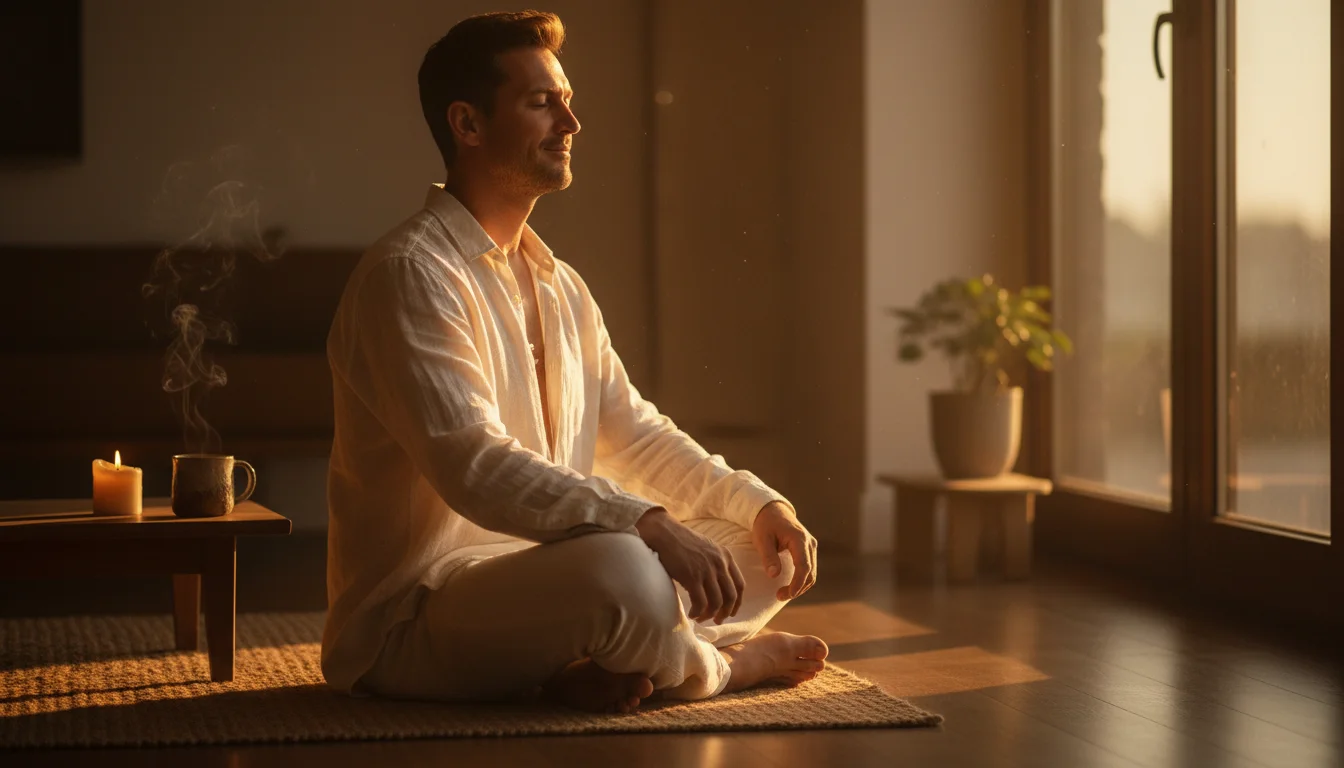
Do you know that feeling when the alarm goes off and, in the very next moment, you feel the day bearing down on you with full force? Thoughts, to-do lists, expectations—all at once, before you’ve even had a sip of water. It is precisely in this moment that a quiet opportunity lies hidden: morning meditation. Not as a complicated ritual, not as an hour on a meditation cushion, but as five mindful minutes that can transform your entire day. In this article, we’ll show you why a short breathing exercise in the morning is so powerful, what happens in your nervous system during it—and how you can start right away, with absolutely no prior experience.
Why the Morning Is So Crucial to Your Well-Being
From a neurological perspective, the first few minutes after waking up are extraordinary. Your brain is in a state between sleep and full wakefulness—so-called theta waves still dominate. During this phase, your mind is particularly receptive and malleable. What you perceive during this time and how you behave sets the emotional and mental tone for the next few hours.
Many people immediately reach for their smartphones at this moment. News, social media, emails—all of this activates the stress response even before the body has fully woken up. The result: a persistently elevated cortisol level that carries through the entire day and, in the long term, leads to exhaustion, irritability, and a vague feeling of being overwhelmed.
Conscious morning meditation addresses this specifically. It gives you the opportunity to set the tone for the day yourself—calm, grounded, and centered.
What Morning Meditation Does to Your Nervous System
There’s no magic behind the soothing feeling you get after meditation—it’s all biology. When you breathe consciously and slowly, you activate the parasympathetic nervous system—the part of your autonomic nervous system responsible for rest, recovery, and inner calm. It’s the natural counterbalance to the sympathetic nervous system, which triggers the familiar “fight-or-flight” response in stressful situations.
Through a targeted breathing exercise in the morning, you signal to your nervous system: It’s safe. There’s no need to rush. This message has been proven to lower your heart rate, relax your muscles, and reduce the release of stress hormones. At the same time, serotonin production increases—the neurotransmitter associated with well-being and emotional stability.
The best part: These effects don’t take weeks to kick in. Even after just one session, measurable physical changes occur. And with regular practice, the nervous system becomes permanently more resilient to stress—a process experts describe as stress reduction through neuroplasticity.
Three Common Misconceptions About Meditation
Before we get to the actual instructions, we’d like to briefly clear up three common misconceptions that prevent many people from even getting started.
“I have to think of nothing”
This is the most persistent misconception. Meditation does not mean emptying the mind. Thoughts will arise—that is normal and even desirable. The core of the practice lies not in suppression, but in observation: You notice that a thought has arisen and gently return to your breath. This back-and-forth is the actual practice.
“I need a lot of time”
Five minutes are more than enough to achieve measurable effects. Quality beats quantity—especially in the morning, when time is already tight. A short, regular practice is always more valuable than an occasional, hours-long session.
“I’m not the type for that”
Meditation isn’t a matter of personality. It’s a skill that anyone can learn—just like riding a bike or cooking. The only difference: You don’t even need any special equipment. Just yourself and your breath.
Mindfulness wisdom "You don't have to calm the storm. Calm yourself - the storm will pass."
Step-by-Step Morning Meditation: The 5-Minute Breathing Exercise
These instructions are designed so that you can do them right after waking up—in bed, on a chair, or on a cushion on the floor. There’s no right or wrong position, as long as you’re comfortable and sitting upright enough to stay awake.
Preparation (30 seconds)
Sit upright or lean back slightly. Rest your hands loosely on your thighs. Close your eyes or gently focus your gaze on a point in front of you. Take a deep breath in through your nose and a long breath out through your mouth. This signals to your body: We are beginning a mindful practice.
Phase 1 – Settling In (1 minute)
Now breathe naturally and without controlling it. Simply observe how your breath flows. How does it feel? Is it shallow or deep, calm or somewhat hurried? Don’t judge anything—just watch. If thoughts arise, that’s perfectly fine. Notice them like passing clouds and gently return to observing your breath.
Phase 2 – The 4-6 Technique (2 minutes)
Now you’ll introduce the actual breathing exercise: the so-called 4-6 technique. Inhale through your nose for four seconds—calmly, evenly, without tension. Then exhale through your mouth or nose for six seconds. The extended exhalation is crucial: it directly activates the parasympathetic nervous system and dissipates the body’s stress response. Repeat this cycle for about two minutes, which is roughly ten to twelve breaths. If you notice your thoughts wandering, that’s not a mistake—simply return to counting.
Phase 3 – Setting an Intention (1 minute)
Now breathe freely and naturally again. Ask yourself a single question internally: “How do I want to feel today?” No pressure, no perfect answer needed. Perhaps a word comes to mind: calm, present, courageous, friendly. Let this word linger briefly in your awareness without holding onto it.
Conclusion (30 seconds)
Take a deep, conscious breath in, and as you exhale, slowly open your eyes. Stretch briefly if you like. You have arrived—within yourself and in the day.


Reducing Stress Through Consistency: How to Establish a Morning Routine
A one-time morning meditation is wonderful. A daily practice is transformative. The key difference lies not in duration or intensity, but in consistency. Your nervous system learns through repetition. The more often you signal calm to your body in the morning, the faster and deeper it can slip into this state.
Psychologically speaking, it’s helpful to link the new habit to an existing one—a principle known as habit stacking. This means: Pair meditation with something you already do every day. For example:
- Right after waking up, before you even get out of bed
- While your morning coffee is brewing or cooling
- Immediately after brushing your teeth, before you go into the kitchen
Choose the moment that feels most natural to you. It’s not about creating a perfect routine—it’s about building a small, reliable anchor into your morning.
It’s also important to be gentle with yourself. There will be days when it doesn’t work out. That’s not a failure; that’s life. What matters isn’t the interruption, but the return.
Variations for Different Needs
The 5-Minute Morning Meditation is a starting point, not a rigid program. Depending on how you feel on any given morning, you can easily adapt it.
If you’re feeling particularly exhausted
Skip the counting technique and simply stick to freely observing your breath in Phase 1. No counting, no controlling—just noticing. Even five minutes of mindful presence without a task can be deeply restorative.
If you’re feeling particularly tense
Extend the exhalation even further: inhale for four seconds and exhale for eight seconds. This technique—often called 4-8 breathing—activates the parasympathetic nervous system even more intensely and is especially helpful during moments of acute stress.
If you’re short on time
Even two minutes count. Sit down briefly, take three conscious deep breaths in and out, visualize your motto for the day, and stand up. Even this brief moment of mindfulness changes how you start your day.
If you want to deepen the exercise
Add a short body scan exercise after Phase 3: Let your attention wander from the top of your head to the soles of your feet and observe where you sense tension, warmth, or emptiness. Without judging, without changing—just be present in your own body.
Morning Meditation and Breathing Exercises: What the Research Shows
The beneficial effects of breathing exercises and meditation on human well-being are now one of the most extensively studied areas of health psychology. Time and again, similar results emerge: People who meditate regularly not only report greater subjective calm but also exhibit measurable physiological changes.
Among the best-documented effects of regular stress reduction through mindfulness practice are:
- A sustained reduction in blood cortisol levels
- Improved heart rate variability—an important marker of the nervous system’s stress resilience
- Increased attention and cognitive flexibility throughout the day
- Less emotional reactivity in stressful situations
- Better sleep quality—paradoxically, this is particularly enhanced by a morning practice
What makes these findings particularly valuable: All these effects do not take weeks of intensive training to manifest. Even short, regular practice sessions of five to ten minutes daily show measurable changes after two to four weeks. This makes morning meditation one of the most efficient tools of modern self-care.
Common Obstacles – and How to Overcome Them
Anyone trying to establish a new habit will inevitably face internal resistance. This isn’t a weakness—it’s simply how the brain works, as it seeks to conserve energy and stick to familiar paths. Here are the most common hurdles and how to gently navigate them.
“I keep falling asleep”
If you’re doing the exercise while lying down, this is very likely to happen. Try to at least sit up—on the edge of the bed, on a chair, or on the floor. The upright posture sends a signal to your nervous system to stay awake and present.
“I just forget”
Place a small symbol on your nightstand: a stone, a bracelet, a card. This visual reminder can be surprisingly effective. Alternatively, a reminder on your phone can help—not as an obligation, but as a friendly invitation.
“It makes me feel uncomfortable or restless”
This is more common than many people think. If you’re suddenly confronted with intense thoughts or feelings while sitting in silence, it can feel uncomfortable at first. Start with shorter sessions of two to three minutes and gradually increase the duration. Silence isn’t the enemy—it just sometimes brings to the surface what remains hidden in the noise of everyday life.
“I don’t know if I’m doing it right”
You’re doing it right. When you breathe and are aware of your breath, you’re meditating. There’s no such thing as perfect meditation—only the one you’re actually doing.
Morning meditation as part of a holistic mindfulness practice
Those five minutes in the morning are a start—and sometimes a gateway to something greater. Many people who begin with a short daily practice notice after some time that their awareness in everyday life is changing. They respond more calmly in stressful moments. They notice sooner when they’re overloading themselves. They regain their composure more quickly when they’ve lost their way.
That is the true goal of mindfulness: not a perfect state of stillness, but a growing ability to be aware of oneself—and thus to remain capable of acting rather than merely reacting.
Morning meditation can be the first step. And sometimes the first step is the one that changes everything.
If you’d like, gradually supplement your practice with additional small moments of mindfulness throughout the day: a conscious break during lunch, three deep breaths before a difficult conversation, a brief pause in the evening. All of this together doesn’t make for a perfect life—but a more mindful one.
When is the best time for a morning meditation?
The most effective time is directly after waking up, before you check your smartphone or start any other activities. At this moment, your brain is in a particularly receptive state and you can consciously shape the mood of the day. If this is not possible for practical reasons - for example because of children or a very early start to work - any other quiet moment in the morning is just as valuable.
Do I need special accessories for morning meditation?
No, not at all. You don't need a meditation cushion, a special mat, calm music or guided audio files. You already have everything you need: your breath, a few minutes of time and the willingness to pause. If aids such as music or a timer app are helpful for you, you are welcome to use them - but they are not a must.
What do I do if I fall asleep during the exercise?
Then you were obviously very tired - and that is important information about your body. Next time, try sitting upright instead of lying down. The upright posture signals alertness to the nervous system. If you regularly fall asleep, this could also be an indication that you generally need more sleep - this is also a form of self-awareness.
How long does it take until I feel the effect of the morning meditation?
Many people notice a slight change after the first exercise - a certain calmness, a clearer presence. More profound effects on stress levels and emotional resilience usually become apparent after two to four weeks of regular practice. Continuity is crucial: five minutes a day is more effective in the long term than occasional, longer sessions.
Can I also use the breathing exercise for acute stress during the day?
Absolutely. The 4-6 breathing technique is not limited to the morning - it works in any moment when you feel overwhelmed, tense or agitated. You can do it at your desk, in the car, in a queue or during a short break. The more familiar you become with the exercise through morning practice, the quicker you can fall back on it in acute stress situations.
Is morning meditation also suitable for people who have never meditated before?
Yes, and particularly well. The exercise described in this article has been deliberately designed to be immediately applicable without any previous experience. There are no difficult techniques, no spiritual concepts you need to know and no expectation of a particular experience. All you do is breathe and perceive. Anyone can do this - right from the start.
Five minutes. That’s all. Five minutes during which you aren’t just going through the motions, aren’t producing, aren’t available—but are simply present. With your breath. With yourself.
At 7zen, we believe that mindfulness isn’t a luxury you have to earn. It’s a basic need you can give yourself every day—in small, genuine moments like this. Morning meditation isn’t the solution to all of life’s challenges. But it is a reliable anchor. A daily reminder that you matter to yourself.
Start today. Not tomorrow, not when you have more time, or when daily life calms down. Set your alarm five minutes earlier tomorrow morning—and use those five minutes for yourself. Breathe in. Breathe out. Be present.
Your action step for today: Set a reminder on your nightstand or in your phone tonight—for tomorrow morning, five minutes after waking up. Use the instructions from this article. You need nothing more than yourself and your breath. We’re curious to see how your morning feels.