Learning self-love: what psychology really means by it
Self-love is not a trend, but a psychological foundation. What research really means by it - and how you can develop it.

Self-love—few terms appear more frequently in today’s self-help literature. On social media platforms, it’s often associated with bubble baths, expensive creams, and inspirational quotes. But what does psychology really mean by self-love? And above all: How can you learn self-love if it doesn’t feel like a personality trait that you either have or don’t? This article clears up common misconceptions, explains the scientific basis behind the term, and shows you concrete ways to build a genuine, lasting relationship with yourself—without esotericism and without unrealistic promises.
Self-Love and Narcissism: An Important Difference
Many people hesitate when they hear the word self-love. An inner voice whispers: Isn’t that self-obsessed? Selfish? Arrogant? This misunderstanding is widespread—and psychologically easy to explain. For there is indeed a fundamental difference between healthy self-love and narcissistic self-absorption.
Narcissism, as described in clinical psychology, is characterized by an excessive need for admiration, a lack of empathy, and a fragile self-image. Narcissistic individuals need constant external validation because their inner world lacks a stable foundation. Healthy self-love, on the other hand, is inwardly directed: it means treating oneself with kindness, acknowledging one’s own boundaries, and feeling valuable regardless of external praise. It is this inner stability that distinguishes genuine self-love from narcissism—and makes it the foundation for deep, authentic relationships.

What self-love means psychologically: The concept of self-compassion
One of the most important scientific foundations for what we now call self-love was provided by psychologist Kristin Neff with her development of the Self-Compassion Scale. As Neff (2003) demonstrated, self-compassion—that is, treating oneself with compassion—can be broken down into three core components: self-kindness (rather than self-criticism), a sense of shared humanity (rather than isolation), and mindful awareness (rather than over-identification with negative feelings).
Neff deliberately distinguishes self-compassion from self-esteem: While self-esteem is often tied to performance or social comparison, self-compassion remains stable—even when we fail, make mistakes, or feel weak. It is precisely this distinction that is crucial if we want to learn self-love: It is not about always feeling good, but about treating ourselves with warmth even in difficult moments.
Carl Rogers and Unconditional Positive Regard
Long before self-love became an Instagram hashtag, human psychologist Carl Rogers explored the question of what conditions a person needs to develop healthily. In his groundbreaking work *On Becoming a Person*, Rogers (1961) formulated the concept of unconditional positive regard—originally as the therapist’s attitude toward the client.
The core idea: People grow and thrive when they feel accepted regardless of their mistakes, their achievements, or their feelings. Rogers saw this principle not only as a therapeutic tool but as a fundamental human need. Applied to self-love, this means: We must learn to give ourselves this unconditional regard—to accept ourselves as we are, without first having to achieve, prove, or change anything.
That is easier said than done. Many of us have internalized voices from childhood that conveyed exactly the opposite: love was only given in exchange for good grades, good behavior, or emotional conformity. Recognizing and dissolving these conditional messages is a crucial step on the path to genuine self-acceptance.
Scientific core: Self-compassion according to Neff (2003) Self-compassion is not weakness or self-pity. It is the ability to treat yourself as you would treat a good friend in a difficult situation - with warmth, understanding and without judgment. As Neff (2003) empirically demonstrated, this attitude is closely linked to mental health, resilience and less anxiety and depression.
Measuring Self-Esteem: What the Rosenberg Scale Teaches Us
Anyone wondering about their self-esteem will quickly come across the Rosenberg Self-Esteem Scale in psychology, one of the most widely used questionnaires in personality research. Developed by Morris Rosenberg in the 1960s, the scale uses ten simple statements to assess how positively or negatively someone views themselves.
What decades of research using this tool have demonstrated is revealing: stable self-esteem does not depend on external circumstances—neither on professional status, attractiveness, nor social recognition. People with high, stable self-esteem demonstrate greater psychological resilience, better relationship quality, and higher life satisfaction. Conversely, low self-esteem is associated with an increased risk of depression, anxiety disorders, and social isolation.
What is interesting here is what research does not confirm: Positive thinking alone or reciting affirmations does little to boost self-esteem—especially when the inner critic is strong. What helps are deeper processes: recognizing and questioning negative beliefs about oneself, experiencing competence and self-efficacy, and the quality of our inner self-talk.
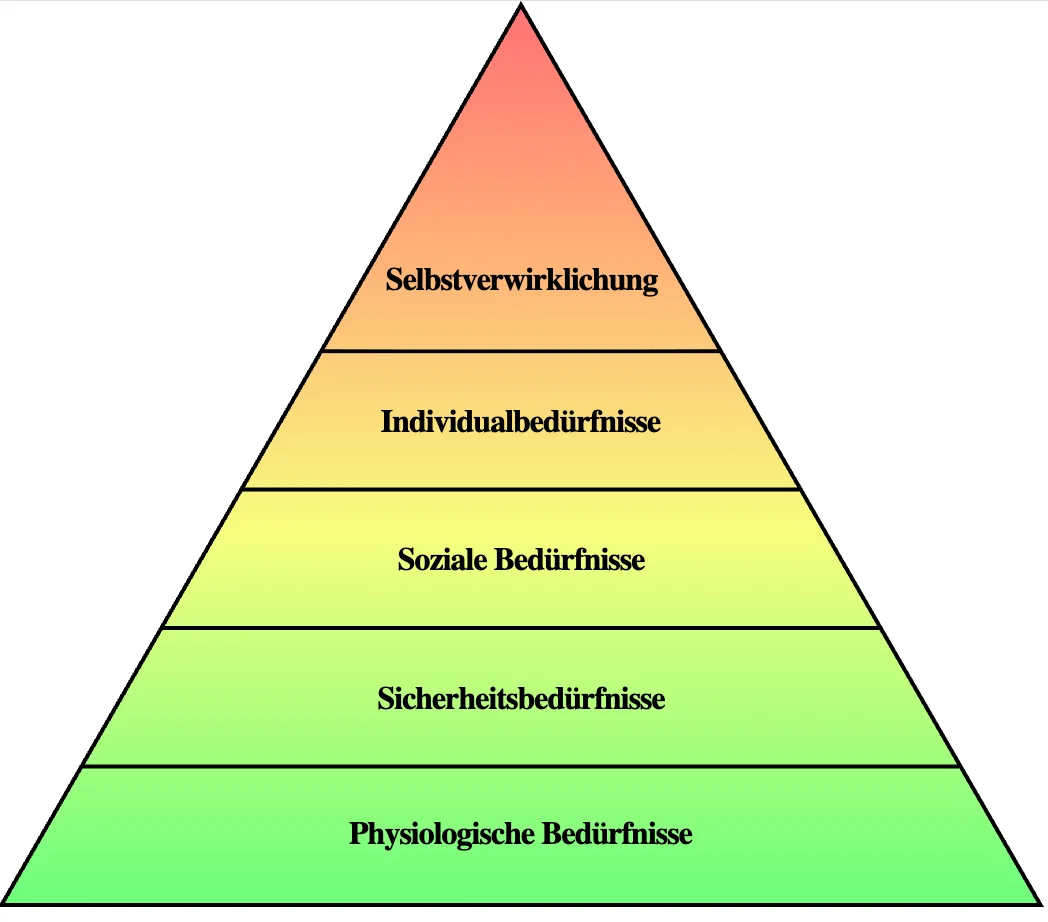
Self-Love in Maslow's Hierarchy of Needs: More Than Just a Luxury
In his Hierarchy of Needs, Abraham Maslow described various levels of human motivation—ranging from basic physiological needs to self-actualization. At the level of esteem needs, Maslow distinguishes between two directions: recognition by others and self-esteem—that is, what we would today call self-worth or self-love.
For Maslow, this sense of self-worth was not a crowning achievement reserved for the few, but a fundamental human need. According to his theory, people who cannot value themselves have difficulty truly reaching the highest level—self-actualization. Self-love is therefore neither a luxury nor a selfish indulgence, but a psychological prerequisite for realizing one’s own potential and leading a meaningful life.
Why Learning Self-Love Is So Hard: The Role of Early Attachment
If self-love is so important—why is it so difficult for so many people? The answer often lies in our developmental history. For decades, attachment research has shown that early relationship experiences with caregivers shape an internal working model—a kind of invisible map that tells us: Am I lovable? Can I rely on others? Am I fundamentally good enough?
Children who grow up in an environment where love is conditional—on performance, conformity, or emotional restraint—often develop a fragile self-image. They learn: I have to do something to be lovable. These deeply ingrained beliefs don’t simply disappear in adulthood. They surface when we excessively berate ourselves for a mistake, when we can’t accept compliments, or when we constantly compare ourselves to others and always come up short.
The good news: neuroplasticity—the brain’s ability to change through new experiences—makes it possible to overwrite these old patterns. Learning self-love is therefore not wishful thinking, but a neurobiologically grounded process that requires time, awareness, and practice.
Self-acceptance as the first step: Accepting things as they are
Self-love is often confused with self-improvement: We think we love ourselves only when we’re finally slimmer, more successful, or more at ease. But that’s a fallacy that keeps us stuck in an endless loop. Self-acceptance—the crucial first step—means accepting yourself exactly as you are right now: with your strengths, your weaknesses, your contradictions, and your unresolved issues.
This does not mean cultivating passivity or rejecting change. On the contrary: Paradoxically, clinical experience shows that genuine change only becomes possible when we stop fighting against ourselves. This so-called paradoxical theory of change, formulated by Gestalt psychologist Arnold Beisser, states: Change does not arise from trying to become someone else, but from sinking deeper into who you already are.
Self-acceptance, then, means: I see myself—including the parts I find unpleasant—and I do not reject myself because of them. This is not surrender. It is the foundation for genuine growth.
Learning Self-Love: Practical Psychological Approaches
What does learning self-love mean in practice? Psychological research and clinical experience offer several well-established approaches:
- Self-compassion exercises according to Neff: Neff (2003) developed structured exercises that help identify the inner critic and replace it with a kinder inner voice. A classic technique is the so-called self-compassion letter: In a difficult situation, you write to yourself just as you would write to a good friend—warmly, understandingly, and without judgment.
- Cognitive restructuring: This technique, derived from cognitive behavioral therapy, involves identifying automatic negative thoughts about oneself and critically questioning them. Is that really true? Would I think that about another person? What evidence contradicts that?
- Mindfulness-based practice: Mindfulness—the non-judgmental awareness of the present moment—helps you step out of the stream of negative self-evaluations. Studies show that regular mindfulness practice demonstrably increases self-compassion.
- Setting boundaries as an act of self-love: Those who value themselves also protect their own time, energy, and emotional well-being. Setting clear boundaries is not an expression of coldness, but a form of self-respect in action.
- Psychotherapy: Especially in cases of deeply ingrained negative self-images, professional support—such as depth psychology-based therapy, schema therapy, or humanistic approaches—can make a decisive difference.
The Role of Inner Speech: How We Talk to Ourselves
An often underestimated aspect of self-love is what is known as inner speech—the constant internal dialogue that accompanies us throughout the day. Research shows that people have an average of between 6,000 and 60,000 thoughts per day—and a significant portion of these are self-focused. For people with low self-esteem, these thoughts are often negative, judgmental, and generalizing: I’m so stupid. I’ll never manage this. Everyone else is better than me.
What helps is not the forced replacement of these thoughts with fake positivity—as mentioned, that has little effect. Instead, a curious observer’s perspective is helpful: noticing the thought, naming it (There’s my inner critic again), and then consciously asking whether this thought is true, helpful, and fair.
In his research on self-distancing, psychologist Ethan Kross describes a particularly effective trick: In difficult moments, speak to yourself in the third person. So instead of “I’m a failure,” say, “Anna is having a tough day today. What would help her right now?” This small linguistic shift measurably reduces emotional stress and promotes more constructive thinking.
Self-Love and Relationships: The Connection Is Real
A common question is: Do I have to love myself first before I can love others? This statement—so often quoted—is an oversimplification. Psychologically speaking, it is more accurate to say that the way we treat ourselves profoundly shapes how we act in relationships.
People with low self-esteem tend to seek validation in relationships, avoid conflict, or develop emotional dependencies. They have difficulty setting boundaries or clearly communicating their needs—out of fear that they will no longer be liked. Rogers (1961) emphasized that genuine connection is only possible when two people are grounded in themselves—when neither person needs the other as a source of their self-worth.
Developing self-love, therefore, does not mean becoming self-sufficient or independent of others. It means giving and receiving from a place of inner abundance—not from a place of lack that needs to be filled by others. This is a profound difference that makes relationships healthier, more honest, and more fulfilling in the long run.
Your path to self-love
The Coaching Cards give you a loving impulse every day - small steps on the path to more self-love.
Your daily companion for inner growth
With the 7zen app, you receive daily coaching impulses, guided breathing exercises and personal reflections - all based on your individual profile.
Is self-love the same as selfishness?
No - that is one of the most common misunderstandings. Selfishness means putting your own needs at the expense of others. Healthy self-love, on the other hand, strengthens the ability to empathize and make genuine connections because you are no longer acting out of a lack. As Neff (2003) showed, self-compassion even correlates positively with prosocial behavior and empathy - the exact opposite of selfishness.
Can you really learn self-love, or are you born with it?
Self-love is not a fixed personality trait, but a skill that can be learned. The neuroplasticity of the brain makes it possible to change even deeply rooted negative beliefs about oneself through targeted practice and new experiences. It takes time, patience and often professional support - but it is possible to fundamentally improve your relationship with yourself.
What is the difference between self-love and self-esteem?
Self-esteem - measured by the Rosenberg Self-Esteem Scale, for example - describes how positively or negatively someone evaluates themselves. It is often linked to performance and social comparisons and can fluctuate. Self-love in the sense of self-compassion (according to Neff 2003) is more stable: it remains intact even if you fail or make mistakes - because it does not depend on success, but on a fundamental attitude towards yourself.
How do I realize that I have too little self-love?
Possible signs are: strong inner self-criticism, the inability to let go of mistakes, constant comparison with others, difficulties in setting boundaries, the feeling of never being good enough, or being dependent on external validation in order to feel valuable. These patterns are common and are no reason to condemn yourself - but they are a helpful reminder to take a closer look.
Do affirmations help to strengthen self-love?
Research shows a differentiated picture: affirmations can help if they are credible and specific. Very general statements such as "I love myself unconditionally" can even have the opposite effect on people with low self-esteem because they encounter inner resistance. It is more effective to link affirmations to concrete experiences or to supplement them with deeper self-reflection and self-compassion exercises.
When should I seek professional help?
If negative self-perception has a significant impact on daily life, leading to persistent sadness, social isolation or a feeling of worthlessness, professional support through psychotherapy is useful and important. Learning to love yourself is a process that sometimes requires professional guidance - and this is not a sign of weakness, but of self-responsibility.
Self-love is not a state that one achieves one day and then maintains forever. It is a practice—a decision renewed every day to treat oneself with kindness, honesty, and patience. As Rogers (1961) described, people do not need to be perfect to be lovable. And as Neff (2003) empirically demonstrated, treating yourself with compassion is one of the most effective foundations for mental health and a fulfilling life.
The first step doesn’t have to be a big one. Your action step for today: Write yourself a short letter—not as a critic, but as your best friend. Write about a situation in which you’re currently feeling bad or inadequate. What would you say to a loved one in this situation? With what warmth, what understanding? This one letter can be the beginning of a new inner relationship—one that supports you instead of weighing you down.