Mirror work: How to learn to love your reflection
Mirror work is more than just a self-help trend - studies show: Looking in the mirror can profoundly change your self-image.

Imagine stepping in front of the mirror in the morning—and instead of your usual critical gaze, you meet yourself with genuine kindness. No scolding, no sighing, no looking away. That is exactly what mirror work promises: a simple yet surprisingly effective practice that can transform the way you treat yourself from the ground up. What became known as a spiritual exercise decades ago is now gaining increasing recognition in psychological research. This article shows you why looking in the mirror is so much more than vanity—and how you can integrate the mirror exercise into your daily life, step by step.
What is Mirror Work—and where does it come from?
The term “mirror work” was largely coined by the American author and self-help pioneer Louise Hay. In her seminal 1984 work, Hay (1984) described a method in which one looks oneself in the eyes in the mirror and speaks positive, loving statements about oneself aloud—so-called affirmations. Hay’s basic premise was as simple as it was radical: The mirror is the most direct path to our subconscious. After all, who can look at themselves while lying?
What sounded to many at the time like self-reflection in a negative sense has since proven to be a psychologically sound concept. Mirror work is not a magic formula, but a structured practice based on the principle of conscious self-awareness. It challenges us to encounter ourselves directly—unvarnished, unmediated, and without distraction. And that is precisely where its power lies.
Today, mirror work is used in various contexts: from positive psychology to body-oriented therapeutic approaches and mindfulness-based programs. The method is accessible, free, and requires only a mirror—and the courage to truly look at oneself.
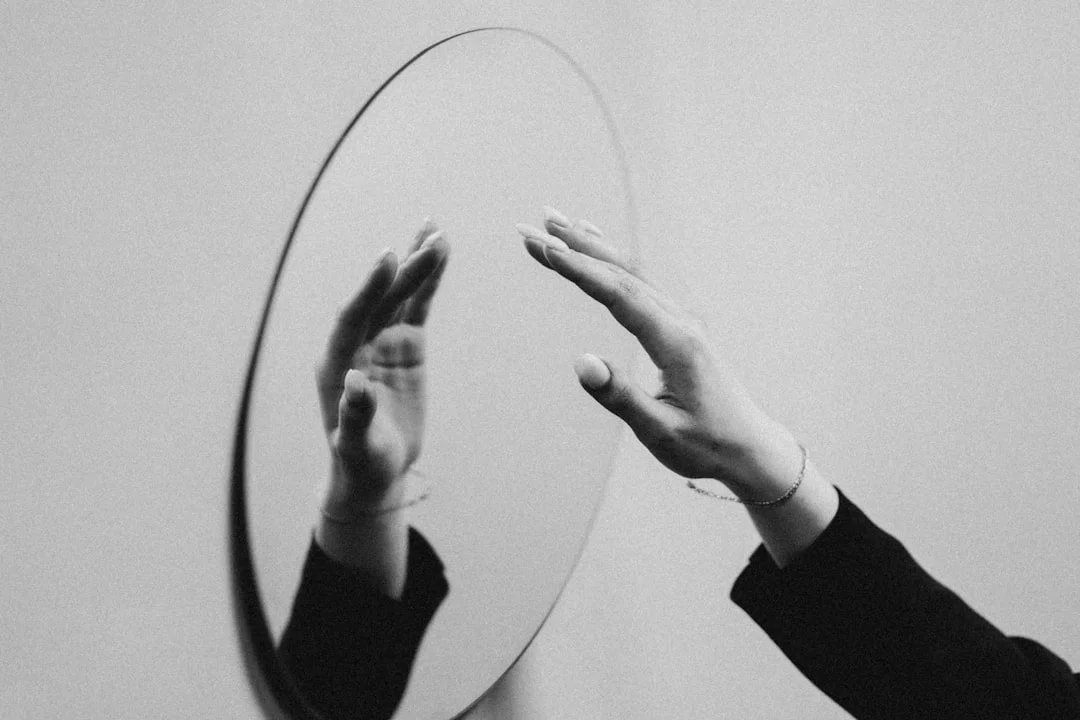
What happens in the brain when we look at ourselves in the mirror?
Before we get to the practical aspects, it’s worth taking a look behind the scenes—into the brain. Because what happens when we see our own reflection is neurologically fascinating. In his research on body image and self-perception (Tsakiris, 2008), neuroscientist Manos Tsakiris demonstrated that our brain does not store our body image rigidly, but rather continuously updates it based on incoming stimuli. This means: How we see ourselves is malleable.
Among other things, Tsakiris worked with the concept of the so-called rubber hand illusion, which demonstrates just how flexible our brain is when it comes to integrating objects into our own body schema. Applied to mirror work, this means: Regular, positive encounters with one’s own reflection can literally reprogram the neural body image—not through self-deception, but through repeated, conscious perception.
Particularly fascinating in this context is the so-called enfacement effect: Studies on social self-perception show that synchronous visual and tactile stimuli cause us to experience other people’s faces as part of our own self. When, on the other hand, we deliberately confront our own face—as in mirror work—this strengthens the coherent self-representation in the brain. In short: We learn to recognize and accept ourselves as who we are.
Mirror Gazing: What Research Shows About Staring at One's Reflection
Research on so-called mirror gazing—the calm, prolonged observation of one’s own reflection—goes a step further. In a controlled study, Grigg and colleagues (2019) examined the psychological effects of this practice and arrived at remarkable findings: Participants who looked in the mirror regularly and mindfully reported increased self-compassion, reduced body dissatisfaction, and more stable self-esteem.
Particularly relevant: The study participants were instructed not to judge or analyze, but simply to observe. This non-judgmental pause in front of one’s own face appears to have a deactivating effect on the inner critic. The brain learns, so to speak: This sight is safe. I don’t need to flee.
These findings fit seamlessly into research on the practice of self-compassion. Kristin Neff, one of the leading researchers in this field, has shown in numerous studies that self-compassion promotes mental health, emotional resilience, and even physical well-being. Mirror work can be understood as a body-based approach to this very self-compassion—for anyone who finds abstract affirmations on paper too intangible.
Scientific background (Tsakiris, 2008 & Grigg et al., 2019) Our brain does not store our body image permanently, but updates it continuously based on perceptual stimuli. Regular, benevolent encounters with your own reflection can demonstrably shape this image in a positive way - neurologically, not just psychologically.
Why the Mirror So Often Makes Us Feel Uncomfortable
Before we explore the exercises, it’s important to understand why encountering our own reflection is so uncomfortable for so many people. Because this isn’t a weakness—it’s psychology.
We are accustomed to seeing ourselves through the eyes of others. Social comparisons, beauty standards, and years of conditioning have taught many of us to view our own bodies and faces critically. The mirror thus becomes a judge, not a reflection of the self. We look for flaws, evaluate, compare—and then quickly turn away.
Added to this is a psychological phenomenon that researchers describe as mirror avoidance: people with a negative body image tend to actively avoid mirrors or only glance at themselves briefly. Paradoxically, this avoidance reinforces the negative image because the brain doesn’t get the chance to correct it through new, neutral, or positive experiences.
Mirror work begins precisely here: not through forced self-flattery, but through patient, repeated, and benevolent engagement. It is not about lying to oneself in the mirror. It is about truly looking at oneself.
Mirror Work According to Louise Hay: The Classic Method
The original mirror exercise by Louise Hay (1984) is incredibly simple—and yet, for many people, one of the most challenging exercises they’ve ever done. Hay recommended standing in front of the mirror in the morning, looking yourself in the eyes, and saying your name. Then you say a loving sentence—out loud, directly into your own eyes: “I love you. I accept you just as you are."
Sounds simple? For many people, even this first step triggers strong reactions—laughter, crying, discomfort, or inner resistance. Hay interpreted these reactions as a sign that this is exactly where work is needed. From a psychological perspective, one could say: The exercise activates the inner evaluation system, and the discomfort shows how deeply rooted self-criticism often is.
It’s important not to force anything that doesn’t feel genuine. The exercise works best when approached as an experiment—with curiosity, openness, and without pressure to meet expectations. Self-acceptance in front of the mirror doesn’t happen in a week, but through daily, patient practice over weeks and months.
Mirror Work in Practice: Four Exercises for Beginners
You don’t have to start with anything big. The following four exercises build on one another and provide you with a gentle, scientifically informed introduction to mirror work.
Exercise 1: Neutral Observation
Stand in front of the mirror for two to three minutes and observe your face without judging it. No “too wide,” no “too tired.” Simply: This is my face. This is me. This exercise builds on findings from the mirror-gazing research by Grigg et al. (2019): Non-judgmental observation has been shown to reduce the activity of the inner critic.
Exercise 2: Eye Contact
Look into your own eyes for a full minute—only into the eyes, not at the rest of your face. Eyes are social signal transmitters; the brain responds to eye contact with increased emotional activation. Maintaining eye contact with yourself creates a connection—to yourself.
Exercise 3: The Whispered Affirmation
Combine eye contact with a short, genuine sentence. Not exaggerated, not forced. Start, for example, with: “I’m doing my best today” or “I’m good enough.” The sentence doesn’t have to feel true right away—it just has to be sincere.
Exercise 4: The Gratitude Round
Name three things you’re grateful to your body for today. Not appearances, but functions: “Thank you for carrying me through the day. Thank you for your hands that worked today. Thank you for your eyes that are reading this text.” This shift from appearance to function is one of the most effective ways to achieve self-acceptance in front of the mirror.
Common Obstacles – and How to Overcome Them
Almost everyone who starts mirror work encounters inner resistance. This is normal and not a sign that the method doesn’t work—quite the opposite. Here are the most common obstacles and helpful perspectives on them:
- “This feels silly.” Yes, it often does at first. The brain isn’t used to this form of self-reflection. The discomfort is a sign that you’re stepping out of your comfort zone—not that you’re doing something wrong.
- “I can’t believe these statements.” You don’t have to right away. Studies on cognitive restructuring show that beliefs change through repeated exposure—even if they don’t “feel right” at first. Start with statements that feel achievable.
- “I don’t have time for this.” Mirror work takes two to five minutes. It can be integrated directly into brushing your teeth or your morning routine. It doesn’t require an extra ritual.
- “I only see my flaws when I do this.” That’s an important sign. If you notice only negative things when you look at your own face, it may be helpful to seek additional professional support—such as from a body-oriented therapist or through psychological counseling.
Mirror Work and Self-Acceptance: What Science Really Says
It would be dishonest to claim that mirror work is a panacea. The research landscape is still developing, and many studies are small or methodologically limited. But what we do know is this: The underlying mechanisms—body image plasticity (Tsakiris, 2008), enfacement effects, mirror gazing (Grigg et al., 2019), and the effectiveness of self-compassion practice—are well-established.
What distinguishes mirror work from mere positive thinking is its embodied nature. It does not take place in the mind, but in the body, in real time, with one’s own face as an anchor. This physical connection makes it more accessible to many people than abstract affirmations—and potentially more sustainable.
At the same time, it is important to emphasize: mirror work is not a substitute for therapy. In cases of severe body image disorders, eating disorders, or deep trauma, professional support is essential. In such cases, mirror work should only be used in consultation with specialists.
For healthy adults in their daily lives, however, it is a low-threshold, free, and scientifically plausible method for cultivating self-acceptance in front of the mirror—one breath at a time, one morning at a time.
A 7-Day Introduction to Mirror Work
If you want to try mirror work but don’t know where to start, a structured introduction can help. Here is a simple seven-day plan that builds up gradually:
- Days 1–2: Neutral observation. Two minutes every morning, without judgment. Just look.
- Days 3–4: Maintain eye contact. Look into your own eyes for one minute. You don’t have to say anything.
- Day 5: Say the first sentence. Quietly or out loud: “I am here. I am enough.”
- Day 6: Express three things you’re grateful for regarding your body.
- Day 7: Bring it all together: observation, eye contact, affirmation, gratitude—five minutes, calm and present.
After this week, you’ll have a foundation. What comes next is up to you. Some people do mirror work daily for months; others use it as needed during difficult times. Both approaches are valid.
Treat yourself with love
The Coaching Cards complement your mirror work with daily affirmations and reflection impulses.
Your daily companion for inner growth
With the 7zen app, you receive daily coaching impulses, guided breathing exercises and personal reflections - all based on your individual profile.
How long does it take for mirror work to have an effect?
This varies greatly from person to person. After two to four weeks of daily practice, many people report a noticeable change in the way they interact with their reflection - less self-criticism, more neutrality or even warmth. Research shows that body image and self-perception are malleable, but changes take time and regularity. Don't expect a miracle cure in three days, but don't underestimate what three honest minutes a day can achieve either.
Do I have to speak out loud, or is it enough to think the affirmations?
Louise Hay explicitly recommended speaking out loud - and there is a good reason for this: when we hear sentences that we pronounce ourselves, this activates different areas of the brain than silent thinking. Speaking out loud intensifies emotional processing. If you feel very uncomfortable doing this, you can start by whispering. It will become easier over time.
Is mirror work also suitable for people with a negative body image?
Mirror work can be very helpful for mild to moderate discomfort with one's own appearance. In the case of pronounced body image disorders - such as body dysmorphic disorder or eating disorders - the exercise should only be started in consultation with a therapist, as direct confrontation with the mirror can be counterproductive in these cases. If in doubt, seek professional help first.
What do I do if I start crying when I look in the mirror?
This is more common than you think - and not a bad sign. Emotional reactions when mirroring often show that deep layers of your self-image are being touched. Allow the feelings without pushing them away. You don't have to do anything except stay present. If you notice that the emotional reactions are very intense or distressing, it may be useful to discuss the experience with a professional.
Can I combine mirror work with other self-care practices?
Absolutely. Mirror work goes well with breathing exercises, meditation or journaling. Many people briefly write down what they felt or thought after the mirror exercise - this creates additional depth of reflection. A short breathing exercise beforehand can also help you to calm down and experience the exercise more fully.
Is there scientific evidence that affirmations really work?
Yes, with restrictions. Research shows that so-called self-affirmations have been proven to reduce stress, improve problem-solving skills under pressure and stabilize self-esteem - but only if they are experienced as credible. Affirmations that feel completely unrealistic often fizzle out ineffectively or even generate inner resistance. It is therefore important to start with sentences that feel achievable, not perfect.
Mirror work isn’t a promise that you’ll love yourself completely after two weeks. It’s an invitation to end the hostility toward your own reflection—one mindful encounter at a time. Science gives us good reasons to believe that this approach works: body image is malleable (Tsakiris, 2008), non-judgmental observation strengthens self-compassion (Grigg et al., 2019), and Louise Hay’s intuitive insight from 1984—that the mirror is a powerful tool for self-encounter—has a solid psychological foundation.
Your action step for today: Tonight, before you go to bed, stand in front of the mirror for exactly two minutes. Look into your own eyes. Don’t judge, don’t analyze. Just look. And if you like, whisper a single honest sentence to yourself: “I’m trying. That’s enough.” That is mirror work—simple, courageous, and effective.