Opening & Activating Chakras: Gentle Practices for Everyday Life
Opening your chakras doesn't have to be a ritual. Discover inviting ways to incorporate breathing, sound, movement, and stillness into your daily life.
Maybe you know this feeling: You wake up in the morning, and something feels heavy—not sick, not sad, but not really alive either. As if an inner switch hasn’t quite been flipped yet. In many ancient traditions, especially in yoga and Indian medicine, there’s a concept that captures this: chakras—energy centers in the body that spin like wheels and are said to help maintain inner balance. Whether you take this image literally or use it as a helpful metaphor for your inner experience—the practices that have grown out of it can feel enriching. This article invites you to explore various gentle ways to incorporate into your daily life that might help you open, activate, and harmonize your chakras—without any pressure, entirely at your own pace.
What It Might Mean to Open Chakras
The word “chakra” comes from Sanskrit and means “wheel” or “circle.” In the yogic tradition—especially in Tantra and Kundalini Yoga—seven main chakras are described, arranged along the spine. From the base of the spine to the crown of the head, they are said to represent living energy fields connected to various physical, emotional, and mental qualities.
In this context, the root chakra (Muladhara) represents grounding and security. The sacral chakra (Svadhisthana) represents creativity and joy of life. The solar plexus chakra (Manipura) represents self-efficacy and inner strength. The heart chakra (Anahata) represents compassion and connection. The throat chakra (Vishuddha) represents expression and truth. The third eye chakra (Ajna) represents clarity and intuition. And the crown chakra (Sahasrara) represents expansiveness and a sense of connection to something greater.
When people speak of “opening the chakras,” the tradition does not necessarily mean a mechanical process. It is more about an invitation—an inner attitude of attention and openness. Activating a chakra can therefore mean consciously directing one’s attention to a specific area of the body, pausing there, and mindfully sensing what arises.
From a scientific perspective, there is currently no evidence that chakras exist as physical structures. However, research increasingly shows that mindfulness, conscious breathing, and body awareness can support well-being—and this is precisely what chakra practices draw upon in their own way.

Opening the Chakras Through Breathing: A Gentle Invitation
Breath is perhaps the most accessible tool of all—it’s always there, requires no equipment, and can be practiced anywhere. In the yogic tradition, conscious breathwork is called pranayama (from Sanskrit: prana = life energy, yama = control). The idea behind it: By consciously directing our breath, we can also influence the flow of energy in the body.
Modern breathing research suggests that slow, deep breathing can activate the parasympathetic nervous system—the part responsible for rest and recovery. Studies such as that by Zaccaro et al. (2018), published in *Frontiers in Human Neuroscience*, suggest that breathing techniques involving a slowed exhalation can positively influence heart rate variability and feel calming to many people. This isn’t evidence of chakra effects—but it could explain why breathing exercises in a chakra context can feel so effective.
Here’s one technique you could try: Sit comfortably, place one hand on your abdomen and one on your chest. Breathe in slowly through your nose, pause briefly, and then let the breath flow out slowly and gently. You might want to imagine how each breath gently brightens or warms a specific area of your body—for example, the area around your heart center. Using this breathing exercise in conjunction with the chakras can feel like an inner awakening for some people.
Chakra Meditation and Visualization: Discovering Spaces Within Yourself
Meditation is probably the best-known way to harmonize your chakras. And here, too, the same rule applies: You don’t need any special equipment or specific knowledge—just a little time and a willingness to pause and reflect.
In chakra meditation, you focus your attention on the various energy centers one after another. Many people start at the tailbone and then slowly move upward—step by step, chakra by chakra. Color visualization can be helpful here: In the yogic tradition, each chakra is associated with a specific color. The root chakra is red, the sacral chakra is orange, the solar plexus chakra is yellow, the heart chakra is green, the throat chakra is light blue, the third eye chakra is indigo, and the crown chakra is violet or white.
So you could sit or lie down for a few minutes, close your eyes, and imagine a gentle, colored light emerging at a specific point on your body—small at first, then slowly growing larger. It’s not about seeing anything specific; it’s about opening up a space where perception can take place.
Mindfulness research suggests that guided visualizations can support subjective well-being. In a meta-analysis published in *Clinical Psychology Review*, Khoury et al. (2015) showed that mindfulness-based interventions can be associated with positive changes in the experience of stress—with visualization considered one such element. This doesn’t mean that chakra meditation guarantees these effects, but it may offer a clue as to why regularly turning our attention inward can feel so soothing.
Perhaps you’d like to start with five minutes—simply sitting, breathing, and allowing your attention to gently wander through your body.
Broader Context According to Zaccaro et al. (2018), slow, conscious breathing can support the parasympathetic nervous system—the part of our nervous system responsible for calm and inner balance. Many traditional chakra practices, such as pranayama or chakra meditation, take advantage of precisely this effect, without claiming to have a specific effect on the chakras.
Journaling: Making Space for Your Inner Life
Writing is an underrated form of self-discovery—and when it comes to chakras, it can be a surprisingly profound invitation. The idea: Each chakra symbolizes specific life themes. If you’re wondering in which area of your life you’d like more grounding, more expression, or more connection, you can reflect on the corresponding chakra qualities and explore them through writing.
For the throat chakra, for example, which represents communication and self-expression, you might ask yourself: Is there something I haven’t said yet? What would I say if I knew I was being listened to?
For the heart chakra, the question might be: To whom in my life would I like to show more warmth—including toward myself?
Researcher Kristin Neff (2003), a pioneer in self-compassion research at the University of Texas, has shown that a kind, nonjudgmental inner dialogue with one’s own experiences can support emotional well-being. Connecting with yourself through writing can be a way to practice this very attitude—very gently, without any pressure.
You could place a small notebook next to your bed and take five minutes in the morning or evening to simply write down what you’re sensing in a specific part of your body. Without judgment, without a goal—just as a gesture of self-care.
Sound and Mantra: Harmonizing the Chakras Through Vibration
In many cultures, sound is an ancient means of influencing inner states. In the context of chakra work, bija mantras play a particularly important role—short syllables assigned to each chakra, whose vibrations can be felt in the body. For example, the mantra for the heart chakra is YAM, for the throat chakra HAM, and for the root chakra LAM.
You could try repeating one of these syllables quietly or aloud—humming it, singing it, or simply feeling it internally. Some people experience a kind of inner vibration or a soothing warmth in the corresponding area of the body. It’s hard to say exactly what happens during this process—but it can feel calming and grounding.
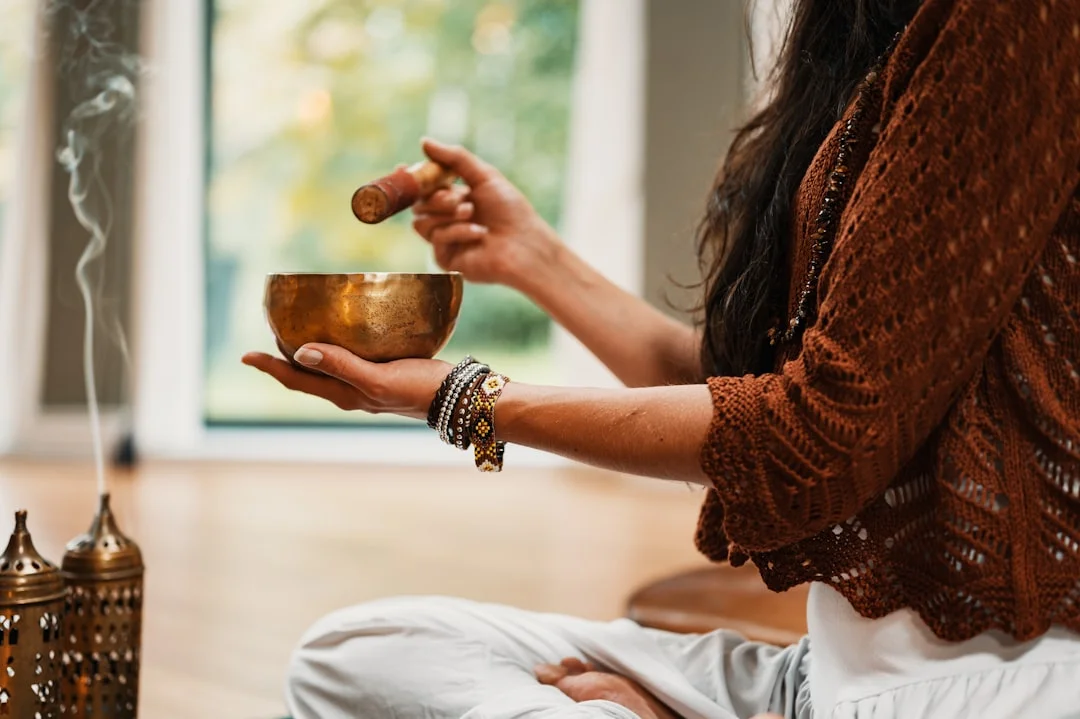
Singing bowls, gongs, or simply listening to music mindfully can also be used for this purpose. Research on music perception, such as that by Gold et al. (2019) in the Annals of the New York Academy of Sciences, suggests that sound can trigger emotional responses and positively influence well-being. This is not evidence of chakra activation—but it does suggest that sound could serve as an invitation to mindfulness and relaxation.
Perhaps you’d like to simply try out whether humming a particular syllable or listening to a singing bowl during a quiet moment brings you something—without any expectations at all.
Movement and Yoga: Activating the Chakras Through the Body
The body is not an obstacle to inner work—it is its home. In Hatha Yoga, there are specific postures (asanas) for each chakra that can direct your attention to the corresponding area. It’s less about athletic perfection and more about consciously connecting with your own body.
Here are a few examples you might want to try:
Root Chakra: The Tree (Vrikshasana)—stand on one leg and let your attention sink toward the earth. This may feel grounding.
Sacral Chakra: Hip circles or gentle body rotations while standing—consciously move the hip region and notice what arises.
Heart Chakra: Heart-opening poses like the Cobra (Bhujangasana) or a gentle backbend—the chest opens, and your breath can deepen.
Throat Chakra: Gentle neck stretches or lowering your chin toward your chest and lifting it back up — bring awareness to the throat area.
Bodywork in a yoga context can help you feel more present and alive. In a review article published in the *Evidence-Based Complementary and Alternative Medicine Journal*, Cramer et al. (2013) found evidence suggesting that yoga practice may be associated with reduced stress—though the researchers note that further studies are needed to draw reliable conclusions.
So it’s not about mastering perfect poses. It’s about using the body as an invitation—and in doing so, perhaps noticing where there is tension, where expansion is possible, and where something needs to be soothed.

Connection to Nature: Harmonizing the Chakras Outdoors
There’s a way that requires no mat, no mantra, and no instructions: simply going outside. Many people experience a kind of inner relief when they’re in nature—a letting go of what weighs them down in everyday life. In chakra tradition, the root chakra is closely connected to the earth, to the element of earth, and to the feeling of being grounded.
You could walk barefoot on grass or soil, consciously noticing how the ground feels beneath your feet. Some people find this simply soothing—others describe it as something that feels like an inner sense of arrival.
The concept of “earthing” or “grounding”—that is, direct physical contact with the ground—has also sparked scientific interest in recent years. In a paper published in the *Journal of Environmental and Public Health*, Chevalier et al. (2012) described possible physiological effects of direct contact with the earth, but acknowledged that the research is still limited and that larger studies are lacking. The bottom line is this: spending time in nature can feel rejuvenating—many people experience this, and that alone can be a good reason to get outside more often.
Perhaps on your next walk, you might pause for a moment, take a deep breath, and consciously notice what you see, hear, and smell. The third eye chakra, which is associated with clarity and perception, might receive a gentle invitation through such moments of mindful awareness of the outside world.
Chakras in Everyday Life: Small Gestures That Could Add Up
Opening your chakras doesn’t have to be a grand ritual. It can also involve incorporating small, mindful gestures into your daily life—moments when you pause, breathe, and feel.
Here are a few ways chakras could look like in your everyday life:
- In the morning: Before you check your phone, briefly place your hand over your heart and take three deep breaths. You could ask yourself: How am I feeling today?
- While cooking: Consciously notice colors, scents, and textures—a sensory exercise that can stimulate the sacral chakra.
- During conversations: Take a brief pause before responding—in keeping with the throat chakra, consciously choose what you want to express.
- In the evening: As you lie down, let your attention wander briefly through your body—from your feet to your head—and notice where there is tension and where there might be space.
These small gestures require no time, no knowledge, and no conviction. They are invitations—and perhaps that is the most beautiful thing about the idea of chakra work: that it invites us to pause more often and ask ourselves how we’re really doing.
A Realistic Expectation: What Chakra Practice Can Offer
It’s important to be honest: Chakra practices are not miracle cures. They can feel soothing, they can foster inner awareness, and they can help you feel more at home in your body—but they are no substitute for professional guidance, therapy, or medical treatment.
If you’re going through a difficult phase in your life, it’s wonderful when breathing exercises and meditation give you moments of stillness. At the same time, it can be important to seek professional support if you feel you need it. Both can coexist.
What chakra work can offer, however, is a language for inner experience—a way to express in images what is sometimes hard to put into words. “My heart chakra needs more peace right now” might sound strange—but perhaps this very image helps you take care of yourself.
Some people experience a deeper connection to themselves through regular chakra meditation, breathing exercises, or yoga. Others find it interesting but not essential to their well-being. Both are perfectly fine. The only way to find out is to try it—with genuine curiosity and without any pressure to meet expectations.
Daily Inspiration with the Coaching Cards
The 7zen Coaching Cards feature uplifting messages that invite you to take a moment to be mindful—right when you draw a card.
Your daily companion for personal growth
With the 7zen app, you'll receive daily coaching tips, guided breathing exercises, and personal reflections—all based on your individual profile.
How long does it take to feel something during chakra activation?
This varies greatly from person to person, so there’s no one-size-fits-all answer. Some people describe feeling warmth or relaxation in certain parts of their body after just a few minutes of conscious breathing or meditation. For others, such sensations may not emerge until after several weeks of regular practice—or may not manifest at all in the way they expected. It’s important to begin without fixed expectations and to view the practice as an invitation to self-awareness, not as a test.
Can I open my chakras without practicing yoga or meditation?
Many of the methods described can also be used without traditional yoga or meditation practices. Conscious breathing, journaling, mindful moments in nature, or humming a syllable are all options that require no special prior knowledge. Chakra work can begin anywhere—while taking a walk, cooking, or pausing for a moment in the morning. It’s primarily about mindfulness, not technique.
Is there scientific evidence for chakras?
Chakras as physical structures in the body have not yet been scientifically proven. They originate from the yogic and tantric traditions of India, where they are described as subtle energy centers. What modern science has been able to demonstrate is that certain practices from this tradition—such as conscious breathing, meditation, or yoga—can have a positive impact on well-being. The concept of chakras can therefore be understood as a useful mental image, even without assuming their literal existence.
Which chakra should I activate first?
In many yogic traditions, it’s recommended to start with the root chakra—the foundation, the sense of grounding and security. The idea behind this is that a stable foundation can serve as the basis for everything that follows. But that doesn’t mean you have to do it this way. If another chakra or life issue feels particularly prominent right now, you can start by focusing on that instead. There’s no set order.
What if I don't feel anything at all during chakra meditation?
This is completely normal and not a sign that something is wrong. Not everyone experiences physical sensations during inner work, and that says nothing about the depth or value of the practice. Some people experience chakra work more as a mental image, others as an emotional resonance, and still others as simple stillness. All forms of perception—or even the absence of any—are valid.
Can chakra work replace therapy?
No. Chakra practices such as breathing exercises, meditation, or yoga can complement your well-being and feel beneficial—but they are no substitute for professional psychological or medical care. If you’re experiencing ongoing emotional distress, mental health issues, or physical symptoms, it’s important to seek expert help. Chakra work and professional support can coexist effectively.
Here’s a little thought to take with you: Take five minutes today—maybe even tonight. Sit comfortably, close your eyes, and place one hand on the center of your chest. Take three deep breaths in and exhale slowly. Ask yourself inwardly, without any expectations: What do I need right now? Whatever comes to mind—it’s okay to let it be there. This can be the first step toward understanding chakra opening as a daily invitation: a gesture of self-care. This article is not a substitute for therapy or professional counseling. If symptoms persist, it’s recommended that you consult a professional.