Cardinal Directions in Feng Shui — and How to Measure Them Correctly
How to orient your apartment using a compass, find the center point, and avoid common measurement errors.

Maybe you’ve heard that the cardinal directions play a special role in Feng Shui—and at the same time wondered how to actually put that into practice. Where exactly is north in my apartment? Is my smartphone compass enough? And what do I do if my floor plan is anything but a nice rectangle? These are perfectly valid questions, and you’re not alone in asking them. At first glance, Feng Shui can seem like an impenetrable system of numbers, elements, and compass directions—but at its core lies a very concrete, practical foundation that many people find surprisingly accessible. This article aims to introduce you to exactly that core: calmly, clearly, and without any esoteric jargon.
What the Cardinal Directions Mean in Feng Shui
Feng Shui—literally translated as “wind and water”—is a millennia-old Chinese philosophy that explores the interaction between people and their built environment. A central concept is the idea that spaces are organized into directions not only physically but also energetically. Each cardinal direction is associated with a specific element, a quality, and certain areas of life.
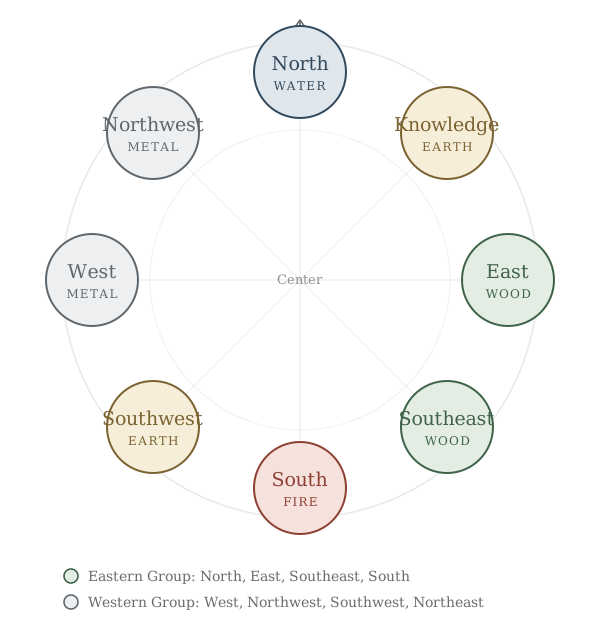
This assignment is very specific in classical Feng Shui: The compass divides the space into eight sectors, each covering 45 degrees. Each sector corresponds to an element—and thus a specific symbolic energy. Thus, the element of water is assigned to the north, earth to the northeast and southwest, wood to the east and southeast, fire to the south, and metal to the west and northwest. This division originates from the Bagua, the eight-part basic scheme of Feng Shui, and forms the basis for many practical recommendations.
Whether and to what extent these associations have a measurable effect on well-being cannot be definitively determined. What is clear, however, is that consciously engaging with one’s own living space—including light, orientation, layout, and atmosphere—can be a valuable process for many people. Research in environmental psychology, such as Roger Ulrich’s work on the effect of interior design on well-being (Ulrich, 1984), suggests that our environment can indeed influence our inner experience.
The Feng Shui Compass: From the Luo Pan to the Smartphone
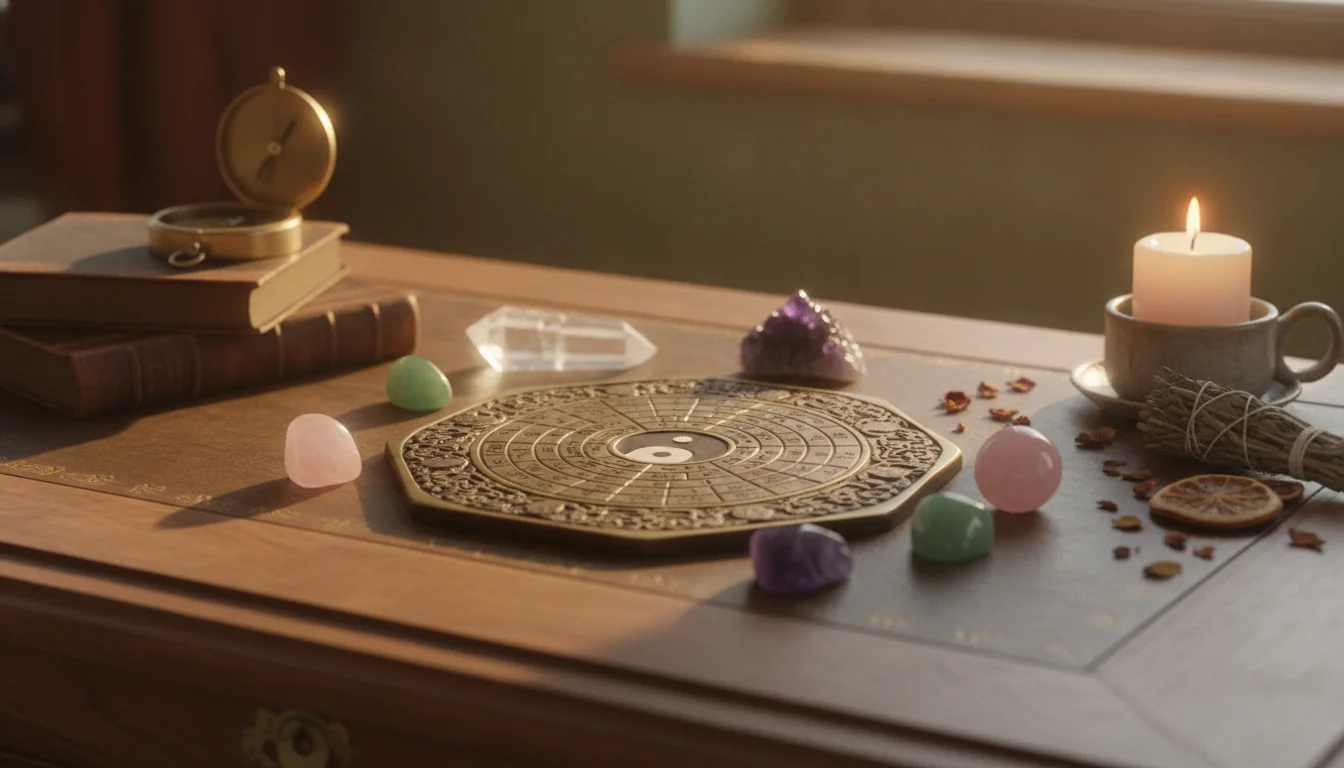
When it comes to the Feng Shui compass, the term “Luo Pan” inevitably comes up sooner or later. This traditional Chinese compass is a fascinating instrument: It consists of a magnetic needle in the center, surrounded by numerous concentric rings that contain various Feng Shui formulas, trigram assignments, and degree markings. A high-quality Luo Pan can be a true tool of the trade for experienced Feng Shui practitioners.
To get started, however—and this is good news—the Luo Pan isn’t necessary. A simple needle compass from an outdoor store is perfectly sufficient for determining the basic directions in your home. It’s sturdy, inexpensive, and significantly less prone to interference than a smartphone compass. Many people actually start with the compass app on their phone—which can certainly be helpful for initial orientation, but it harbors some tricky sources of error that we’ll discuss shortly.
Those who want to delve deeper into traditional Feng Shui might eventually consider purchasing a simple Luo Pan. For most people who want to orient their home and develop a basic understanding of the sectors, however, the traditional needle compass remains the tool of choice.
Measuring Correctly: How to Determine North in Your Apartment
The question “Where is north?” sounds simple—and in theory, it is. In the practical setting of an apartment, however, it can prove surprisingly tricky. That’s because many everyday objects and building materials can interfere with a compass’s magnetic field. To get reliable results, it’s worth following a few simple rules.
Take multiple measurements at different locations: Don’t just stand in the middle of the room and read the value. Instead, take measurements at three to five different points within your apartment—ideally in different rooms as well. If the readings differ significantly from one another, this indicates local interference fields, and you should change the measurement point. Consistent, similar readings at multiple locations will give you a more reliable guide.
Keep a distance from metallic and electrical sources of interference: When taking measurements, stay at least half a meter to one meter away from steel beams, radiators, electrical appliances, speakers, and magnets. All of these objects can locally distort the Earth’s magnetic field and throw off your compass. Speakers, in particular, with their strong permanent magnets, are often underestimated sources of interference.
Use your smartphone’s compass with caution: Most smartphones have a built-in magnetic field sensor and offer compass apps. These can be useful for a rough initial orientation—but they’re significantly more susceptible to interference than a traditional needle compass. Your smartphone case, nearby cables, metal tables, or even jewelry can distort the reading. Many apps offer a calibration feature (often involving moving the phone in a figure-eight pattern)—this should be performed before each measurement. Nevertheless, anyone who wants to work seriously with Feng Shui might want to consider making a small investment in a simple needle compass.
Magnetic North vs. Geographic North — What You Should Know The difference between magnetic north and true north—known as magnetic declination—is currently only a few degrees in Central Europe (approximately 2–4 degrees east, depending on location and year). For practical Feng Shui applications in the home, this difference is generally negligible. However, those who wish to work with great precision can look up the current declination value for their location at the Geomagnetic Institute or using the GFZ Potsdam’s online calculator and make the necessary corrections.
Magnetic North and Geographic North: A Small but Significant Difference
A compass always points to the magnetic North Pole—the point toward which magnetic needles align worldwide. However, this does not correspond exactly to the geographic North Pole, which is defined as the point where the Earth’s axis intersects the Earth’s surface. The deviation between the two is called magnetic declination.
In Central Europe, this deviation is currently relatively small—depending on the exact location and the current year, it typically amounts to about two to four degrees in an easterly direction. This means that the magnetic north indicated by your compass lies slightly east of true geographic north. For most applications in Feng Shui—that is, the assignment of rooms to the eight sectors—this difference is so small that it is practically insignificant. No Feng Shui sector is so narrow that two to three degrees would result in a different assignment, as long as you are not directly on a sector boundary.
If you still want to be on the safe side, you can look up the current declination value for your location using the online calculator from the GeoForschungsZentrum Potsdam (GFZ) and adjust the measured compass readings accordingly. However, this is not a necessary step for beginners—Feng Shui in the home is ultimately about a rough, meaningful orientation, not precision measurement.
Finding the Center of Your Home—The Foundation of Applying the Bagua
Once you know where north is, the next practical question arises: From where do you apply the Bagua—that is, the eight-sector division—to your home? The starting point is the center of the apartment. Finding it is easier than it sounds, at least if your floor plan is roughly rectangular.
For a rectangular floor plan: Draw the apartment (or display it from the floor plan) on paper. Draw the two diagonals—that is, one line from each corner to the opposite corner. Their intersection is the center. From this point, align the Bagua with true north so that each of the eight 45-degree sectors can be assigned to a corresponding area of the apartment.
For L-shaped or irregular floor plans: This is where it gets a bit more complex. A common method is to draw the smallest enclosing rectangle around the floor plan—that is, to mentally add the “missing” corners to form a complete rectangle. The center of this imaginary rectangle then serves as a reference point. Areas that lie outside the actual floor plan are considered “missing corners” in Feng Shui. This means that the corresponding sector is either not present at all or only weakly represented in the home.
Missing Corners and Irregular Floor Plans: What This Might Mean in Feng Shui
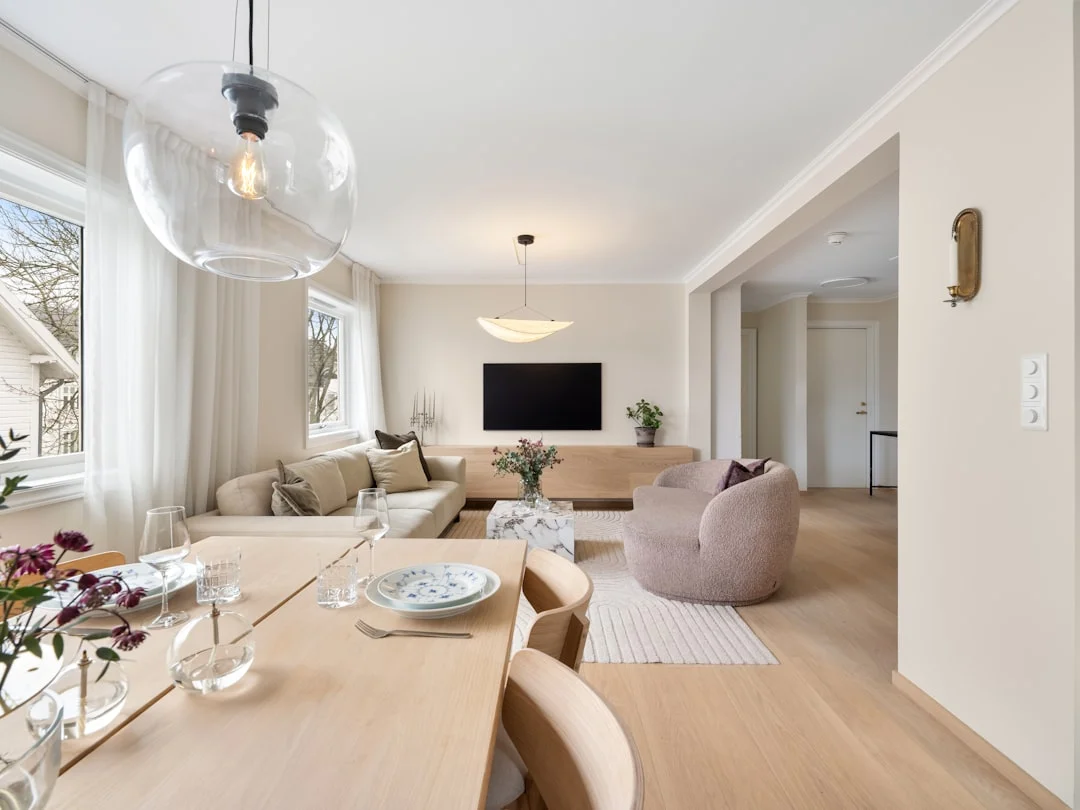
Not every apartment is a neat rectangle—and that’s completely normal. Many apartments, especially in older buildings or those with modern floor plans, feature protrusions and recesses, L-shapes, sloped ceilings, or other unique features. In classical Feng Shui, this is described by the concept of missing corners and extensions.
A missing corner occurs when an area of the imaginary enclosing rectangle is not part of the actual living space—in other words, it’s missing. Depending on which sector this missing corner corresponds to, in Feng Shui philosophy this could mean that a certain aspect of life or area receives less support from the space. Some people view such considerations as a helpful invitation to reflect—as an opportunity to consciously ask where in their own lives a little more attention might be beneficial.
An extension is the opposite: an addition or projection that extends beyond the imaginary base rectangle. This sector would then be particularly emphasized. Whether such spatial conditions actually influence our experience is difficult to verify scientifically—however, environmental psychology suggests that room shape, proportions, and lighting conditions can certainly contribute to our well-being. Research by Sally Augustin (2009) on applied environmental psychology suggests that cramped spaces, a lack of natural light sources, and unfavorable proportions can influence the emotional experience within a room.
When working with your floor plan, it might be helpful to make a simple sketch: Draw your actual floor plan, add the surrounding rectangle, mark the center point, and then label the eight sectors with their north orientation. This visualization alone can have a surprisingly clarifying effect—regardless of how deeply you wish to delve into the teachings of feng shui.
The Eight Sectors and Their Elements: An Overview
Once the center point has been determined and the north direction is known, the eight sectors can be plotted onto the floor plan. Each sector spans 45 degrees and is assigned to one of the five elements. This overview can serve as a starting point—it does not claim to be exhaustive, as classical Feng Shui teachings include many further distinctions:
- North (337.5° – 22.5°): Water element—often associated with depth, stillness, career, and the flow of life.
- Northeast (22.5° – 67.5°): Earth element—often associated with knowledge, clarity, and personal growth.
- East (67.5° – 112.5°): Wood element—linked to family, new beginnings, health, and fresh starts.
- Southeast (112.5° – 157.5°): Wood element — often associated with abundance, prosperity, and gratitude.
- South (157.5° – 202.5°): Fire element — associated with reputation, visibility, joy, and connection.
- Southwest (202.5° – 247.5°): Earth element — frequently associated with partnership, relationships, and mutual support.
- West (247.5° – 292.5°): Metal element — linked to creativity, children, joy, and bringing things to a close.
- Northwest (292.5° – 337.5°): Metal element — often associated with mentors, helpful people, and travel.
These associations are essentially symbolic in nature—they invite you to become more aware of certain qualities of a space and perhaps to redesign it. For many people, it can be inspiring to try out this perspective and see what emerges.
Practical Steps: How to Orient Your Apartment Using a Compass
If you want to align your home, the following step-by-step guide might be helpful. It’s meant as a suggestion—not a strict rule:
1. Get or draw a floor plan
If possible, get a floor plan of your apartment—it’s often included with lease agreements or can be requested from your landlord. Alternatively, you can draw a simple sketch yourself. It’s important that the proportions are roughly accurate and that all rooms are included.
2. Determine the center point
If necessary, complete the surrounding rectangle and draw the two diagonals. Their intersection point is your reference point for the Bagua layout.
3. Calibrate the compass and measure north
Take your needle compass (or calibrated smartphone compass) and stand in the center of the apartment—or as close to it as possible. Stay away from radiators, speakers, and electrical appliances. Note the compass direction. Repeat the measurement at two or three additional points and check whether the values match.
4. Mark the north direction on the floor plan
Mark the determined north direction with an arrow on your floor plan sketch. Now you can draw the eight 45-degree sectors starting from the center point.
5. Mark missing corners and extensions
Compare your actual floor plan with the enclosing rectangle. Areas that are missing or protrude might warrant closer examination.
The result of this exercise doesn’t have to be perfect. Even a rough overview can help you see your own apartment with fresh eyes—and perhaps look at one or two rooms with renewed attention.
Feng Shui and Science: What We Know and What Remains Unclear
It would be dishonest to present Feng Shui as if all of its assumptions were scientifically proven. They are not—and that is important to know. Classical Feng Shui is a culturally evolved system with roots stretching back thousands of years, based on a specific worldview. Whether energy (Qi) flows through spaces in the physical sense and whether the orientation of a room toward the north actually affects one’s career or relationships cannot be measured.
What research can show, however, is that our environment has a measurable influence on our well-being, our concentration, and our emotional experience. Studies in environmental psychology, such as the pioneering work by Roger Ulrich (1984) on the effects of nature and interior design on recovery processes, suggest that thoughtfully designed spaces can indeed influence subjective well-being. Research on the effects of daylight, natural materials, and spatial proportions on the experience of stress—for example, in the field of evidence-based design (Hamilton, 2003)—also points in a similar direction.
In this sense, Feng Shui could also be understood as a culturally framed invitation to conscious interior design—as a way to pay more attention to one’s own home, clear up ambiguities, optimize lighting, and design one’s environment with intention. Whether one takes the element assignments literally or uses them more as a symbolic guide remains a deeply personal decision.
At the end of the day, when it comes to arranging your home according to the cardinal directions, it’s really all about one thing: developing a more mindful relationship with your living space. You might discover that a certain room feels completely different than you expected—or that a long-neglected corner suddenly deserves your attention. Feng Shui can serve as a framework, a vocabulary that helps you describe and experience spaces in a new way. No more, no less. And sometimes that’s exactly the first step toward a home that truly feels right.
Your action step for today: Maybe you’d like to get a simple needle compass (or calibrate the compass app on your smartphone) and take a first, completely informal measurement in your apartment. Mark the north direction on a small sketch of your floor plan—and see what emerges. Which room is in which sector? Which placement surprises you? It’s not about perfection, but about taking a curious first look.
For a comprehensive analysis: On-site consultation
This article offers some guidelines for your own living space—and that’s a great place to start. However, a comprehensive Feng Shui analysis should be conducted by a trained consultant. It takes into account factors that a written guide cannot: the location of the house, the layout of the rooms, the actual compass directions in the floor plan, the surroundings, and the people who live there. In most regions, there are specialists available; consulting with one is particularly advisable when renovating, buying a home, or when the preferences of several people in the household cannot be reconciled.
Can I just use my smartphone's compass for Feng Shui?
Yes, a smartphone compass can certainly be helpful for getting your bearings at first. However, it’s more prone to interference than a traditional needle compass, since your phone itself, nearby cables, metal objects, or magnets can distort the reading. Many apps offer a calibration feature—a figure-eight motion with the phone in the air—that should be performed before taking a reading. Anyone who wants to work with Feng Shui on a regular basis might consider making the small investment in a simple needle compass, which is more durable and reliable.
What is a Luo Pan, and do I need one as a beginner?
The Luo Pan is the classic Chinese Feng Shui compass with a magnetic needle in the center and numerous concentric rings that contain various Feng Shui formulas, degree measurements, and trigram assignments. It is a fascinating tool for experienced practitioners, but by no means necessary for beginners. A simple needle compass and a floor plan are entirely sufficient to determine the eight sectors of your home and take your first steps with Feng Shui.
How do I find the center of my apartment if the floor plan is irregular?
For an irregular or L-shaped floor plan, the “enclosing rectangle” method is recommended: Mentally fill in the missing areas to form a complete rectangle, and then draw the two diagonals of this imaginary rectangle. Their point of intersection serves as the center point for the Bagua layout. Areas of the imaginary rectangle that are not part of the actual living space are considered “missing corners” in Feng Shui.
What do missing corners mean in Feng Shui?
Missing corners occur when part of the imagined enclosing rectangle does not belong to the actual living space—that is, is literally missing. In Feng Shui philosophy, this could mean that the corresponding sector and its symbolic qualities are less present or supported in the room. Some people use this insight as an invitation to reflect—as an opportunity to ask which area of their lives they might want to strengthen more consciously. There are various traditional approaches to symbolically filling in missing corners, such as using mirrors, plants, or light sources outside the home.
Do I need to take into account the difference between magnetic north and true north?
Generally speaking, no—at least not for a simple Feng Shui analysis of your own home. In Central Europe, the deviation between magnetic north and true north is currently only about two to four degrees. Since each Feng Shui sector spans 45 degrees, this small difference is negligible for most applications. If you want to be very precise or are located near a sector boundary, you can look up the current declination value for your location using the GFZ Potsdam’s online calculator and make the necessary adjustments.
How often should I check the compass directions in my apartment?
Once you’ve taken careful measurements—at several points, away from sources of interference—that’s usually enough. The compass directions in your apartment don’t change. It may be a good idea to take additional measurements if you’ve done major renovations (such as installing new steel beams or modifying electrical wiring) or if you feel that your initial measurement was affected by sources of interference. Otherwise, the orientation you’ve determined once will remain stable.