Feng Shui Overview: Cardinal Directions, Elements, and Colors
All eight cardinal directions at a glance: elements, colors, Bagua sectors, and specific steps to strengthen or weaken them.
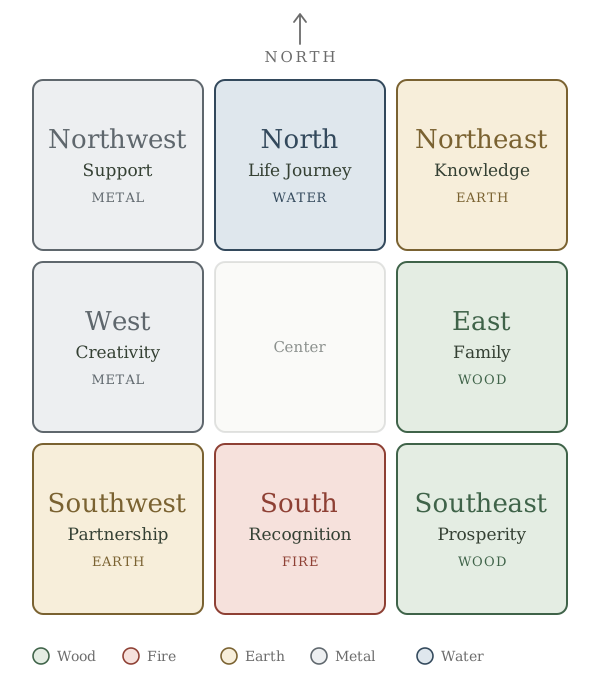
Sometimes you just want a clear, concise page you can turn to when you’re in the middle of redesigning a room and can’t quite remember: Which element goes in the north again? And what was that about the weakening cycle in the south? That’s exactly what this post is meant to be—a concise Feng Shui overview of the cardinal directions that brings together all the essential associations in one place. It’s no substitute for the more in-depth individual posts, but it’s a practical reference guide for looking things up and putting them into context. Here you’ll find, for each of the eight main directions, the corresponding element, the Bagua life area, the traditionally recommended colors, suitable shapes and materials, as well as one measure to strengthen and one to weaken—all presented in a structured, clear manner, without any esoteric jargon.
What This Feng Shui Guide to Cardinal Directions Does—and What It Doesn't
Feng Shui (Chinese for “wind and water”) is a millennia-old philosophy concerning the arrangement and design of spaces, based on the concept of the life energy Qi (also Chi). The assignment of cardinal directions to elements, colors, and areas of life stems from the so-called Bagua—an octagonal orientation scheme that originally emerged from the I Ching and serves as the basis for room analysis in classical Feng Shui.
This overview reflects the traditional assignments of the Compass School, which works with actual cardinal directions—in contrast to the Black Hat School, which always aligns the Bagua with the front door. Whether and how you apply these recommendations is entirely up to you. Feng Shui is not a science in the empirical sense, and it would be inappropriate to make specific promises about its effects. What research can show, however, is that the conscious design of one’s own environment—colors, order, light, materials—can influence mood and well-being. Studies in environmental psychology, such as those by Ulrich (1984) on the effect of natural materials and colors on human well-being, suggest that our environment actually affects us more than we often realize. Feng Shui offers a centuries-old system for putting this connection to practical use.
The following overview is intended as a Feng Shui reference guide—you can jump directly to the desired cardinal direction and find all relevant information there at a glance.
An Overview of the Five Elements and Their Cycles
Before we delve into the individual aspects, it’s worth taking a brief look at the core of these classifications: the five elements—water, wood, fire, earth, and metal. They do not represent physical substances, but rather qualities, movements, and energy patterns.
In the Nourishing Cycle (also known as the Mother Cycle), each element strengthens the next: Water nourishes Wood, Wood nourishes Fire, Fire nourishes Earth, Earth nourishes Metal, and Metal nourishes Water. So, if you want to strengthen an element in a particular area, you introduce its mother element.
In the cycle of weakening (also known as the child element), an element’s energy is depleted by the element it nourishes: Water, which nourishes Wood, loses its strength in the process. This principle is used to gently temper an element that is too dominant. In the following sections, you’ll find exactly these two measures for each cardinal direction—each presented as a specific suggestion, not as a rule.
North, East, and South—The Three Main Axes in Detail
North – Water – Career and Life Path
Element: Water | Bagua Area: Career / Life Path | Colors: Blue, Black | Shapes: Wavy, Flowing | Materials: Glass, Mirrors, Dark Fabrics
The North is traditionally considered the area of the flow of life—the path we take and the way we move through the world. The element of Water represents adaptability, depth, and movement. Dark shades of blue and black, curved and wavy shapes, and materials such as glass or mirrors are traditionally associated with this sector.
- Strengthen (Mother Element: Metal): Metallic accents such as silver picture frames, white or gray pillows, or a small metal wind chime can energetically support the north area—in the nourishing cycle, metal nourishes water.
- Balancing (Child Element: Wood): If the Water energy is too strong or the northern area feels heavy and dark, green plants or wooden elements can bring a sense of lightness—Wood draws Water energy toward itself and thus tempers it.
East – Wood – Family and Roots
Element: Wood | Bagua Area: Family / Heritage | Colors: Green, Turquoise | Shapes: Vertical, columnar | Materials: Wood, Bamboo, Plants
The East represents growth, renewal, and family background. Tall, slender shapes and fresh shades of green reflect the upward-reaching energy of the Wood element. Family photos, plants, and natural wood furniture feel particularly harmonious here.
- Strengthen (Mother Element: Water): A small water feature, an aquarium, or pictures of bodies of water can nourish the Wood energy in the East and keep it vibrant.
- Weakening (Child Element: Fire): Candles, light sources, or warm red tones can help reduce overwhelming Wood energy—Fire consumes Wood and thus tempers its intensity.
Southeast – Wood – Prosperity and Abundance
Element: Wood | Bagua Area: Prosperity / Abundance | Colors: Green, turquoise, purple accents | Shapes: Vertical, column-like | Materials: Wood, live plants
The southeast shares the Wood element with the east but is associated with prosperity and a sense of abundance. Lush plants, fresh flowers, or a well-tended small tree can keep this area vibrant.
- Strengthen (Mother Element: Water): Similar to the East: bodies of water, fountains, or images of rivers and lakes can nourish the Wood energy in the Southeast.
- Mitigate (Child Element Fire): Warm light sources or fire symbols can gently limit an overly strong Wood presence in this area.
South – Fire – Reputation and Recognition
Element: Fire | Bagua Area: Reputation / Prestige / Recognition | Colors: Red, orange, bright pink | Shapes: Pointed, triangular, jagged | Materials: Candles, light, leather, wool
The south is ablaze—figuratively speaking. It represents visibility, how others perceive us, and what we want to be known for. Warm shades of red, candlelight, and triangular shapes bring Fire energy to this area.
- Strengthen (parent element Wood): Green plants, wooden decor, or images of forests and trees can stoke the fire energy in the south—wood feeds the fire.
- Toning Down (Child Element: Earth): Flat, square shapes, ceramics, or earth tones such as beige and ochre can calm excessively intense fire energy—fire generates earth and thus releases energy.
Environmental Psychology & Interior Design Environmental psychology suggests that colors, materials, and interior design can indeed influence mood and well-being. Mehta and Zhu (2009) showed in their studies that shades of blue can promote creative, associative thought processes, while shades of red tend to sharpen attention and perception of detail—an indication that the choice of colors in a room is no trivial matter, even though Feng Shui and color psychology follow different systems.
Southwest, Northeast, and the Earth Sectors
Southwest – Earth – Partnerships and Relationships
Element: Earth | Bagua Sector: Partnership / Love / Marriage | Colors: Yellow, Ochre, Beige, Pink | Shapes: Flat, Square, Horizontal | Materials: Ceramic, Clay, Natural Stone, Heavy Fabrics
The southwest is traditionally associated with togetherness, relationships, and caring. The Earth element represents stability, reliability, and groundedness—qualities that can provide a solid foundation in close relationships. Warm earth tones, images of couples, or ceramic objects can make this area cozy and inviting.
- Strengthen (parent element Fire): Candles, light sources, or decorative elements in shades of red and orange can nourish the Earth energy in the southwest—Fire generates Earth in the nourishing cycle.
- Mitigate (Child Element Metal): Metallic decorative elements, white or gray tones, or round metal shapes can lighten an overly heavy, earthy atmosphere in this area.
Northeast – Earth – Knowledge and Self-Development
Element: Earth | Bagua Area: Knowledge / Self-Development / Education | Colors: Yellow, ochre, beige, turquoise as an accent | Shapes: Flat, square, horizontal | Materials: Natural stone, ceramics, books
The northeast shares the same element as the southwest but is associated with inner growth—learning, reflection, and personal maturity. A workspace, a reading area, or a meditation space could feel particularly harmonious in this part of the room.
- Strengthen (Mother Element: Fire): Here, too, warmth from candles, light, or fiery accent colors can nourish the Earth energy and invigorate the area.
- Mitigate (Child Element: Metal): Round metal objects, a silver picture frame, or light, clear tones can temper overly dominant Earth energy in the northeast.
West and Northwest—Strengthening the Metal Element in a Room
West – Metal – Creativity and Children
Element: Metal | Bagua Sector: Creativity / Children / Projects | Colors: White, Gray, Silver, Gold | Shapes: Round, oval, arched | Materials: Metal, stone, ceramics in light tones
The West represents creative energy, self-expression, and—in a broader sense—projects we wish to bring into the world. Round, clean shapes and metallic or stone materials traditionally belong in this area. Artwork, musical instruments, or craft corners could find their natural place here.
- Strengthens (Mother Element Earth): Ceramics, natural stone, terracotta pots, or warm shades of yellow and beige can nourish the Metal energy in the west—Earth generates Metal in the cycle of nourishment.
- Weakening (Child Element Water): A small fountain, images of bodies of water, or dark shades of blue and black can soften excessively strong Metal energy—Metal nourishes Water and, in doing so, releases energy.
Northwest – Metal – Helpful Friends and Travel
Element: Metal | Bagua Sector: Helpful People / Mentors / Travel | Colors: White, Gray, Silver, Gold Tones | Shapes: Round, Oval, Arched | Materials: Metal, Light-Colored Natural Stone
The northwest shares the Metal element with the west but is dedicated to the themes of networking, support, and mobility. Traditionally, this area is associated with people who accompany us on our journey—mentors, friends, and helpful encounters. Pictures of travel destinations, a world map, or gestures of gratitude toward important people in your life can make this area feel personal and vibrant.
- Strengthen (Mother Element Earth): Similar to the West: ceramics, sandstone, or earthy tones can nourish the Metal energy in the Northwest.
- Mitigate (Child Element: Water): Water elements, dark colors, or glass containers can gently reduce an overly dominant Metal presence in this area.
Element, Color, Direction—A Table for a Quick Overview
For anyone who prefers a condensed view when looking up Feng Shui information, here’s a brief overview of the most important associations—a sort of cheat sheet for everyday life:
- North: Water · Career · Blue/Black · Wavy · Strengthen with Metal · Weaken with Wood
- East: Wood · Family · Green/Turquoise · Vertical · Strengthen with Water · Weaken with Fire
- Southeast: Wood · Prosperity · Green/Turquoise · Vertical · Strengthen with Water · Weaken with Fire
- South: Fire · Reputation · Red/Orange · Pointed · Strengthen with Wood · Weaken with Earth
- Southwest: Earth · Partnership · Yellow/Ochre/Beige · Flat/Square · Strengthen with Fire · Weaken with Metal
- Northeast: Earth · Knowledge · Yellow/Ochre/Beige · Flat/Square · Strengthen with Fire · Weaken with Metal
- West: Metal · Creativity · White/Gray/Silver · Round · Strengthened by Earth · Weakened by Water
- Northwest: Metal · Helpful Friends · White/Gray/Silver · Round · Strengthen with Earth · Soften with Water
This list can serve as a starting point if you want to furnish or redesign a room. It does not replace a deeper exploration of the individual areas, but it offers a quick introduction.
Enhancing Your Space with Feng Shui—Here’s What a First Step Might Look Like
Many people who are exploring Feng Shui for the first time feel a bit overwhelmed by the sheer volume of information. That’s understandable—and actually unnecessary. You don’t have to redesign everything at once to feel a difference. Environmental psychologist Sally Augustin describes in her work (2009) how even small, conscious changes in interior design can influence subjective well-being—through altered color perception, material contrasts, or a different arrangement of objects.
Feng Shui suggests always starting with the area that feels most important or urgent at the moment. Perhaps that’s the area that already seems a bit cluttered or empty. Or the one that corresponds to the life issue you’re currently grappling with. Some people find it helpful to simply pull out a compass—or use a corresponding app—and walk slowly through their home to see which cardinal directions correspond to the individual rooms or corners.
Then a single change might be enough: placing a plant in the east, putting a blue pillow in the north, lighting a candle in the south. Not as a ritual with guaranteed results, but as a conscious gesture—an invitation to yourself to see your own space with fresh eyes. Research on mindfulness, such as that by Kabat-Zinn (1994), suggests that consciously perceiving and shaping one’s own environment can, in and of itself, have a calming and centering effect.
Common Misconceptions About the Feng Shui Overview of Cardinal Directions
A common misconception is that Feng Shui means filling every space with Chinese decorations. That is not the case. The traditional recommendations focus on elements, colors, shapes, and materials—and these can be applied to a wide variety of interior design styles. A Scandinavian minimalist space can have just as good Feng Shui qualities as a colorfully patterned interior, as long as the basic principles are followed.
Another common misconception concerns the difference between the Nourishing Cycle and the Controlling Cycle. The Controlling Cycle (in which, for example, water extinguishes fire) is sometimes confused with the Weakening Cycle, which is described in this post. However, the “weakening cycle” used here describes something different: When an element nourishes its child element, it releases energy—not through suppression, but through giving. This is a gentler mechanism and is often easier to apply in everyday life.
And finally: Feng Shui is not a panacea and does not replace solutions to structural problems (a damp wall remains a damp wall) or personal processes of self-reflection. It is one tool among many—a system that invites you to design your own environment more consciously and to imbue it with a certain meaning.
Feng Shui as a Reference in Everyday Life – A Summary
This overview is not intended to be the final word on the subject, but rather a practical guide. Feng Shui is a living system that has evolved over many centuries and is still interpreted differently by various schools today. What you’ve found here are the classic classifications of the Compass School—a solid foundation from which to build.
Whether you take the recommendations literally, use them as creative inspiration, or simply stay curious and experiment—that’s entirely up to you. Perhaps you’ll find a small change in one area of your home that just feels right. Perhaps you’ll discover a connection between interior design and your own mood that you hadn’t noticed before. And maybe this page will help you the next time you’re in the middle of a redesign and need quick guidance—as a reliable go-to resource for Feng Shui.
Note: Feng Shui is a traditional school of interior design and is not a substitute for professional consultation, therapy, or architectural planning. The associations described here are of a traditional nature and do not constitute scientifically proven claims regarding their effects.
Your action step for today: Grab a compass (or a compass app), stand in the center of your home, and find out which cardinal direction your favorite spot or your desk faces. Then check this overview to see which element and which area of life are traditionally associated with that spot—and take a moment to calmly consider whether you might want to change a small detail that fits this area. No pressure, no obligations—just a curious look at your own space.
For a comprehensive analysis: On-site consultation
This article offers some guidelines for your own living space—and that’s a good place to start. However, a comprehensive Feng Shui analysis should be conducted by a trained consultant. It takes into account factors that a written guide cannot: the location of the house, the layout of the rooms, the actual compass directions in the floor plan, the surroundings, and the people who live there. In most regions, there are specialists available; consulting with one is particularly advisable when renovating, buying a home, or when the preferences of several people in the household cannot be reconciled.
Do I have to take all eight cardinal directions into account at the same time?
No, that would simply be too much all at once for most people. It can be helpful to start with a single area—the one that feels most relevant right now or that needs the most visual attention. Over time, as your curiosity grows, you can gradually expand your knowledge to other areas.
What is the difference between a nutrient cycle and a depletion cycle?
In the nourishing cycle, one element directly strengthens the next—water nourishes wood, wood nourishes fire, and so on. To strengthen an element, you introduce its parent element. In the weakening cycle, an element transfers energy to its child element: If you introduce the child element into an area, it draws strength away from the dominant element. This mechanism is gentler than the control cycle, in which one element actively suppresses another.
Does this overview apply to every school of Feng Shui?
Not entirely. This overview is based on the Compass School, which uses actual geographical cardinal directions. The Black Sect (or BTB) always aligns the Bagua with the front door, regardless of the actual cardinal direction. The element and color assignments are largely identical in both schools, but the spatial placement may differ.
What should I do if my room doesn't face a specific direction?
In many apartments, the areas cannot be clearly delineated—rooms overlap zones, or the Bagua falls within an area that does not physically exist (such as a courtyard or a stairwell). In such cases, many Feng Shui practitioners focus on the areas that are actually usable and work with symbolic gestures or intentions. Perfection is not a requirement here.
Is there scientific evidence supporting the effectiveness of Feng Shui?
Feng Shui relies on experience rather than measurement, and concepts such as Qi cannot be measured empirically. What research can show, however, is that consciously designing one’s own environment—colors, organization, materials, light—can indeed influence mood and well-being. Studies in environmental psychology (e.g., Ulrich, 1984; Mehta and Zhu, 2009) suggest that interior design has a greater impact than we often assume. Feng Shui offers its own systematic language to describe this relationship.
Can I apply Feng Shui even in a rented space that I'm not allowed to remodel?
Yes, and that’s actually the most common situation. Most Feng Shui recommendations relate to decorative elements, colors, plants, lighting, and the arrangement of existing furniture—all things that can be done without any structural changes. Even a single colorful pillow, a plant, or a picture in the right spot can serve as a deliberate gesture. Major renovations are not a prerequisite.