Understanding Your Qua Number: What Your Number Means
What's behind the Qua number? Here you'll learn how it's calculated, which trigram it corresponds to—and what that really means.

Maybe you’ve come across this term for the first time, or perhaps you’ve already calculated your number and are now wondering: What does this actually mean? The meaning of the Qua number—also known as Ming Gua in Chinese—is a concept from classical Feng Shui that assigns each person one of nine numbers based on their year of birth. This number corresponds to a trigram, an element, and specific cardinal directions. In this article, you’ll learn what this might mean for your everyday life—and what it definitely doesn’t mean—all explained in a warm, clear way, without any esoteric exaggerations.
What exactly is the Gua number?
The term “Gua” (sometimes spelled “Kua”) originates from classical Chinese thought and originally refers to the eight trigrams of the I Ching—a millennia-old Chinese text that describes processes of change in nature and life. The so-called Ming Gua—literally meaning “life trigram”—is the personal number derived from one’s year of birth and assigned to one of these trigrams.
It’s important to understand: The Gua number is primarily a tool for spatial orientation in Feng Shui. It indicates which cardinal directions are considered favorable or less favorable for a person in classical Feng Shui—and it says nothing definitive about character, destiny, or personality. No number is better or worse than another. This clarity is particularly important to us before we delve deeper.
Some people find exploring their Qua number to be an inviting opportunity for reflection—a mirror that can open up new perspectives if you don’t take it too seriously. Others view it purely as a practical guide for spatial orientation. Both approaches have their place.
Ming Gua Meaning: How Is the Number Calculated?
The calculation of the Ming Gua meaning follows a traditional formula based on the Chinese lunar calendar. The last two digits of the year of birth are added together and reduced until a single-digit number is obtained. Different formulas apply to women and men—an indication that this system originated in an era shaped by binary notions of gender. Today, everyone can decide for themselves which formula feels right for them.
For example: Someone born in 1987 calculates 8 + 7 = 15, then 1 + 5 = 6. For men, the classic formula (11 minus the sum of the digits) yields a “Qua” number of 5—which, however, is a special case and is replaced by either 2 or 8 depending on gender. For women, the formula is: sum of digits plus 4, also reduced to a single-digit number.
There are various versions of this calculation, which may differ slightly depending on the school of Feng Shui. If you want to be absolutely sure, you can use a specialized calculator or consult a Feng Shui advisor. It’s important to remember: The calculation is a starting point, not a judgment.
Qua-Zahl berechnen
Die Qua-Zahl (Ming Gua) wird aus Geburtsjahr und Geschlecht gebildet und ordnet vier guenstige und vier unguenstige Himmelsrichtungen zu. Massgeblich ist das chinesische Sonnenjahr, das mit Lichun Anfang Februar beginnt — wer im Januar geboren ist, zaehlt zum Vorjahr.
Die Zahlen 1, 3, 4 und 9 bilden die Ostgruppe mit den guenstigen Richtungen Norden, Osten, Suedosten und Sueden. Die Zahlen 2, 6, 7 und 8 bilden die Westgruppe mit Westen, Nordwesten, Suedwesten und Nordosten. Eine rechnerische 5 wird bei Maennern auf 2, bei Frauen auf 8 gelegt.
Deine Himmelsrichtungen
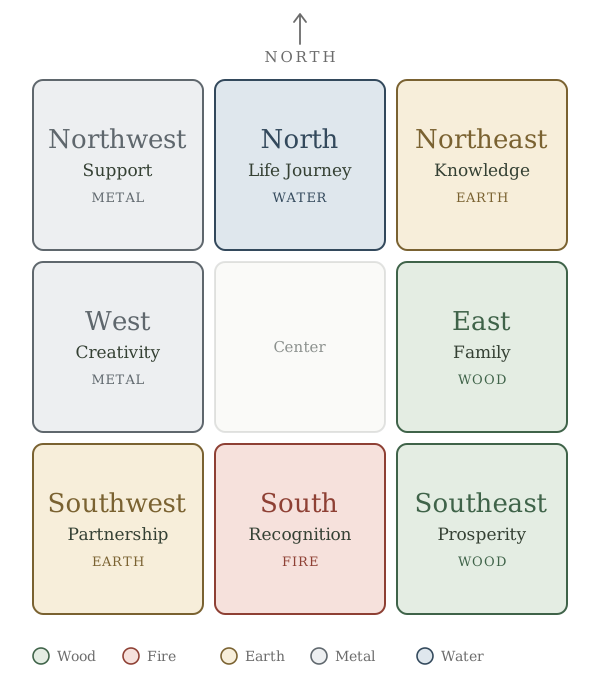
Jede Himmelsrichtung traegt ein Element und einen Bagua-Lebensbereich: Norden Wasser und Lebensweg, Nordosten Erde und Wissen, Osten Holz und Familie, Suedosten Holz und Wohlstand, Sueden Feuer und Anerkennung, Suedwesten Erde und Partnerschaft, Westen Metall und Kreativitaet, Nordwesten Metall und Unterstuetzung. Im Raster liegt Norden oben — so wird das Bagua ueber einen Grundriss gelegt.
Farben, Formen und Materialien
Jedes Element bringt eigene Traeger mit: Holz gruene und tuerkise Toene, senkrechte Formen, Holz, Textilien und Pflanzen. Feuer rote, orange und pinke Toene, spitze Formen, Kerzen, Leder und Licht. Erde gelbe, ockerfarbene und beige Toene, flache Formen, Keramik, Stein und Ton. Metall Weiss, Grau, Silber und Gold, runde Formen, Metall und Glas. Wasser Blau und Schwarz, wellige Formen, Wasser und Spiegel. Im naehrenden Zyklus staerkt Wasser das Holz, Holz das Feuer, Feuer die Erde, Erde das Metall und Metall das Wasser.
Im Alltag
Am Bett zeigt das Kopfende in eine der guenstigen Richtungen, die Tuer im Blick, aber nicht in ihrer Linie. Am Schreibtisch blickt man beim Sitzen in eine dieser Richtungen, mit fester Wand im Ruecken. Am Esstisch waehlt man den Sitzplatz entsprechend. Lassen sich Richtung und Kommandoposition nicht vereinbaren, hat traditionell die Kommandoposition Vorrang.
Der interaktive Rechner ergaenzt je Richtung das zugehoerige Element und den Bagua-Lebensbereich, dazu passende Farben, Formen und Materialien sowie einen Vergleich mit einer zweiten Person im Haushalt.
Dazu im Wissensbereich
- Ostgruppe & Westgruppe: deine günstigen Himmelsrichtungen
- Das Bagua: die acht Lebensbereiche im Raum
- Himmelsrichtungen im Feng Shui — und wie du richtig misst
- Die fünf Elemente im Feng Shui: Wu Xing und ihre Zyklen
- Feng-Shui-Farblehre: Welche Farbe zu welchem Element passt
- Die Kommandoposition für Bett und Schreibtisch
- Was Feng Shui nicht ist: eine ehrliche Einordnung
The Eight Trigrams: Symbols from the I Ching
Each qua number belongs to a trigram—one of the eight basic symbols of the I Ching. Each of these trigrams consists of three horizontal lines, which can be either solid (Yang) or broken (Yin). Together, they form eight possible combinations, each of which is associated with a natural phenomenon, an element, and a cardinal direction.
An overview of the quai number–trigram assignments:
- 1 – Kan: Element Water, cardinal direction North. The symbol is deep, flowing water—perhaps a reference to fluidity and the subterranean.
- 2 – Kun: Element Earth, southwest. The symbol is the receptive, nourishing earth.
- 3 – Zhen: Element Wood, East. The symbol is thunder—new beginnings, movement, awakening.
- 4 – Xun: Element Wood, southeast. The symbol is the gentle wind that acts steadily.
- 6 – Qian: Metal element, northwest. The symbol is the sky—strength and vastness.
- 7 – Dui: Metal element, West. The symbol is the lake—reflection and joy.
- 8 – Gen: Earth element, northeast. The symbol is the mountain—stillness, steadfastness.
- 9 – Li: Fire element, South. The symbol is the flame—clarity, visibility, warmth.
These images are symbols—not statements about a person’s true nature. They can serve as poetic lenses through which one might view one’s own situation. Nothing more, but also nothing less.
Kua Numbers 1 through 9: What Does Each Number Mean?
Let’s take a closer look at Kua numbers 1 through 9—always keeping in mind that these are traditional symbols that should be understood as an invitation to reflection, not as a fixed definition of personality.
Kua Number 1 – Kan (Water, North)
The Kan trigram symbolizes deep, flowing water—representing fluidity and the quest to find one’s path. In Feng Shui, the north is considered particularly significant. People with this number might find in it a symbol of adaptability and depth—though this is not meant to be a definitive statement about their character.
Qua Number 2 – Kun (Earth, Southwest)
Kun symbolizes the nurturing, receptive earth. In classical Feng Shui, the southwest is considered the starting direction. The image of the earth can be interpreted as a symbol of care and reliability—as an invitation to reflection, not as destiny.
Qua Number 3 – Zhen (Wood, East)
Zhen, thunder, symbolizes new beginnings and vibrant energy. The east is traditionally regarded as the direction of beginnings. Those who wish may find in it a symbol of the joy of new beginnings and movement.
Qua Number 4 – Xun (Wood, Southeast)
Xun, the gentle wind, is steady and penetrating—silent but persistent. The southeast is its cardinal direction. This image could represent patience and steady growth.
Qua Number 5 – Special Case
In the Bagua (the eight-field symbol of Feng Shui), the number 5 is the center and is not assigned to any of the eight trigrams. In the classical calculation, it is therefore replaced—men receive the number 2, women the number 8. More on this in the FAQ section below.
Qua Number 6 – Qian (Metal, Northwest)
Qian, the Heaven trigram, symbolizes strength and vastness. The northwest is its cardinal direction. This image can be understood as an invitation to cultivate perspective and clarity—as an impetus for reflection, not as an obligation.
Qua Number 7 – Dui (Metal, West)
Dui, the Lake, reflects and rejoices. The west is considered its corresponding cardinal direction. The symbol of the lake could be interpreted as an image of openness and serene composure.
Qua Number 8 – Gen (Earth, Northeast)
Gen, the mountain, stands for stillness and steadfastness. The northeast is its direction. The image of the mountain can be interpreted as a symbol of being deeply rooted and inner peace.
Qua Number 9 – Li (Fire, South)
Li, the flame, represents clarity, light, and warmth. The south is its cardinal direction. The image of fire could be understood as an invitation to explore visibility and vitality.
Psychological Background: Symbols and Self-Reflection Research on the psychology of symbolic systems—such as Carl Gustav Jung’s work on archetypes and collective symbols—suggests that people can use symbolic structures to organize and reflect on their own experiences. Symbols such as the trigrams of the I Ching can serve as surfaces for projection that stimulate self-reflection—without it being necessary to attribute any independent effect to them. What matters is how a person interacts with a symbol and what meaning they ascribe to it.
Qua Number, Trigrams, and Cardinal Directions: What Is Feng Shui Really About?
At its core, the Gua Number Trigram system is a system of orientation. In classical Feng Shui—particularly in the school known as Xuan Kong or the Eight Mansions system—certain compass directions are classified as more or less favorable for specific activities based on one’s personal Gua number.
In practical terms, this means that anyone who knows their Qua number can consult Feng Shui to determine which areas of a room or house might be considered supportive for sleeping, working, or relaxing—based on their own personal number. Whether and to what extent one follows these recommendations is a completely personal decision.
Scientifically, there are no controlled studies that unequivocally prove Feng Shui principles. What research does show, however, is that the way a room is designed can influence well-being. Studies in environmental psychology, such as those by Mehrabian and Russell (1974), suggest that spatial factors like light, layout, and orientation can influence people’s emotional state. The Qua number gives this discussion a concrete form. What is evident is that consciously designing one’s own environment can feel good for many people.
What the Qua Number Is Not: Clearly Defining Limits
It’s worth being very clear on this point: The Qua Number is not a personality test, not a psychological tool, and not a set of rules for life. It says nothing about who you are as a person, what you’re capable of, what you’ll become, or how you should behave. This clarity is important—not to devalue the system, but to use it respectfully and without causing harm.
Some online sources go too far and describe Qua numbers as if they determine personalities, strengths, weaknesses, and even life paths. This goes beyond what the classic system actually claims—and, in the worst case, can lead people to feel pigeonholed in categories that weren’t meant for them at all.
If you know your number and find an image or symbol within it that resonates with you—wonderful. If not, that’s just as valid. As psychologist Martin Seligman (2002) emphasized in his work on positive psychology, human strength lies in the diversity of individual experiences and resources—not in assigned categories.
The Meaning of the Qua Number in Everyday Life: How Can I Make Use of It?
Let’s say you’ve calculated your Qua number and know which trigram, element, and cardinal directions correspond to it. Now what? Here are a few ways some people put this knowledge to use—without any pressure and by no means an exhaustive list:
- Interior Design as an Experiment: You might want to try positioning your desk or bed toward your personal primary direction—and then simply observe whether anything feels different. This is a playful approach, not a requirement.
- The Trigram Image as a Prompt for Reflection: If your trigram features the image of the mountain, you could spend some time exploring the question: What kind of stillness or stability am I currently missing—or what might I already have within me? This isn’t a definitive truth, but it might be a helpful starting point for reflection.
- The Element as Inspiration: The five classical elements—water, wood, fire, earth, metal—also appear in other contexts, such as in traditional Chinese medicine or in Taoism. Some people find it enlightening to engage with the element associated with their number—as a cultural point of entry, not as a rule for life.
- Curiosity Instead of Certainty: Perhaps the most valuable way to approach the Qua number is simply this: curiosity. What has this system meant to people over the centuries? What wisdom lies within these images? And what aspects of it might resonate in my own life?
For many people, it can be helpful to view symbolic systems like this one as a kind of invitation to self-reflection—much like a journal prompt or a poetic image. In her research on the practice of self-compassion, psychologist Kristin Neff (2003) showed that reflective self-observation can be particularly beneficial when it takes place without self-criticism or pressure to perform. Perhaps this can also be applied to how we approach our own Qua number.
The Eight Houses System: Cardinal Directions and Personal Number
In the so-called Eight-House System (Chinese: Ba Zhai)—one of the best-known classical schools of Feng Shui—the personal Gua number is used to create an individualized directional scheme. In this system, four cardinal directions are classified as supportive and four as less supportive.
The four directions considered favorable are traditionally associated with areas such as well-being, personal growth, health, and relationships. The four directions considered less favorable bear traditional names such as “five spirits” or “total loss”—images that may sound quite dramatic but should be understood within a historical and cultural context, not as modern life advice.
The original purpose of the system was to arrange one’s living space in harmony with natural energy flows. Whether and to what extent one chooses to integrate this traditional knowledge into one’s daily life is an entirely personal decision—and should never be subject to pressure to be “right” or “wrong.”
The Qua Number and Cultural Context: Knowledge with a History
It is worthwhile to consider the Qua number within its cultural and historical context as well. Feng Shui as a practice originated in China more than two thousand years ago—as a system that established connections between people, space, and nature. It was not an esoteric trend, but a serious system of thought that influenced architecture, urban planning, tomb design, and later, interior design as well.
In his research on Feng Shui in China, sinologist Ole Bruun (2003) describes how the system has changed significantly over the centuries and was practiced very differently depending on the region and social context. What we know today in the West as “Feng Shui” is often a greatly simplified and popularized version—sometimes enriched with elements that have little to do with the classical system.
This historical perspective is not a criticism, but an invitation: Anyone who explores the Qua number enters a rich cultural field that deserves respect and curiosity—and one that is best explored with an open yet critical eye.
Your daily companion for personal growth
With the 7zen app, you'll receive daily coaching prompts, guided breathing exercises, and personal reflections—all based on your individual profile.
For a comprehensive analysis: On-site consultation
This article offers some guidelines for your own living space—and that’s a good place to start. However, a comprehensive Feng Shui analysis should be conducted by a trained consultant. It takes into account factors that a written guide cannot: the location of the house, the layout of the rooms, the actual cardinal directions in the floor plan, the surroundings, and the people who live there. In most regions, there are specialists available; consulting with one is particularly advisable when renovating, buying a home, or when the preferences of several people in the household cannot be reconciled.
What is the difference between the Qua number and the Kua number?
The terms “Qua” and “Kua” refer to the same concept—they are simply different spellings of the Chinese term “Gua,” which means “trigram.” In German, you’ll encounter both spellings, though “Kua” is used more frequently in Western Feng Shui circles. There is no difference in meaning.
Why isn't there a "Qua" number 5?
In the Bagua—Feng Shui’s eight-sector orientation model—the number 5 corresponds to the center. Since the center is not assigned to any of the eight cardinal directions or any of the eight trigrams, it is not used as a personal Gua number. In the classical tradition, people whose calculation yields 5 are instead assigned a substitute number: 2 (Kun/Earth) for men and 8 (Gen/Earth) for women. Some schools of Feng Shui handle this slightly differently—in such cases, it’s worth looking into the specific tradition or seeking a personal consultation.
Can I calculate my Qua score myself?
Yes, that is generally possible. The traditional formula is based on the year of birth according to the Chinese lunar calendar. Since the Chinese New Year does not fall on January 1, people born in January or early February should check whether their date of birth falls within the new Chinese year or still within the previous one. There are specialized online calculators that take this into account. A manual calculation is possible but prone to small errors—if you want to be absolutely sure, you can consult a Feng Shui expert.
Does the Qua number say anything about my personality?
No—at least not in the sense of a personality test or a psychological diagnosis. The Qua number primarily corresponds to cardinal directions and refers to a trigram with a symbolic image and an element. These images can be understood as poetic invitations to reflection, but they do not describe fixed character traits. No number is better or worse than another—and the diversity of human personalities cannot be captured by any single number.
Is Feng Shui scientifically proven?
The classical principles of Feng Shui, taken as a whole, are not supported by scientific studies. However, research does show that spatial factors such as light, layout, order, and a person’s sense of well-being in a room can influence emotional well-being—as suggested, for example, by studies in environmental psychology. Feng Shui can therefore be understood as a cultural framework that can help people design their living spaces more consciously—without claiming that its effects have been scientifically proven.
Do I need to know my Qua number to practice Feng Shui?
No. There are various schools and approaches to Feng Shui—some focus more on the personal trigram, while others emphasize spatial structure, energy flow, or other principles. The Qua number is just one tool among many—helpful for those who wish to work with it, but not a prerequisite. Anyone interested in Feng Shui can start with simple principles such as organization, light, and mindful interior design, regardless of their own number.
Understanding the meaning of the Qua number means, above all, putting it into context—as a cultural heritage, a symbolic system of orientation, and an invitation to reflection—not as a set of rules for life or a judgment on one’s personality. Whether you use the trigram images as poetic mirrors, explore your cardinal directions with curiosity, or simply get to know the system as an interesting cultural phenomenon: all of these are valid approaches.
Perhaps today you’d like to simply begin by consciously exploring your space—not with a specific goal in mind, but with open curiosity: Where do you feel at ease? Which corner invites you to pause? Sometimes it’s these small, mindful moments of self-awareness that prove to be the most valuable—regardless of numbers and cardinal directions.