School of Form
The School of Form (Chinese: Luan Tou) is the older of the two main schools of Feng Shui. It evaluates the landscape, the shape of buildings, and the surroundings—back support, views, and access routes—and does so entirely without a compass or calculations. Its focus is on what is visible: How is a place shaped, protected, and situated?
What is the School of Form?
The School of Forms, known in Chinese as Luan Tou, is the older of the two major Feng Shui traditions. Its origins lie in the observation of the landscape and nature: Where does the terrain offer protection? Where does the view open up? How does water flow, and how does the wind blow? Long before any compass calculations were made, these questions were central to the selection of a site.
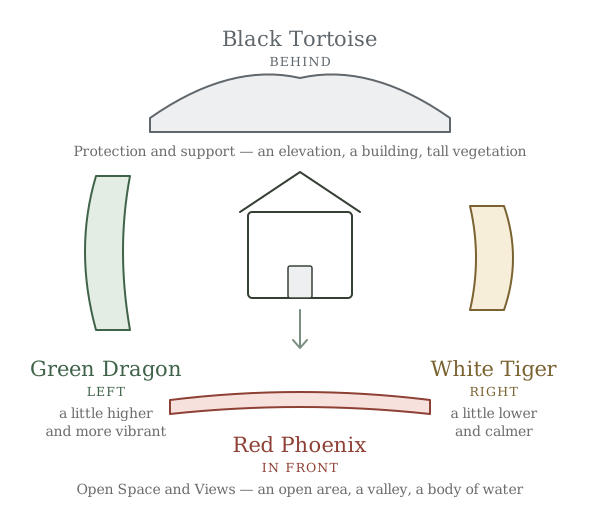
The core principle of the Form School can be briefly described as follows: A good location has a solid backing, an open, inviting view to the front, and lateral support on the left and right. These three qualities can be discerned in landscapes as well as in individual buildings or even in a seating area within a room. The classic symbol for this is the four animals—the tortoise, the phoenix, the dragon, and the tiger—which embody precisely these spatial dimensions.
An important advantage of the School of Form is its immediacy: You don’t need measuring instruments or numerical calculations; instead, you train your own eye for spatial qualities. This makes it particularly accessible—and at the same time so fundamental that it is traditionally considered a priority in the joint practice of both schools. Even elaborate compass calculations lose their value if the foundational form of a location is incorrect.
Among the elements evaluated by the School of Form are, among others:
- Natural and man-made elevations behind the building
- Openness and depth of the view to the front
- Proportions and symmetry of adjacent buildings or terrain features
- Access routes and how energy (Qi) flows to the site
Can the Form School be practiced in the city as well?
Yes. In an urban setting, buildings, streets, and open spaces take the place of hills and waterways. A taller building behind, a quiet side street framing the entrance, and an open plaza in front of the entrance—these are the urban equivalents of classical formal qualities.
How does the Form School relate to the Compass School?
In practice, the two schools complement each other. The Form School provides the foundation—it assesses whether a location fundamentally meets the necessary conditions. The Compass School then refines this assessment through directional measurements and calculations. Traditionally, it is held that without solid formal quality, compass analyses can achieve little.