The Five Elements in Feng Shui: Wu Xing and Their Cycles
Wu Xing, Wood, Fire, Earth, Metal, Water—what is the significance of the five elements in Feng Shui and their cycles?
Anyone who studies Feng Shui will sooner or later encounter a central concept: the five elements in Feng Shui, known in Chinese as Wu Xing. Before we delve deeper, it’s worth making an important distinction—because this is where misunderstandings often arise. Wu Xing has nothing to do with the four Western astrological elements you may be familiar with from European tradition: fire, earth, air, and water. In our article “The Four Elements,” you’ll find more about this Western system, which is closely linked to temperaments and astrological zodiac signs. In Feng Shui, however, there is no Air element—instead, Wood and Metal appear, which are absent from the Western concept. And there’s another fundamental difference: Wu Xing does not describe fixed states or character types, but rather phases of transformation—dynamic processes that influence, nourish, control, and weaken one another. So it’s less about what things are and more about how they relate to one another.
What Does Wu Xing Mean? Understanding the Five Elements in Feng Shui
“Wu” means five, and “Xing” is best translated as transformation, movement, or process. The term “phases of transformation” is therefore probably more accurate than the German word “elements,” which in German tends to evoke the idea of basic substances. In fact, these are five qualitative processes that have played a central role in Chinese philosophy, medicine, and the observation of nature for millennia.
The five phases of transformation are: Wood (Mù), Fire (Huǒ), Earth (Tǔ), Metal (Jīn), and Water (Shuǐ). Each phase represents a specific quality of energy, a direction of movement, a season, and much more. Wood, for example, represents growth and new beginnings; Fire, expansion and vitality; Earth, stability and grounding; Metal, clarity and consolidation; and Water, depth and retreat.
In research on Chinese philosophy and cultural history—such as in Paul Unschuld’s (1985) work on the history of Chinese medicine—it is repeatedly emphasized that Wu Xing is not a rigid classification system, but rather a model for interactions and transitions. In everyday life, this might mean: If you understand how these phases relate to one another, you may be better able to assess why certain spatial qualities feel the way they do—and how you could gently restore balance.
Why Feng Shui Is Part of 7zen
7zen is based on a simple idea: be who you are. This includes the assumption that the inner and outer worlds are interconnected—that your surroundings affect you, and that what goes on inside you is also reflected in how you live.
This interdependence is precisely what Feng Shui is all about. It views space not as a backdrop, but as a counterpart, and it works with what occurs naturally in the world: light and air, water and wood, stone and metal. A harmonious external environment can therefore potentially touch on inner issues—not as a cure and not at the push of a button, but because one is connected to the other.
Here’s an analogy: If you run regularly, eat well, and work on your inner attitude, you’ll become a good runner—no shoe can change that. But with the right shoes, running is easier. Feng Shui is roughly that: not the training, but the shoes. It doesn’t replace anything you’re already doing for yourself—it can complement it.
This is not a guarantee of results. It’s the mindset from which we approach this topic.
Wood, Fire, Earth, Metal, Water—the five elements
Each of the five phases of transformation embodies its own quality—a kind of inner essence that can be reflected in colors, shapes, materials, seasons, and even in our inner state.
- Wood represents new beginnings, growth, and vision. Its natural symbol is the tree, reaching upward. In a room, Wood can be embodied by plants, bamboo, or vertical shapes. Its colors are green and turquoise. Its season is spring.
- Fire embodies warmth, vitality, and connection. It represents summer, light, and expansion. Red tones, candles, triangles, and pointed shapes can express this phase.
- Earth brings balance and stability. Warm earth tones, rectangular shapes, and ceramic materials can embody Earth in a space. It is the phase of transition, the center—the bridge, so to speak, between the other four.
- Metal stands for clarity, precision, and letting go of the superfluous. White, gray, and metallic tones, round shapes, and smooth surfaces are typical ways to express it. Its season is fall.
- Water symbolizes depth, retreat, and wisdom. Dark blue, black, flowing and irregular shapes, as well as reflective surfaces, can embody water. Winter is its season.
For many people, it can be helpful not only to view these qualities as abstract concepts but also to experience them physically: How does a space feel when it’s characterized by vertical wooden elements and green plants? And how does the atmosphere change when clean metal forms are added?
The Nourishing Cycle (Sheng): How the Elements Strengthen One Another
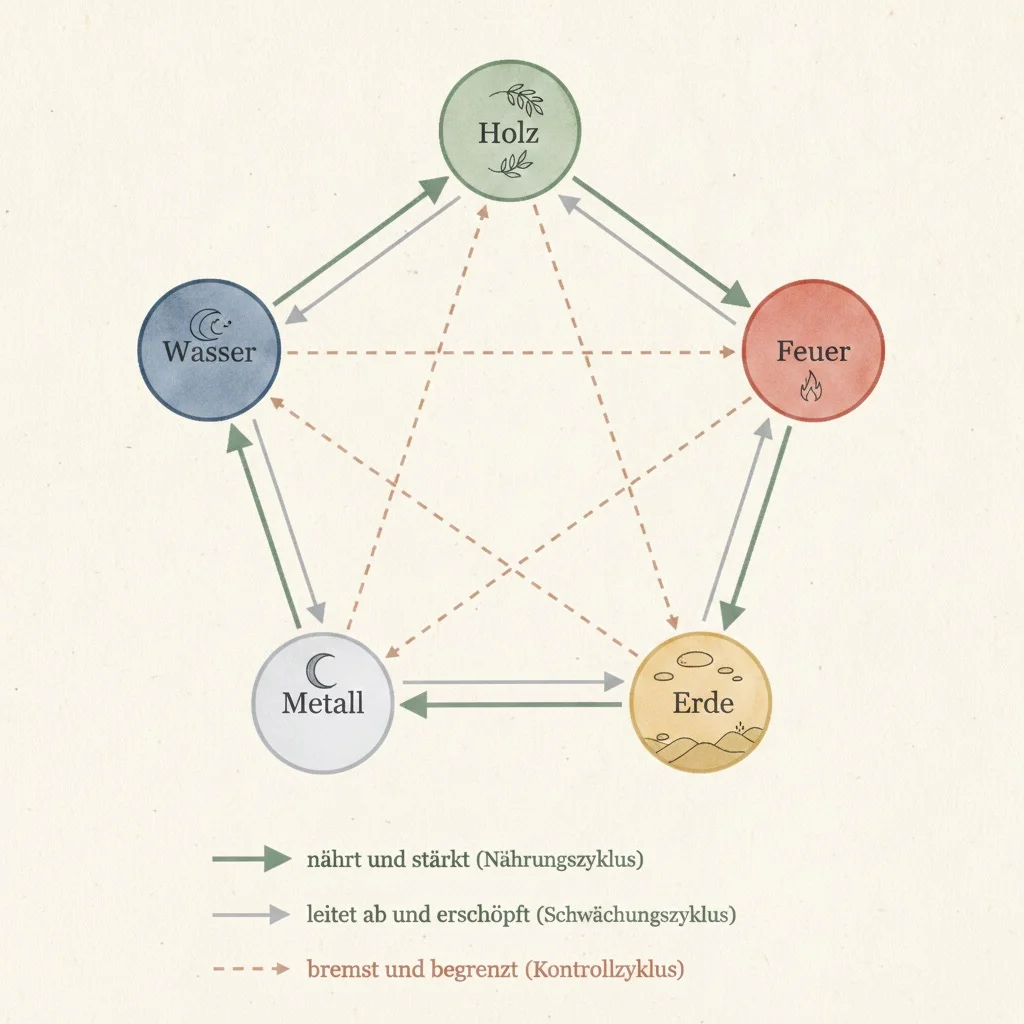
At the heart of the Wu Xing system are three cycles through which the five phases of transformation interact with one another. The first and perhaps best-known is the Nourishing Cycle, known in Chinese as Sheng—which can be translated as “generation,” “birth,” or “nourishment.” It describes a loving, supportive relationship between the phases: one phase gives rise to the next, just as a mother nourishes her child.
The Nourishing Cycle proceeds as follows:
- Wood nourishes Fire—Wood provides Fire with its fuel. Without wood, there is no fire.
- Fire nourishes Earth—Fire leaves behind ashes that enrich the soil. Fertile soil arises from what has been burned.
- Earth nourishes Metal—Metal is formed in the womb of the earth, is born from it, and is sustained by it.
- Metal nourishes water—metal can collect and channel water; mineral springs arise from rock.
- Water nourishes Wood—water enables the growth of plants and trees. Without water, there is no wood.
This cycle is complete because wood, in turn, nourishes fire—and so on, without beginning and without end. In Feng Shui, it can be a rewarding exercise to design a space with this cycle of nourishment in mind: Which elements might be underrepresented? Could a little more “water” quality—perhaps through a small bowl of water or darker, flowing textiles—help the Wood element in the room to flourish?
Research on environmental psychology—such as Esther Sternberg’s (2009) work on healing environments—suggests that the composition and quality of a space can indeed influence our well-being, even if the underlying mechanisms are not yet fully understood. The cycle of nourishment could serve as a kind of intuitive guide to help design spaces that are balanced and vibrant.
Scientific Background Research in environmental psychology suggests that the sensory qualities of a space—its materials, colors, shapes, and surfaces—can influence subjective well-being (see Sternberg 2009; Evans & McCoy 1998). In this context, Wu Xing could be viewed as a culturally evolved organizing principle that intuitively describes how different spatial qualities harmonize with one another or create tension.
The Control Cycle (Ke): When Elements Restrain One Another
In addition to the nourishing Sheng cycle, there is a second, less gentle cycle: the control cycle, known in Chinese as Ke—which can be translated as “defeat,” “control,” or “restrain.” It describes how one phase keeps another in check, weakens it, or limits it. In Chinese thought, this cycle is considered necessary: without control, every form of energy would proliferate unchecked and fall out of balance.
The control cycle works as follows:
- Wood drains Earth—roots penetrate and deplete the soil.
- Earth restrains Water—dams, banks, and soil limit the flow of water.
- Water extinguishes Fire—water can smother any flame.
- Fire melts Metal—heat transforms solid metal into liquid.
- Metal cuts wood—the axe fells the tree.
In Feng Shui, the Ke cycle is considered effective but crude. It works quickly and directly—like a cut or a clear boundary. If one element appears very dominant in a room and is noticeably out of balance, the controlling element could be used strategically to create a counterbalance. A room with a heavy Fire element—featuring many red tones, sharp shapes, and plenty of light—could potentially be balanced by Water elements such as a small fountain or dark blue accents. Some people experience such interventions as very direct and quite noticeable—others may not notice any difference at all. That’s perfectly fine: Feng Shui invites you to experiment and listen to your own perceptions.
The Weakening Cycle (Xie): The Gentlest Method of Balancing
The third cycle is perhaps the least well-known—and at the same time, the one that is often considered the preferred method in Feng Shui when an element has become too strong and needs to be moderated. It is called Xie and can be translated as “exhausting,” “dispersing,” or “weakening.” At first, the principle sounds counterintuitive: a phase is weakened by nourishing the next phase in the nourishing cycle particularly strongly—that is, by excessively supporting its “child” until it becomes exhausted itself.
The cycle of weakening proceeds as follows:
- Earth weakens Fire—Fire becomes exhausted when it produces too much ash and earth.
- Metal weakens Earth—Earth becomes exhausted by constantly producing Metal.
- Water weakens Metal—Metal is depleted when it carries and collects more and more water.
- Wood weakens Water—Water is depleted when it ceaselessly nourishes the growth of Wood.
- Fire weakens Wood—Wood burns and becomes depleted when the fire grows too large.
What makes this cycle so special? Unlike the Ke cycle, which intervenes directly and “cuts” through, so to speak, the Xie cycle acts indirectly and gently. Instead of directly combating a dominant element, its energy is redirected. The excess is diverted, not suppressed. In practice, this could mean: If a room is characterized by very strong Earth energy—for example, due to many heavy, earthy materials and warm ochre tones—it would be conceivable, according to the Ke cycle, to use Wood, which controls Earth. However, it would be gentler to introduce more Metal qualities, because Earth would then be occupied with nourishing Metal and would naturally become depleted. It may sound complex—but in practice, it could be as simple as adding a metallic sculpture or white, clean shapes to a very heavy, dark room.
An Overview of the Three Element Cycles: Sheng, Ke, and Xie
To summarize the three cycles once again and clarify their different qualities:
- Nourishing Cycle (Sheng): loving, supportive, nurturing. One phase gives birth to and nourishes the next. This is considered the natural balance when all five phases are adequately represented.
- Control Cycle (Ke): direct, fast, powerful. One phase restrains and limits another. Effective in cases of severe imbalance, but is considered harsh and should be used with caution.
- Weakening Cycle (Xie): indirect, gentle, dissipating. One phase weakens itself by over-nourishing its child. This is considered the preferred and most sensitive method for mitigating excess energy.
In Feng Shui consultations—and in one’s own exploration of one’s home—these three cycles can serve as conceptual tools that help to interpret the character of a space and, if necessary, adjust it in a targeted manner. It is important to emphasize: Feng Shui is not an exact system with guaranteed results. It is rather an invitation to be mindful—to view one’s own space with fresh eyes and to sense what feels harmonious.
The Five Elements of Feng Shui in Everyday Life: How to Explore the Cycles
You don’t have to be a Feng Shui expert to encounter the five phases of transformation. Even a careful look around your home could raise some interesting questions: Which elements are particularly prominent? Are there rooms that feel strangely cold or overheated—not in terms of temperature, but in terms of atmosphere?
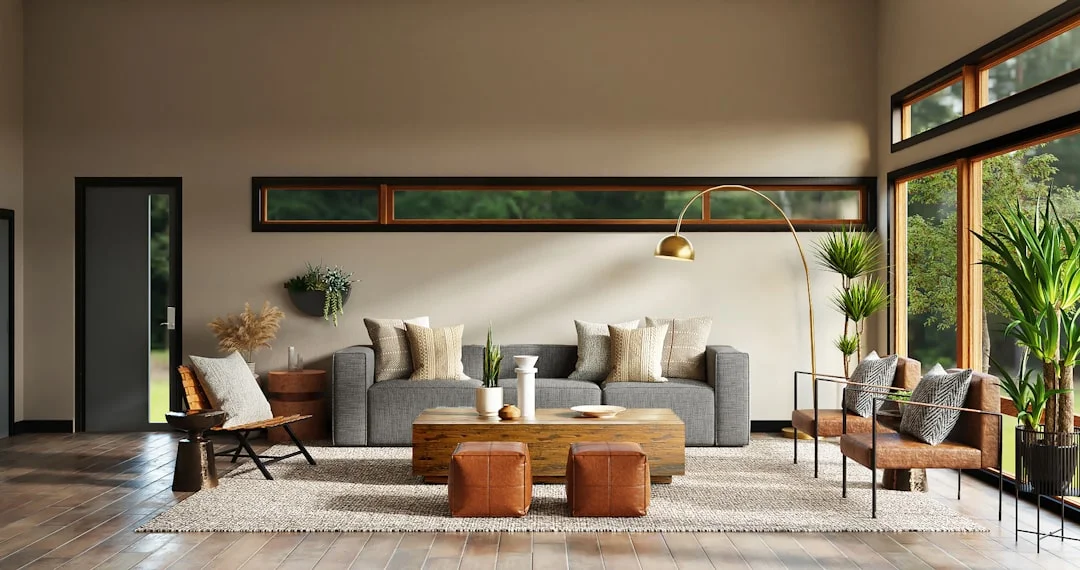
For example, some people find that a home office dominated by stark white surfaces, metal, and hard edges feels clear and focused, but also somehow lifeless. Perhaps it’s missing a touch of the Wood element—a plant, a desk made of natural wood, or a soft shade of green. The cycle of the elements reminds us that Wood feeds Fire: perhaps a little more vitality in the room could also support inner vitality and creativity.
Or a living room might feel somewhat restless despite its many colorful hues and decorative elements. Here, the Earth element might be missing—that centering, stabilizing force. A few ceramic objects in earth tones, a thick rug, and round shapes could help the room feel grounded.
Research in the field of environmental psychology—such as that by Roger Ulrich (1984), who demonstrated that natural elements in rooms can influence subjective well-being—suggests that we do indeed respond to the sensory qualities of our environment. Wu Xing could be understood as a culturally evolved language for these reactions: a way to describe and organize what many people intuitively sense but often cannot put into words.
Perhaps you’d like to start with a single question: Which element might be missing from the room where you feel least comfortable? You could then playfully introduce a small symbol of that element—and observe whether anything changes.
Wu Xing and Balance: Not Too Much, Not Too Little
A common misconception when dealing with the five elements in Feng Shui is the assumption that more is better. So, for example, someone who wants more “water” energy in their life might be tempted to fill their space with as much blue and black as possible, along with flowing shapes and mirrors. But Wu Xing is a system of balance, not of maximization. Any element that becomes too dominant can throw the balance off—and weaken or suppress other elements.
The goal is not so much to distribute all five elements in equal amounts as it is to facilitate a harmonious interplay. Sometimes the focus is on a specific element because the room serves a particular function: A meditation room could benefit from Water and Metal, as these elements represent stillness, depth, and clarity. A child’s room, on the other hand, could benefit from Wood and a touch of Fire—symbolizing growth, curiosity, and vitality.
It can also be helpful to consider your current life situation. Are you currently in a phase of new beginnings and change? Then more Wood energy in the room might be a good fit. Do you need stability and security above all else right now? Then Earth could be your ally. This kind of intuitive self-reflection is no substitute for professional support—but it can be a welcoming way to shape your relationship with your home more consciously.
Feng Shui and Science: What We Know and What Remains Unclear
It would be disingenuous to conclude this article without briefly addressing an important question: What does science actually say about Feng Shui and the five elements? The honest answer is: very little, and much remains to be explored.
Feng Shui as a comprehensive system has hardly been studied in controlled scientific trials to date. What research is increasingly confirming, however, is that our environment can indeed influence our well-being, our concentration, and our mood. Studies such as those by Evans and McCoy (1998) on interior design and stress, or the work of Anjan Chatterjee (2014) on aesthetics and neural processing suggest that factors such as light, color, natural materials, and spatial organization influence us—even if we are not always aware of it.
In this sense, Wu Xing could be viewed as a millennia-old, culturally encoded intuition about these connections—not as a scientifically proven theory, but also not as mere superstition. It is a framework that invites us to design our own surroundings with greater attention and care. And that in itself can make a difference.
If you’d like to explore Feng Shui more deeply, it might be helpful to consult an experienced Feng Shui advisor who can address your specific space and situation. This article is intended as a guide—it is not a substitute for personal consultation.
For a comprehensive analysis: On-site consultation
This article offers some guidelines for your own living space—and that’s a great place to start. However, a comprehensive Feng Shui analysis should be conducted by a trained consultant. It takes into account factors that a written guide cannot: the location of the house, the layout of the rooms, the actual cardinal directions in the floor plan, the surroundings, and the people who live there. In most regions, there are specialists available; consulting with one is particularly advisable when renovating, buying a home, or when the preferences of several people in the household cannot be reconciled.
What is the difference between the five elements in Feng Shui and the four Western elements?
The five elements in Feng Shui (Wu Xing) are Wood, Fire, Earth, Metal, and Water—and they describe dynamic phases of transformation, that is, processes and relationships between energy qualities. The four Western elements (Fire, Earth, Air, Water) originate from Greek and European traditions and are often associated there with temperaments or astrological character traits. In Feng Shui, there is no Air element; instead, there are Wood and Metal. You can find out more about the four Western elements in our article at /de/wissen/die-vier-elemente.
Which of the three element cycles is the best?
None of the three cycles is inherently the best—they each have different qualities and areas of application. The Nourishing Cycle (Sheng) is considered the natural balance. The Controlling Cycle (Ke) acts quickly and directly, but is regarded as coarse. The Weakening Cycle (Xie) is considered the gentlest and is often the preferred method for gently dissipating excess energy. Which cycle might be appropriate depends on how severely an element has become unbalanced and what effect is being sought.
How can I recognize the five phases of transformation in my home?
Each element has typical correspondences in colors, shapes, and materials. Wood is represented by plants, natural wood, and vertical shapes in shades of green and turquoise. Fire is represented by shades of red and orange, triangles, and candles. Earth is expressed through ceramics, earth tones, and round or square shapes. Metal is found in white, gray, and metallic surfaces, as well as round shapes. Water is represented by dark blue, black, flowing shapes, and reflective surfaces. A careful look around your home might reveal which elements are particularly strong or particularly weak.
Is Feng Shui scientifically proven?
Feng Shui as a comprehensive system has hardly been studied scientifically to date. However, in spatial psychology and environmental research, there is growing evidence that spatial qualities such as light, color, materials, and order can influence well-being. Wu Xing can be understood as a culturally evolved framework that intuitively describes how various spatial qualities interact—although this has not yet been proven in a scientific sense. It is advisable to view Feng Shui as an inviting perspective rather than an exact science.
Can I practice Feng Shui on my own without having taken any training courses?
Many people discover the principles of Wu Xing and Feng Shui as a personal framework for reflection on their home design—without any formal training. Small experiments, such as adding a plant, changing colors, or trying out different materials, can be a playful way to bring more awareness to your own environment. For more in-depth advice or more complex spatial issues, it may be helpful to consult an experienced Feng Shui consultant.
Why do we say "transition phases" instead of "elements"?
The German word “Elemente” suggests that these are solid, fundamental substances—similar to chemical elements or the four Western elements. The Chinese concept of Wu Xing, however, describes processes and transitions: Wood grows, Fire expands, Earth centers, Metal condenses, and Water flows and recedes. It is therefore not about what something is, but rather about how something moves and changes. That is why the term “phases of transformation” is more accurate—even though the term “elements” remains in common use in German.
If there’s one thing you’d like to take away after reading this article, it might be this: The five elements in Feng Shui are neither a set of rules nor a formula. They are an invitation to pay attention—a language through which you can begin to describe your space and your sense of well-being within it. Perhaps you’d like to take a moment today or in the next few days to walk through your living space, keeping this question in mind: Which of the five qualities—Wood, Fire, Earth, Metal, or Water—feels strongest here? And which one might I be missing? You could introduce a small object, a color, or a material that embodies that missing quality—and simply observe how it feels. No more, no less. Feng Shui begins with mindfulness.