The Command Post for Your Bed and Desk
Why the placement of the bed and desk is so important in Feng Shui—and what lies behind it.
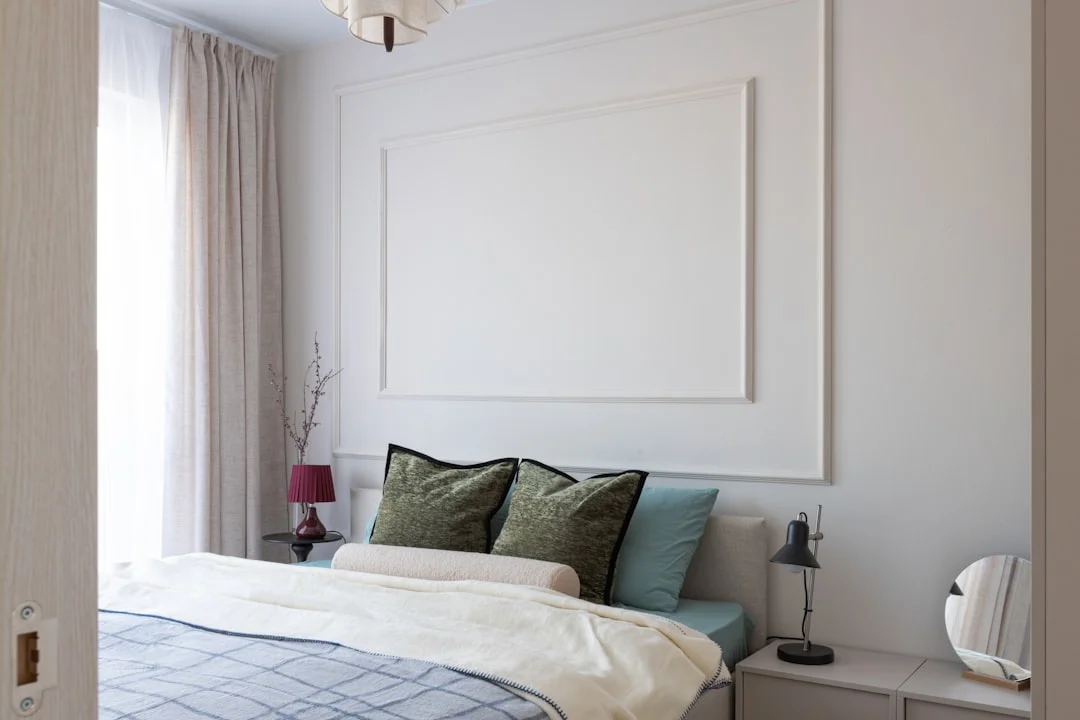
Have you ever wondered why you immediately feel at peace in some rooms—and in others, a subtle sense of unease that’s hard to put into words? The “command position” in Feng Shui might hold the answer. It refers to the idea of arranging your bed, desk, and stove in the room so that the door is always within your field of vision—without being directly opposite it. What sounds like ancient wisdom from the Far East can perhaps also be explained by what researchers have discovered about human perception and the need for security. This article invites you to better understand the command position—and perhaps to try out, in a practical way, what it could mean for your own home.
What is the command position in Feng Shui?
In Feng Shui—the Chinese philosophy of harmoniously designing spaces and environments—the command position is considered one of the most fundamental recommendations of all. The term describes a specific orientation within a room: You are in a position from which you can see the front door without sitting or lying directly in its line of sight. Ideally, you sit or lie diagonally across from the door, with a solid wall behind you—rather than a window or an open passageway.
The name itself gives away quite a bit: “command” does not refer to control in the military sense, but rather to a sense of overview and orientation. Anyone who can see the entrance to a room has—at least symbolically—the situation in view. And as many people report, it is precisely this feeling that can have a noticeable effect on one’s well-being.
Traditionally, this positioning applies to three key areas in the home: the bed in the bedroom, the desk in the workspace, and the stove in the kitchen. We spend a great deal of time in these three places—and they’re linked to sleep, work, and nutrition, that is, to areas of life that can significantly shape our well-being.

Bed Placement in Feng Shui: What to Avoid, What to Aim For?
When it comes to the bed in Feng Shui, there are some placements that are traditionally considered unfavorable—and others that are described as particularly beneficial. Among the classic positions to avoid are:
- Feet directly toward the door: This arrangement is often described in Feng Shui as the most unfavorable—it symbolically resembles the position of a body laid out for viewing and is said to heighten feelings of vulnerability.
- Bed under a sloped ceiling or a ceiling beam: A sloping ceiling above the body can intensify a feeling of confinement and may affect sleep.
- Head of the bed against a window wall: Without a solid wall behind you, a kind of psychological support is missing, which some people find unsettling.
Instead, aim for this arrangement: the bed diagonally across from the door, with the head against a solid wall. From there, you can see the door—without being directly exposed to it. Many people describe this positioning as calming and conducive to sleep, even though individual experiences can, of course, vary greatly.
Arranging Your Desk: Focus and Clarity in the Workplace
The same principles that apply to the bed can also be applied to arranging your desk. One of the most common—and, from a Feng Shui perspective, most unfavorable—desk arrangements is having your back to the door. If you work this way, you can never see who is entering. The brain—which is trained to detect potential dangers—must remain continuously “on standby” in this position, even if no threat is consciously perceived.
Research on so-called vigilance—that is, the nervous system’s state of alertness—suggests that sustained heightened vigilance can be exhausting. Studies on spatial perception suggest that people in environments where they can see the door often report feeling calmer than in comparable rooms without this line of sight.
For the desk, this means: Position it so that the door is visible—ideally diagonally, with a solid wall behind you rather than a window. If you have no choice but to sit with your back to the door, you could hang a mirror so that the door is visible in it. This simple workaround is often recommended in Feng Shui and can—even from a purely practical standpoint—help maintain a sense of control over your surroundings.
Environmental Psychology & Spatial Perception Research in environmental psychology—such as Roger Ulrich’s (1984) work on healing environments—suggests that a sense of having a clear view and a secure “back” can contribute to a perceived sense of relaxation. A manageable space with a stable, secure backdrop—whether in the office or the bedroom—may make it easier for the nervous system to shift into a calmer state. This is no guarantee of good health, but it is an observation that seems to align with many people’s personal experiences.
Why does the front-row seat feel more peaceful to many people?
A question many people ask: Is there something measurable behind the commanding position—or is it purely symbolic? The honest answer is probably: both. Feng shui itself works with concepts such as the flow of life energy (qi), which cannot be easily translated into the language of Western science. And yet, certain aspects of the commanding position can certainly be linked to considerations in environmental psychology.
In his work on brain research, neurologist and evolutionary scientist John Medina has pointed out that the human nervous system reacts to certain spatial conditions—and that a clear view and having one’s back covered may be among the factors that have a calming effect. Similar ideas can be found in the so-called Prospect-Refuge Theory by geographer Jay Appleton (1975), who described how people prefer environments that offer both a view (prospect) and protection (refuge). A solid wall behind you and an unobstructed view of the door fit this pattern perfectly.
Some people experience a noticeable sense of letting go in such spaces—a kind of relieved relaxation that is hard to describe but pleasant. The best way to find out if this is true for you is to try it out for yourself.
Feng Shui for the Bedroom: When the Ideal Isn't Possible
In practice, you’ll quickly run into a problem: Not every room allows for the ideal layout. Sloped ceilings, fixed radiators, small floor plans, or door placements can make it difficult to position your bed or desk as desired. This is completely normal—and no reason to be discouraged.
In bedroom Feng Shui, there are traditionally recognized workarounds for such situations:
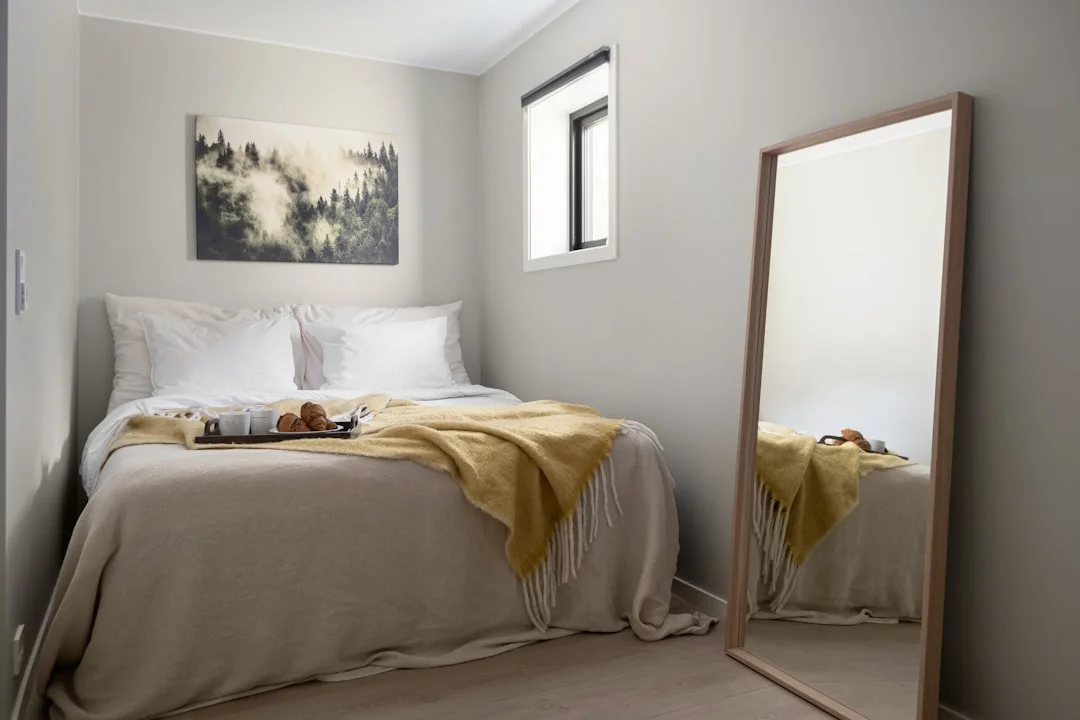
- Strategically place a mirror: A mirror that reflects the door without directly reflecting the bed can create a sense of openness—even if the position itself isn’t ideal.
- A tall headboard: A sturdy, solid headboard can symbolically and practically make up for the lack of a sense of support—it creates a sort of wall where there isn’t one.
- Room dividers or curtains: When a bed or desk is positioned directly in a walkway, a room divider can help create a protective boundary without major renovations.
It’s important to note: These workarounds aren’t fixes for a “defective” room. They’re small, often inexpensive adjustments that could improve how you experience the space. Sometimes, simply moving a piece of furniture a few centimeters is enough to make you feel significantly more comfortable in the room.
Command Position or Cardinal Direction—Which Takes Precedence?
In Feng Shui, there are other systems besides the command position—including the calculation of the so-called Qua number (sometimes also called the Kua number), which can be used to determine personal preferred directions for sleeping and working. At first glance, this sounds like an appealing addition: If you know both the ideal position and the ideal compass direction, the result should be especially good—right?
In practice, however, it turns out that if the command position and the compass direction conflict and both cannot be implemented at the same time, the command position takes precedence. This is not an arbitrary hierarchy, but a practical decision shared by many experienced Feng Shui consultants. The reason is obvious: The command position influences the sense of space—something that is experienced directly and every day. The compass direction is an abstract consideration that is harder to sense.
So if you’re faced with a choice: it’s better to place the bed diagonally across from the door, with a solid wall behind you—even if the compass direction isn’t ideal. For many people, this approach is likely to be much more noticeable than alignment based solely on the Qua number.
Feng Shui Command Position in the Kitchen: Keep an Eye on the Stove
Even though the bed and desk often take center stage, it’s worth taking a quick look at the kitchen. In Feng Shui, the stove is considered a symbol of nourishment and prosperity—and here, too, it’s recommended not to stand with your back to the door. According to Feng Shui principles, anyone who cooks without being able to see the entrance may feel rushed or uncomfortable—even though cooking could actually be a mindful, nourishing activity.
Especially in kitchens with a fixed stove connection, the position can rarely be changed. Here, too, a mirror or reflective surface above the stove can help keep the door in view. Many people report that they actually feel more relaxed while cooking if they can see the entrance area—even just out of the corner of their eye.
Whether this is due to an ancient survival instinct, Appleton’s Prospect-Refuge Theory, or simply personal habit, the effect seems to be real, even if it cannot be measured.
Step by Step: How to Find Your Commanding Position
You don’t have to be a Feng Shui expert to try out the command position for yourself. Here’s a simple approach you can explore at your own pace:
1. Observe the room
Before you move any furniture, it might be helpful to simply sit in the room for a while—on the bed, at the desk—and consciously take it all in: How does it feel? Can you see the door? Do you get the feeling that someone could be standing behind you without you noticing? Just becoming aware of these things can be revealing.
2. Explore the possibilities
Think about which positions are even possible in the room. Sometimes there’s more flexibility than you might initially think—especially with the desk, which is easier to move than the bed. You might want to play around with a tape measure or a simple floor plan on paper.
3. Give it a try
Temporarily move the piece of furniture—even if just for a few days—and see how the room feels. Do you sleep differently? Are you more focused when you work? Does it feel easier to fall asleep? Observations like these can tell you more than any theory.
4. Use aids
If the ideal position isn’t achievable, you could experiment with a mirror or a tall headboard. This is also something you can easily test before making a final decision.
5. Trust your own experience
In the end, what matters is how you feel in your space. Feng Shui—and the command position in particular—is not a rigid set of rules, but an invitation to pay attention to your own living space. What works for many people isn’t necessarily right for you. Your own experience is the most reliable guide.
What Science Can Say About This—and What It Cannot
It would be dishonest to claim that the command position has been unequivocally proven by science. Feng Shui as a whole is not a recognized scientific system, and controlled studies on the commanding position in the strict sense are rare. What does exist, however, are findings from environmental psychology, evolutionary biology, and spatial research that could support individual aspects of it.
As early as 1984, Roger Ulrich demonstrated in his influential study that the spatial environment influences subjective well-being—and that a sense of security and a sense of overview can play a role in this. Jay Appleton’s Prospect-Refuge Theory (1975) suggests that humans may be evolutionarily shaped to prefer spaces that offer both a view and a place of refuge. And research on so-called vigilance—that is, the nervous system’s constant state of alertness—suggests that a space in which one feels unobserved or exposed may contribute to increased inner tension.
None of this explains whether Qi flows or stagnates. But it suggests that a manageable space with a sense of security behind you might simply feel calmer to many people—and that’s a statement that doesn’t rely on mysticism yet can still be valuable. If you’re interested in exploring this topic further or feel that your home’s layout is linked to sleep or concentration problems, it might be worth speaking with a professional—this article is not a substitute for professional advice.
A Fresh Perspective on Your Own Space
Perhaps the best thing about the command position is that it doesn’t require any major renovations. As Feng Shui practitioners often emphasize, it is the most important single measure you can take in your interior space—precisely because it requires no contractors, no budget, and no in-depth prior knowledge. A repositioned bed, a desk oriented differently, a strategically placed mirror: these are small gestures that can potentially have a big impact.
Ultimately, it comes down to something fundamentally human: the need to feel safe, secure, and grounded within one’s own four walls. Whether you attribute this to Feng Shui, environmental psychology, or simply common sense—the result can be the same: a home where you breathe more deeply.
For a comprehensive analysis: On-site consultation
This article offers some guidelines for your own living space—and that’s a great place to start. However, a comprehensive Feng Shui analysis should be conducted by a trained consultant. It takes into account what a written guide cannot: the location of the house, the layout of the rooms, the actual compass directions in the floor plan, the surroundings, and the people who live there. In most regions, there are specialists available; consulting with one is particularly advisable when renovating, buying a home, or when the preferences of several people in the household cannot be reconciled.
Calculate Your Qua Number
Your birth year and gender determine your personal Qua number—and with it, the four cardinal directions traditionally considered favorable for you. You can calculate it directly using the calculator. The calculation runs in your browser; your date of birth is neither transmitted nor stored.
What exactly does the "command position" mean in Feng Shui?
The "command position" refers to the placement of a bed, desk, or stove such that the room's entrance door is within your field of vision—without you facing it directly. Ideally, you should be positioned diagonally across from the door, with a solid wall behind you. This arrangement is intended to promote a sense of control and security, which many people find reassuring.
Why shouldn't the bed be positioned with its foot of the bed facing the door?
In Feng Shui, the so-called “coffin position”—that is, lying with your feet directly toward the door—is considered particularly unfavorable. It symbolically resembles the laying out of the deceased and is said to create a subconscious feeling of vulnerability. From an environmental psychology perspective, this position could also be problematic, as it leaves you defenseless and at the mercy of the door, without the ability to quickly take in your surroundings. Many people report that they actually sleep more peacefully after rearranging their bed.
What can I do if I can't position my desk facing the door?
If the layout of the room doesn’t allow you to position your desk so that the door is visible, there’s a simple workaround: A mirror placed so that the door is reflected in it can create a sense of openness. Alternatively, a room divider or a curtain can help create a protective boundary between the desk and the door area. Even small decorative elements that symbolize stability and support could improve your subjective experience of work.
When aligning the bed, does the compass direction or the command position take precedence?
If both cannot be implemented at the same time, experienced Feng Shui practitioners recommend giving priority to the command position. Alignment based on one’s personal Gua number (i.e., the individual’s preferred direction according to the cardinal directions) is a valuable addition, but it feels more abstract and is harder to perceive immediately. The command position, on the other hand, directly influences the daily experience of a space—and in practice, this tangible effect usually carries more weight.
Is there scientific evidence supporting the effectiveness of the command position?
Feng Shui as a system is not a recognized scientific concept, and there are hardly any direct studies on the command position. However, related findings can be found in environmental psychology: In 1984, Roger Ulrich demonstrated that spatial environments can influence well-being. Jay Appleton’s Prospect-Refuge Theory (1975) suggests that, from an evolutionary perspective, people may prefer spaces that combine a view and shelter—exactly what the command position describes. This research does not prove the command position, but it does suggest that the underlying principle could be psychologically plausible.
Do I have to rearrange everything, or will small changes be enough?
Small steps are often enough. The “command position” is considered so practical precisely because it doesn’t require any major rearrangements. Sometimes it’s enough to rotate the desk 90 degrees, move the bed a few centimeters, or position a mirror. Maybe you’d like to start by trying just a small change and seeing how it feels—without pressure and without expecting everything to be perfect right away.
Your prompt for today: Sit down at your desk or on your bed for a moment—and just take a conscious look around: Do you see the door? Is there a solid wall behind you? If not, it might be worth moving just one piece of furniture a few centimeters and then observing for a week how the room—and you in it—feel. Sometimes, a calmer home begins with a single small change.