Calculate Your Qua Number: Here's How to Find It
What does your Qua number reveal about you? Here's how you can calculate it yourself, step by step.

Perhaps you’ve come across the term “Qua number”—or its alternative spelling, “Kua number”—and wondered what it’s all about. Being able to calculate your Qua number is a first, inviting step in Feng Shui: It’s meant to reveal which of the eight trigrams of the I Ching you belong to, and—according to traditional teachings—can offer clues as to which cardinal directions, spaces, or energy qualities might suit you. Whether you attach much or little importance to this tradition is entirely up to you. Some people see it as a playful tool for self-reflection, while others view it as a serious component of their interior design. This article shows you how the formula works, what you should keep in mind—and where mistakes are commonly made.
What exactly is the Qua number?
The Gua number—also known in Chinese as Ming Gua, which can be roughly translated as “life trigram”—is a number between 1 and 9, though 5 does not exist as a separate Gua number. It originates from classical Feng Shui, specifically the so-called Eight Houses System (also known as the Ba Zhai School). Each of the eight valid numbers is associated with one of the eight trigrams of the I Ching and thus describes a specific energetic quality or orientation.
It is important to understand: The Qua number is neither a horoscope nor a personality test in the Western sense. It is an element of a comprehensive cosmological system that has been developed and refined over centuries in China. Research in the field of cultural psychology—such as the work of Nisbett (2003) on the differences in thinking between Eastern and Western cultures—suggests that holistic, relationship-oriented systems such as Feng Shui can be deeply rooted in collective worldviews and serve as a genuine source of guidance for many people. Whether and to what extent you trust it is entirely up to you.
The beauty of having your Ming Gua calculated: All you need is your year of birth and to know whether you’re male or female. That’s all.
Calculating the Qua-Number: The Formula Step by Step
The Qua number formula follows a clear, easy-to-understand pattern. Let’s go through it together.
Step 1: Add the last two digits of your birth year
Take the last two digits of your birth year and add them together. If the result is a two-digit number, add its digits together again—and keep doing this until you have a single-digit number. In numerology, this process is called “calculating the sum of the digits.”
Example: Year of birth 1987 → 8 + 7 = 15 → 1 + 5 = 6
Step 2a: For men (Yang)
If you were born before the year 2000: 10 minus the resulting number.
If you were born in or after the year 2000: 9 minus the resulting number.
Step 2b: For women (Yin)
If born before the year 2000: Add 5 to the result.
If born in or after the year 2000: Add 6 to the result.
Then reduce the number back to a single digit, if necessary.
Step 3: The special case with the number 5
If your calculation results in a 5, then the following applies: Men are assigned to 2, women to 8. The number 5 does not exist as a Qua number—it is traditionally regarded as a neutral center and is not assigned to any of the eight trigrams.
Qua-Zahl berechnen
Die Qua-Zahl (Ming Gua) wird aus Geburtsjahr und Geschlecht gebildet und ordnet vier guenstige und vier unguenstige Himmelsrichtungen zu. Massgeblich ist das chinesische Sonnenjahr, das mit Lichun Anfang Februar beginnt — wer im Januar geboren ist, zaehlt zum Vorjahr.
Die Zahlen 1, 3, 4 und 9 bilden die Ostgruppe mit den guenstigen Richtungen Norden, Osten, Suedosten und Sueden. Die Zahlen 2, 6, 7 und 8 bilden die Westgruppe mit Westen, Nordwesten, Suedwesten und Nordosten. Eine rechnerische 5 wird bei Maennern auf 2, bei Frauen auf 8 gelegt.
Deine Himmelsrichtungen
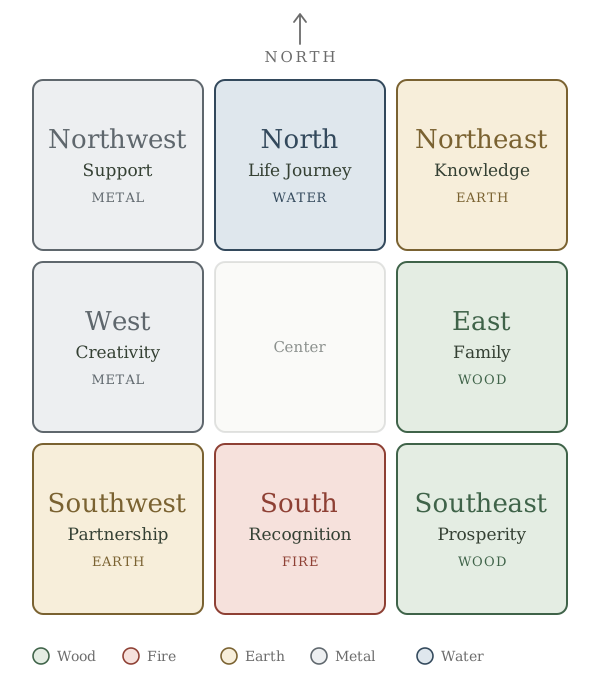
Jede Himmelsrichtung traegt ein Element und einen Bagua-Lebensbereich: Norden Wasser und Lebensweg, Nordosten Erde und Wissen, Osten Holz und Familie, Suedosten Holz und Wohlstand, Sueden Feuer und Anerkennung, Suedwesten Erde und Partnerschaft, Westen Metall und Kreativitaet, Nordwesten Metall und Unterstuetzung. Im Raster liegt Norden oben — so wird das Bagua ueber einen Grundriss gelegt.
Farben, Formen und Materialien
Jedes Element bringt eigene Traeger mit: Holz gruene und tuerkise Toene, senkrechte Formen, Holz, Textilien und Pflanzen. Feuer rote, orange und pinke Toene, spitze Formen, Kerzen, Leder und Licht. Erde gelbe, ockerfarbene und beige Toene, flache Formen, Keramik, Stein und Ton. Metall Weiss, Grau, Silber und Gold, runde Formen, Metall und Glas. Wasser Blau und Schwarz, wellige Formen, Wasser und Spiegel. Im naehrenden Zyklus staerkt Wasser das Holz, Holz das Feuer, Feuer die Erde, Erde das Metall und Metall das Wasser.
Im Alltag
Am Bett zeigt das Kopfende in eine der guenstigen Richtungen, die Tuer im Blick, aber nicht in ihrer Linie. Am Schreibtisch blickt man beim Sitzen in eine dieser Richtungen, mit fester Wand im Ruecken. Am Esstisch waehlt man den Sitzplatz entsprechend. Lassen sich Richtung und Kommandoposition nicht vereinbaren, hat traditionell die Kommandoposition Vorrang.
Der interaktive Rechner ergaenzt je Richtung das zugehoerige Element und den Bagua-Lebensbereich, dazu passende Farben, Formen und Materialien sowie einen Vergleich mit einer zweiten Person im Haushalt.
Dazu im Wissensbereich
- Ostgruppe & Westgruppe: deine günstigen Himmelsrichtungen
- Das Bagua: die acht Lebensbereiche im Raum
- Himmelsrichtungen im Feng Shui — und wie du richtig misst
- Die fünf Elemente im Feng Shui: Wu Xing und ihre Zyklen
- Feng-Shui-Farblehre: Welche Farbe zu welchem Element passt
- Die Kommandoposition für Bett und Schreibtisch
- Was Feng Shui nicht ist: eine ehrliche Einordnung
A complete example calculation—to make it really clear
To make sure the formula doesn’t remain abstract, let’s walk through it together using a concrete example. Let’s say you’re a woman born on June 15, 1990.
- Step 1: Last two digits of the year: 9 and 0 → 9 + 0 = 9
- Step 2: Born before 2000, female → 9 + 5 = 14 → 1 + 4 = 5
- Step 3: The result is 5 → for women, this becomes 8
This person’s Qua number would therefore be 8, associated with the Gen (Mountain) trigram. Some Feng Shui traditions associate this number with qualities such as stability, calmness, and a special connection to northeastern directions.
Here’s a second example: A man born on March 3, 2003.
- Step 1: Last two digits: 0 and 3 → 0 + 3 = 3
- Step 2: Born in 2000 or later, male → 9 − 3 = 6
- Step 3: No 5 → The Qu number remains 6
This may sound mechanical at first—and indeed, the calculation is purely mathematical. It is only within the context of the Feng Shui system that the number reveals its potential meaning.
Important Note: The year does not begin on January 1 The Chinese solar year does not begin on January 1, but with the Lichun solar term—which falls on February 3, 4, or 5, depending on the year. This date is what determines the Qua number, not the Gregorian New Year. Anyone born between January 1 and early February could recalculate their result using the previous year’s data—and might end up with a different number.
The Most Common Mistake Regarding the Feng Shui Birth Year: Which Year Really Counts?
Experience shows that this is where the biggest mistake regarding the Feng Shui birth year occurs: Many people simply use the calendar year in which they were born—that is, the year listed on their German passport. In classical Feng Shui, however, this does not necessarily count.
What matters is the Chinese solar year, which begins on the date of Lichun (“Start of Spring”). Depending on the year, this date falls on February 3, 4, or 5. It is an astronomically calculated point in the sun’s cycle—not a fixed date on the calendar.
Specifically, this means that someone born on, say, January 28, 1975, should use the year 1974 for the Qua number calculation—because the Chinese solar year of 1975 had not yet begun.
Lunar New Year vs. Solar Year—Where Schools Differ
It’s worth being honest here: Not all Feng Shui schools agree. Some traditions use the Lunar New Year (the Chinese New Year, which falls between mid-January and mid-February depending on the year) instead of the solar year. Since these two dates are not identical, people born between roughly mid-January and mid-February may get different results depending on the system used.
This isn’t a flaw in the system—rather, it reflects the fact that Feng Shui is a living tradition with various regional and school-specific variations. If you were born between these dates, it might be worth exploring both possible numbers and seeing which one feels more resonant to you.
The Eight Qua Numbers and Their Possible Meanings
In classical Feng Shui, each of the eight valid Qua numbers is associated with a trigram, an element, and specific cardinal directions. Here is a brief overview—intended to spark reflection, not as a definitive judgment:
- 1 — Kan (Water): Possible qualities: adaptability, depth, intuition. Favorable directions could be southeast, east, south, and north.
- 2 — Kun (Earth): Often associated with care, community, and stability. Favorable directions could be northeast, west, northwest, and southwest.
- 3 — Zhen (Thunder): Possible qualities: growth, initiative, vitality. Auspicious directions could be south, north, southeast, and east.
- 4 — Xun (Wind): Sometimes associated with communication, creativity, and agility. Auspicious directions could be north, south, east, and southeast.
- 6 — Qian (Heaven): Possible qualities: leadership, clarity, responsibility. Auspicious directions could be west, northeast, southwest, and northwest.
- 7 — Dui (Lake): Often associated with joy, expression, and connection. Favorable directions could be northwest, southwest, northeast, and west.
- 8 — Gen (Mountain): Possible qualities: calmness, stability, inner strength. Auspicious directions could be southwest, northwest, west, and northeast.
- 9 — Li (Fire): Is sometimes associated with clarity, visibility, and passion. Auspicious directions might include east, southeast, north, and south.
These associations may vary slightly depending on the school of Feng Shui—consider them an invitation to reflection, not an immutable truth.
Why do people care about the Kua number?
It’s a valid question—and it deserves an honest answer. The Kua number, or Qua number, is not a scientifically validated tool. There are no controlled studies proving that a specific Qua number predictably leads to certain personality traits or life events.
And yet, many people seek it out. Why? Research on the psychology of symbolic systems may offer an answer. In his work on “Thinking, Fast and Slow,” Kahneman (2011) described how our intuitive thinking—known as System 1—seeks out patterns, meanings, and connections. Symbolic systems such as Feng Shui could cater to this need: They offer a framework that makes complexity manageable.
Furthermore, engaging with concepts such as the “Qua number” can encourage a form of mindful self-observation. When you ask yourself which spatial arrangement, which direction, or which quality feels right for you, you’re essentially exploring your own needs and preferences. Regardless of any metaphysical background, this is a valuable process. Research on the effectiveness of self-reflection—such as that by Eurich (2018)—suggests that consciously pausing and asking yourself questions can lead to a clearer self-image for many people.
In short: Perhaps the path to your Qua number is less important than what you discover about yourself along the way.

Calculating Ming Gua: East or West Group?
If you know your Qua number and want to calculate your Ming Gua, you’ve already delved into the heart of the Ba Zhai system. A central concept there is the division into two groups: the East Group and the West Group.
The East Group
People with Qua numbers 1, 3, 4, and 9 are traditionally assigned to the East Group. The auspicious compass directions for this group are considered to be south, north, east, and southeast.
The West Group
People with the Gua numbers 2, 6, 7, and 8 belong to the West Group. Their traditionally favorable directions are west, northwest, southwest, and northeast.
Within the framework of Feng Shui, this classification can be used to determine the orientation of a desk, bed, or entrance. Whether these considerations make a noticeable difference cannot be generalized. Some people report feeling more comfortable in their redesigned space—whether this is due to the Feng Shui orientation, the more conscious act of arranging the space itself, or other factors remains unclear.
Calculate Your Qua Number—Then What? Possible Next Steps
You have your number—now what? Calculating your Qua number is really just the first step. What you do with it is entirely up to you. Here are a few ways you might want to take it from here:
- Observing your space: Maybe you’d like to consciously notice how you feel in different corners of your home. In which area do you prefer to work? Where do you sleep more soundly?
- Exploring cardinal directions: Take a look at which direction your bed or desk faces. Does it align with one of the auspicious directions assigned to you—or not at all?
- Reflection on the number itself: What qualities does tradition associate with your Qua number? Do you recognize yourself in them—or not really? Both can be insightful.
- Delve Deeper Through Reading: If you’d like to explore this further, you’ll find a wealth of material in classic Feng Shui literature—such as the works of Lillian Too or German translations of classic texts. It’s helpful to always approach this with a critical yet curious mindset.
It could also be that exploring the Qua number simply doesn’t appeal to you—and that’s perfectly fine, too. There are many paths to personal development and well-being, and not every tool is right for every person.
An Honest Look: What the Qua Score Can Do—and What It Can’t
It’s important to us to be transparent here. The Qua Number is not a scientifically validated personality assessment tool; it does not replace professional counseling and does not provide guaranteed answers to life’s questions. Anyone seeking concrete support with personal issues, life crises, or mental health challenges is far better off consulting a qualified professional than relying on numerological systems.
What the Qua Number may be able to do—and this is what many people who work with it report—is to provide a prompt to pay attention. It could be an invitation to take a closer look: How do I shape my space? Which directions, qualities, and energies feel right for me? Which trigram qualities might I want to invite more into my life?
Research on so-called “environmental psychology” suggests that the conscious design of spaces can indeed influence well-being and concentration (Kaplan & Kaplan, 1989). Whether this is based on Feng Shui principles or other aesthetic considerations may not be as crucial as the act of conscious design itself.
Your daily companion for personal growth
With the 7zen app, you'll receive daily coaching tips, guided breathing exercises, and personal reflections—all based on your individual profile.
For a comprehensive analysis: On-site consultation
This article offers some guidelines for your own living space—and that’s a good place to start. However, a comprehensive Feng Shui analysis should be conducted by a trained consultant. It takes into account factors that a written guide cannot: the location of the house, the layout of the rooms, the actual compass directions in the floor plan, the surroundings, and the people who live there. In most regions, there are specialists available; consulting with one is particularly advisable when renovating, buying a home, or when the preferences of multiple people in the household cannot be reconciled.
Is the Qua number the same as the Kua number?
Yes, essentially they are the same thing. “Kua” and “Qua” are different transcriptions of the Chinese character (Gua), which means “trigram” or “hexagram.” Depending on the school of Feng Shui or the tradition, you’ll find both spellings—they refer to the same calculation system.
What should I do if I was born between January 1 and early February?
Then you should pay close attention. The Chinese solar year, which determines the Qua number, begins with Lichun—the astronomical start of spring, which falls on February 3, 4, or 5, depending on the year. If you were born before this date, use the previous year’s data. Additionally, some schools of thought use the Lunar New Year as the cutoff, which can lead to slightly different results. It may be worth calculating both versions and seeing which one feels more accurate.
Why isn't there a Qua number 5?
In the classical Chinese cosmological system, the number 5 represents the center—a neutral point that is not assigned to any of the eight trigrams. Since the Ba Zhai system is based on the eight trigrams, the number 5 does not exist as a personal Gua number. If the formula yields a 5, it is traditionally converted to 2 (Kun, Earth) for men and to 8 (Gen, Mountain) for women.
Can I use my Qua number for Feng Shui in my apartment?
This is possible if you’re interested in it. In the Ba-Zhai system, the Qua number is used to determine so-called favorable and less favorable directions for a person—for example, for the orientation of the bed, the desk, or one’s seating position while eating. Whether and to what extent you put this into practice is entirely up to you. Many people report that simply being more mindful of their living space creates a pleasant sense of order and purpose—regardless of whether one shares the metaphysical background.
Does the Qua number differ between men and women?
Yes, the formula is different. Classical Feng Shui is based on the principles of yin and yang, which are traditionally associated with women and men. Therefore, the calculation steps differ: Men subtract their base number from 10 (before 2000) or 9 (from 2000 onward), while women add 5 (before 2000) or 6 (from 2000 onward) to their base number. This distinction is part of the traditional system—how you classify yourself is, of course, up to you.
Is the Qua number scientifically proven?
No—at least not in the sense of controlled empirical studies. The Qua number stems from a cultural and cosmological tradition, not from a scientific research program. That doesn’t mean it’s worthless—it means its value lies more in the realm of self-reflection, conscious spatial design, and cultural interest. Those who use it as a playful tool for self-observation may gain some interesting insights from it. Those seeking concrete support with personal or psychological issues are better off consulting a qualified professional.
Maybe you’d like to just give it a try right now: Take a sheet of paper, write down your year of birth, and work through the formula step by step. See what number you get—and then perhaps explore the qualities described by the corresponding trigram. Not as a judgment, not as fate, but as an invitation to look at yourself with a little more curiosity. That alone can sometimes feel surprisingly vibrant.